Notice: Function WP_Object_Cache::add was called incorrectly. Cache key must not be an empty string. Please see Debugging in WordPress for more information. (This message was added in version 6.1.0.) in /www/artspiel_344/public/wp-includes/functions.php on line 6131
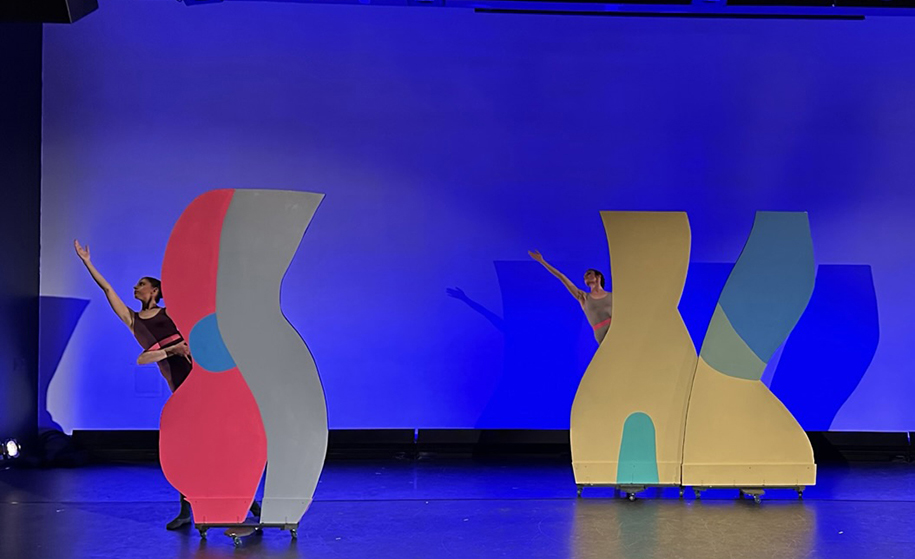
Giulia Faria and Mónica Lima in Sideslip, Photo taken by Marcy Rosenblat
The impetus for this series of conversations between a visual artist and a choreographer comes directly from my recent collaborative work with a choreographer as part of Norte Maar’s CounterPointe10. In this unique project a choreographer is paired with a visual artist to create together over two months a dance performance that integrates the two disciplines into a cohesive vision. Here is the conversation between artist Marcy Rosenblat and Choreographer Amanda Treiber.
Frenchtown in the Delaware river Valley NJ is home to a fantastic new arts center with cutting edge programming: take note art lovers, ArtYard has come to town. ArtYard is a not for profit, state-of-the-art facility with two floors of exhibition space, sculpture lawn, black box theater with chic little bar and a tiny store. It is spacious, light, and beautiful: everything about this place is “feel good” and functional. It overlooks the river where bikers and hikers pass on the Delaware Raritan Canal State Park Trail an old railway track. The facade is a sophisticated blend of metal overhang elements (think Chelsea Meatpacking) and smart graphics with a large welcoming entrance. The pitch perfect brick building, designed by architects Ed Robinson and William Welch, was inspired by 19C industrial factories. The new center weaves itself perfectly into the historic fabric of Frenchtown NJ.
Installation view, Ahavani Mullen: Across Centuries and the Earth, 2023. Dennos Museum Center, Traverse City, MI. Photo by the artist
In Ahavani Mullen’s studio, humble materials of pigment, metal, limestone, and resin transform into spiritual relics. She enters into the act of creation in silence from which paintings, sculptures, and installations evolve and become artifacts of human consciousness. In connecting the seen to the unseen, her objects hold memories of time, space, and sound, referencing the very turning of the earth with its movements and vibrations.
Installation view, David Syre: The Black Drawings, SARAHCROWN New York, 2023.
The creative process is inexplicable. It doesn’t require anything but what the creator needs or chooses to use, and there are no guidelines as to how it works: Tolstoy felt he had to write “each day without fail.” Robert Rauschenberg often had The Young and the Restless on television at his studio. Virginia Woolf used to walk miles and miles. There is no telling what will ignite the process, but like a flash of lightning or fireworks in the night sky, it contains such a force that with the right conditions, generates sublime beauty. American outsider artist David Syre found this force when he was only a child in his Pacific Northwestern family home: The intuitive act of pushing crayons on paper on the floor of his grandmother’s kitchen remained in the heart of his practice. Syre’s art evolved and transformed in time, but the pastels remained––in the end, it turned into a persistent, continuing series of over 4500 pastel drawings on black paper. 40 of these drawings are now hanging on the walls of SARAHCROWN New York, a young contemporary gallery in Tribeca, and at the gallery’s booth at the Outsider Art Fair, gathered for two concurrent solo exhibitions titled David Syre: The Black Drawings.
Moby Dick Illustration by Augustus Burnham Shute, Public domain, via Wikimedia Commons
Gather round, me hearties, and let me tell you a tale: a tale about a much-dreaded comment received by many an artist on Instagram and during a studio visit. This comment can sound like a terrifying roar made by a fearsome beast. And it’s called—the “Leave-It-Like-That.
It’s the kind of comment we might receive on our works-in-progress (a struggling fawn just starting its wobbly walk). And we may have blithely thought to ourselves, “Hey, why don’t I post this WIP on the ‘Gram and give people a window into my process!” But…Beware ye who enter here. This generous sneak peek could attract a Leave-It-Like-That (or even its frightening brethren: the “Stop-Don’t-Touch-It” or the “Looks-Finished-To-Me”).
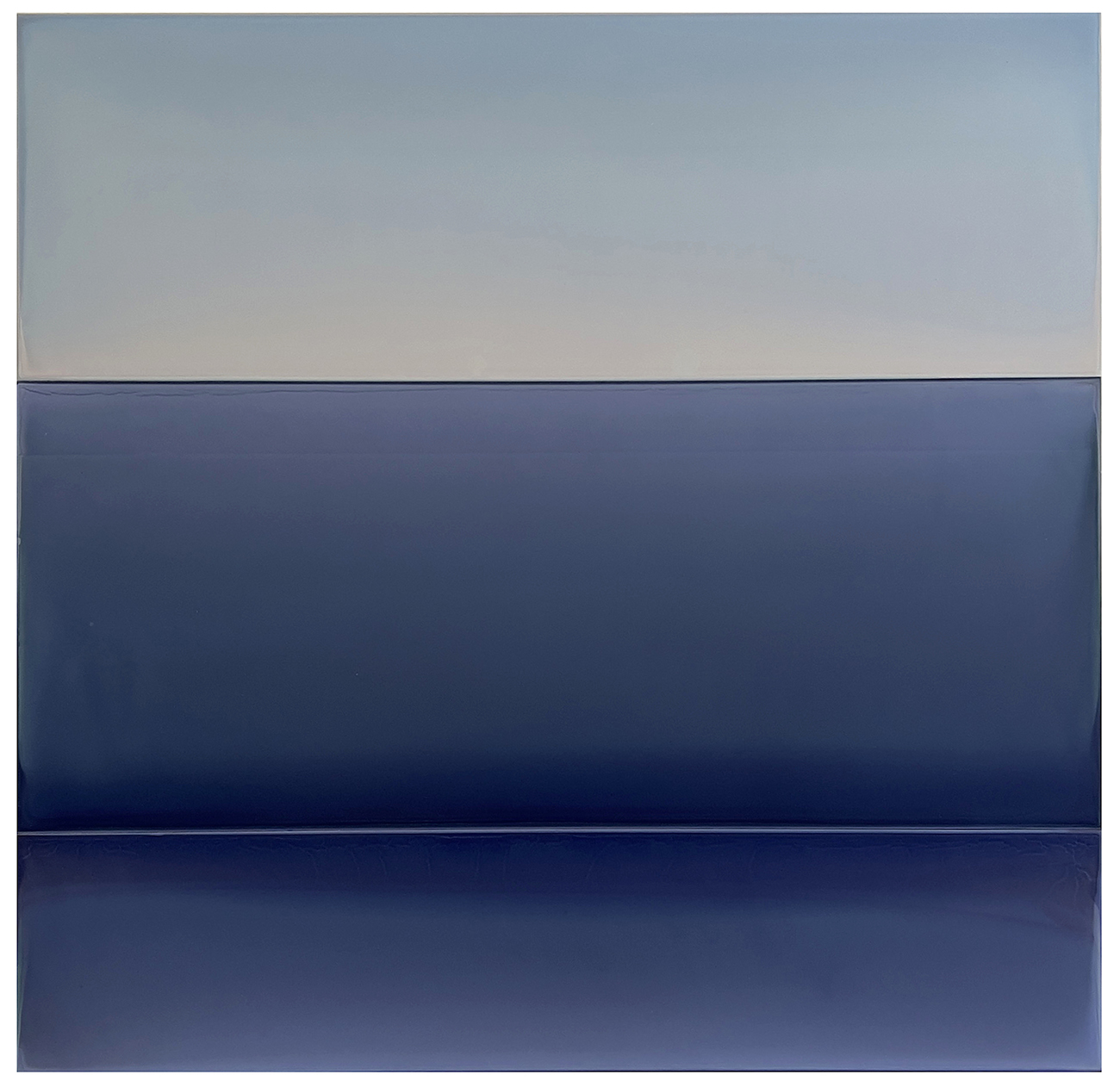
Susan English, Still Light, 2022, tinted polymer on Dibond panel, 34 x 35 in. Courtesy of Kathryn Markel Fine Arts
To confront a person with their own shadow is to show them their own light.
– Carl Jung
In her current exhibition at Kathryn Markel Fine Arts, Light to Light, Susan English explores the vagaries of light as it penetrates layers of polymer and pigment. Subtle gradations in color are infused with radiant light, recalling the sfumato in Van Eyck’s translucent skies or Cimabue’s blushing Virgins. The seamless transitions are achieved through the artist’s unorthodox technique of pouring thin layers of tinted polymer onto panels, then tilting the panels while the pigments settle and dry. The multiple layers interact with light to create varying effects – sometimes luminous, sometimes opaque – which are punctuated by cracks and blemishes in the medium as it dries. These accidents are essential to the piece, as they provide a counterbalance to the exquisite surfaces and tight control of their execution. Indeed, English manipulates the panel in such a way that crackling is anticipated, and she views the result as a simulation of the fissures and fractures found in nature.
Alice Zinnes in her studio, with charcoal drawings behind
Alice Zinne‘s paintings draw from literature and mythology to create dramatic landscapes in which light and dark interplay as main protagonists. Her oil paintings, watercolors, and drawings often depict floods of light intertwined with fragmented darker patches, evoking dense and fluid inner spaces.
In conversation with Patrick Neal, Cathy Diamond, and Laurie Fader
Installation of Luscious Wasteland: Cathy Diamond and Laurie Fader at Radiator Arts (All images courtesy Radiator Arts).
The two-person exhibition Luscious Wasteland at Radiator Arts features landscape paintings by Cathy Diamond and Laurie Fader. Both artists embed in their imagery elements from personal experience, nature, visual art, music, literature or science, to create intricate and imaginative landscapes. The exhibition opens Fri, September 16 and runs through October 23, 2022. Art Spiel invited the curator of the show, Patrick Neal, and the two artists, Cathy Diamond and Laurie Fader to reflect on the featured paintings as separate bodies of work and in relation to each other.
Portrait of Natale Adgnot in the studio. Photo courtesy of the artist.
What does Cognitive Bias and Fallacy Look Like? Natale Adgnot’s Work Tests What We Are Really Seeing. Natale Adgnot’s work explores the power of psychology and the impact that cognitive bias has on our everyday life, routines and choices. Her work incorporates patterns and systems to explore different cognitive biases such as stereotyping and pareidolia (seeing patterns in random information) to reflect on the elusiveness of truth. Best known for wall sculptures made of painted thermoplastic adhered perpendicularly onto birch panels, she challenges the viewer to consider her work from multiple perspectives. Her new series, Bird Brains, continues to delve into her exploration of bias and fallacy. Bird Brains matches entries in the cognitive bias codex with the birds that best exemplify them. From black swan theory to the duck test to the proverbial canary in the coal mine, she taps into this rich language to point out the stunning variety and sheer magnitude of ways we humans misconstrue the world.
Zachary Keeting coffee and cigarettes 2016 acrylic on canvas (triptych) 48” x 124” photo courtesy the artist
In Zachary Keeting’s restless and complex paintings swirls of vivid purples, yellows, and reds float by or contained within geometric shapes of subdued browns and pinkish off-whites. Together they orchestrate distinct rhythms and create a sense of luminosity. Keeting’s alluring colors often generate dynamic pictorial spaces filled with an imaginative array of fragmented forms which remind me of mirror shards prisms against a shifting light, particles in a quantum physics lab, or visual transcriptions of sounds. Although each of these parts, whether biomorphic or geometric, appears to assume a distinct characteristic, the overall sense we get is—what we see now is on the verge of changing within the next second.