Notice: Function WP_Object_Cache::add was called incorrectly. Cache key must not be an empty string. Please see Debugging in WordPress for more information. (This message was added in version 6.1.0.) in /www/artspiel_344/public/wp-includes/functions.php on line 6131
A person sitting in a chair Description automatically generated with medium confidence

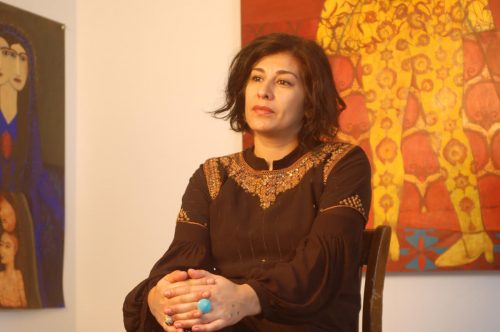
Samira Abbassy: Hybrid Iconography

Samira Abbassy’s paintings and drawings portray mysterious iconic figures, primarily female, who inhabit an ambiguous space. While her pictorial world resonates with archetypal imagery from eastern and western cultures, it equally pulsates with an urgent psychological core, creating an invigorating tension which prompts the viewer to search and discover rich layers for meaning.

A picture containing text, indoor, floor, wall Description automatically generated

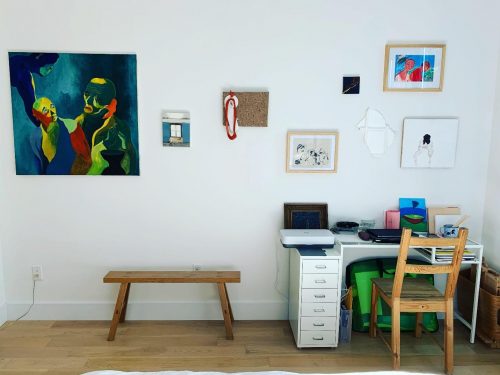
Private View from Home to Home

In Dialogue with Naomi Lev, Rebecca Pristoop, and Sarah Crown

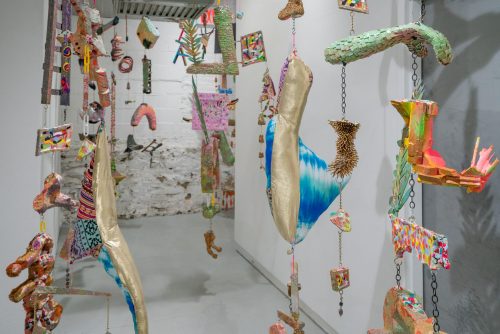
The Exhibition Private View is a bit like an artist’s game of telephone. Three curators: Sarah Crown, Naomi Lev, Rebecca Pristoop, coordinated the movement of works by seven artists (Aimée Burg, Noa Charuvi, Tamar Ettun, Julia Goldman, KB Jones, Dana Levy, Gabriela Salazar) from home to home of each of the artists. In each new space the works were rehung, re-organized, and displayed in a new environment, often with the addition of the host’s collection of art. I interviewed the curators to find out how they planned and executed this show and how it was recorded and disseminated. In a way this exhibition reversed the traditional structure of personal and private: instead of the public being able to see artworks in a whitebox gallery or museum, which has been made impossible because of the pandemic, we became spectators on an artists private space—we couldn’t be there in person, but via Instagram we were shown more than we usually get to see. These notions of intimacy, personal expression, and a safe space in times of turmoil were central to the exhibition Private View.

Margaret Roleke: Getting a Dialogue Started

When Margaret Roleke finished her MFA, she was a sculptor and installation artist. From early on she created installations dealing with issues of water, sound and light and after becoming a mother to four children, notions of motherhood and domesticity became central in her work. As her children grew, current political events became increasingly part of her visual expression. For instance, around 2002 she started including toy soldiers in her sculptures, referencing the Iraq war, and also around this time for a public art project in Brewster, NY, she made seating for the day-laborers who were regularly gathering on that site. She continued to make work that spoke to issues that were important to her, mainly gun control, domestic abuse, and immigrant rights. She says she had no intention to be an activist artist, but became one in the course of making art and exploring her true voice — “The Trump presidency led me to march on the streets and register voters, but I feel I can be a better activist when I create work which starts a dialogue on these important subjects, as this seems to be what comes naturally to me,” she says.

More Time Less at Cathouse Proper

In Dialogue with David Dixon

For Cathouse Proper’s second ensemble exhibition, More Time Less, curator and gallery director David Dixon brought together five artists — Zac Hacmon, Elana Herzog, Aga Ousseinov, Tim Simonds, and Nari Ward — whose installations, wall-based work, and sculptures reflect our changing perception of ‘normative time.’ David Dixon describes his curatorial process, gives us a closer tour of this ensemble exhibition, and shares some background on his diverse art practices.

In Accordion Time, Unfolding : A Pandemic Archive at Ursa Gallery

In Dialogue with Alexandra Rutsch Brock

The group exhibition In Accordion Time, Unfolding : A Pandemic Archive marks the opening of Ursa Gallery, an experimental gallery showcasing contemporary art and design located at the historic Arcade Mall in Bridgeport, Connecticut. This art venue was founded by Cris Dam and conceived in collaboration with Dustin Malstrom. Cris was also cofounder of Dam Stultrager in 1998 – one of the earliest galleries in Williamsburg, Brooklyn. Co-curated by Alexandra Rutsch Brock and Patricia Miranda, the exhibition features mail art in the form of accordion-fold books and digital dialogues by the London Calling Collective over the challenging past year. It runs through February 12th, 2021.

A picture containing person, person, outdoor, cellphone Description automatically generated

Michael Sakamoto – Resolving the Unresolvable

In Dialogue with Michael Sakamoto

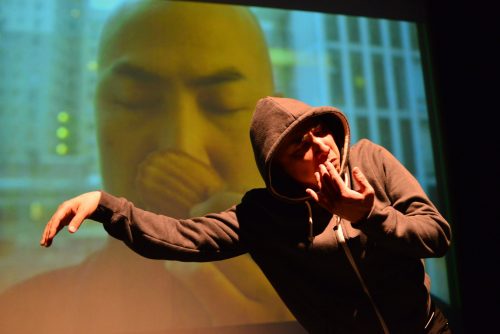
Michael Sakamoto is an interdisciplinary artist and scholar active in dance, theatre, performance, photography, and media. His solo, ensemble, and visual works have been presented in 15 countries throughout Asia, Europe and North America. Art Spiel had a conversation with him on the alienation of the body; the gender roles and queerness in Butoh, as well the deterritorialization and exotification of non-Western art.

A picture containing drawing, tree Description automatically generated

Ana Sophia Tristán: NaturalMente at Galería Matices in San José, Costa Rica

In Dialogue with Ana Sophia Tristán

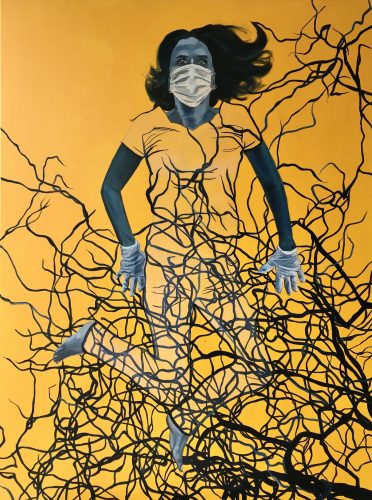
Costa Rican painter Ana Sophia Tristán was set to open her solo show NaturalMente in April, but as was the case with many art events scheduled for this year, the exhibition had to be postponed until further notice as a result of the pandemic. Fortunately by the end of September, Galería Matices – located within the halls of the historic Costa Rica Country Club, felt ready to revisit the task of mounting the emerging artist’s exhibition and Tristan was able to hold a socially-distanced vernissage in late October. NaturalMente had always planned to present paintings from her ongoing series of semi-surrealistic works of figures immersed in nature, but the several month delay allowed the artist to debut a few new pieces inspired by COVID-19 as well.

Joyce Yamada: Contemplating the Human Species

Painter Joyce Yamada grew up on the west coast. She spent her childhood vacations in the beautiful national parks of the US and Canada where pristine forests and the Pacific coast were imprinted in her visual memory. She recalls that although as a teenager she realized that art is her task in life, struggling to survive by minimum wage work led her to medical school which she completed and then subsequently became a diagnostic radiologist. This science background has fed her mind and artwork ever since. Yamada says she is a painter because she conceptualizes in images rather than in words — “when puzzled, my mind juxtaposes or fuses unexpected images, often leading to new work,” she says. For instance, an early series, Body, Earth, came to her in art school — while looking at the hills across the bay from San Francisco she saw the low rounded hills as the reclining body of a woman. The juxtaposed imagery meant to her that we are intimately and indivisibly part of earth and of nature, that what we do to the earth we do to ourselves. She has subsequently seen this idea expressed in indigenous cultures, and it became central in her work.

The Immigrant Artist Biennial: Priyanka Dasgupta & Chad Marshall

The Immigrant Artist Biennial (TIAB) is a volunteer, female-led, artist-run project. TIAB 2020 launched in March in New York City at Brooklyn Museum, and continued in September through December at EFA Project Space, Greenwood Cemetery, and virtually, presenting 60+ artists. This interview series features 10 participating artists.

Priyanka Dasgupta and Chad Marshall’s practice draws from sociological conventions, archival texts, and postcolonial studies to examine power and disenfranchisement in the US and their relationship to appearance. Recent exhibitions of their work include ‘Uptown Triennial’ (2020), ‘The Immigrant Biennial’ (2020), ‘Pigeonhole,’ Knockdown Center, NY (2019), Dodd Galleries, UGA, Athens (2019), Sunroom Project: Paradise, WaveHill, NY (2018), In Practice: Another Echo, SculptureCenter, NY (2018). Residencies include Artist Studio Program, Smack Mellon (2018-19) and AIRspace, Abrons Arts Center (2018). Dasgupta and Marshall’s work has been reviewed in various publications. They are recipients of the Smithsonian Artist Research Fellowship, 2019-20.
“FLUX : Vita Mutata” virtual on Sculptors Alliance

In Dialogue with Marco Palli

The online sculpture exhibition “FLUX : Vita Mutata” curated by Natsuki Takauji and hosted by the veteran non-for-profit artists’ cooperative Sculptors Alliance, features seventeen artists who display works made before the pandemic, throughout the closure, and beyond. The Sculptors Alliance president, Marco Palli. shares with Art Spiel how the show evolved, and how his organization transformed throughout the pandemic, while offering us a generous peek behind the scenes.