Smashworks Dance – CITY STORIES at Center for Performance Research

Smashworks Dance – CITY STORIES at Center for Performance Research

DANCE

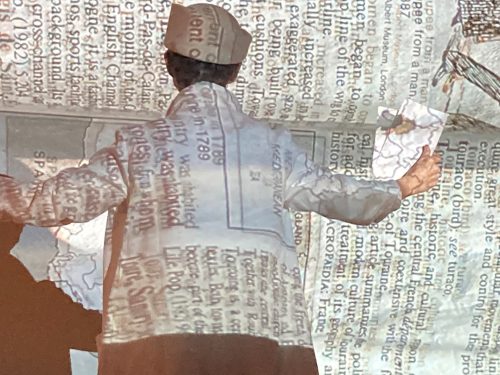
Though I saw Smashworks Dance’s CITY STORIES over a month ago, it still lingers in the back of my mind. As a New Yorker, how could it not? The images from the show are the images of my daily life. Flashes of scenes and movements weave their way through my commute and my coffee run, popping up like absurdist smash-cuts in early-2000s sitcoms. That’s where Artistic Director Ashley McQueen’s magic lies: the source material is everyday, the execution is something else entirely.

Exhibition-View-Andre-Pierre-Arnal-2022-©Adam-Reich-courtesy-Ceysson_Bénétière(1)

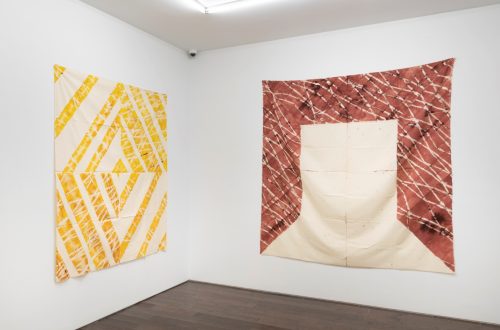
André-Pierre Arnal at Ceysson & Bénétière New York

Opinion

With the advent of Modernism in the late 19th – early 20th century, differing movements, schools, and networks sprang up internationally—some were generative and sustainable, others dead-ended, though unbeknownst to most of us, traces of these persist or return. This cross-fertilization drove Modernism’s evolution until the post-World War II era the new art made in the U.S. came to dominate the narrative. The triumph of the NY School (AbEx) corresponded to the new political and economic order. In this scenario the vanguards that emerged from the rubble and detritus of the War such as C.O.B.R.A., Nouveau Realisme, Lettrist, Zero, Arte Povera, etc. were trivialized, marginalized, or came to be appropriated. To this day, the European artists whose works come to be acknowledged in the States tend to be those whose works are used to typify the whole of a critical discourse, or style. This has reduced post-War European art to a short list that includes Pierre Soulages, Antonio Tapies, Lucio Fontana, Yves Klein, Francis Bacon, Joseph Beuys, Gerhardt Richter, Anselm Keifer, etc. In this manner, the illusionary status of the U.S. as the cultural leader of the free world is sustained, while European art is made to appear to be broken, fragmented, or at best sporadically relevant, rather than constituting a network of competing histories, practices, and critical discourses.

Text Description automatically generated

Table of Contents at Time and Space Limited in Hudson

In October 2021, at the periphery of the parking lot outside of the Time and Space Limited Center in Hudson, artwork by Linda Mussman appeared—about 20 large dictionaries and encyclopedias opened out on a crude wooden table. For several months, round the clock, these dictionaries were exposed to rain, sunlight, and snow, and rifled through by winds. Peach-colored streetlight bathed the texts some nights, and bright sunlight bleached the pages some days. The grass around the table receded and then returned with – mirabile dictu – a green shoot briefly fighting its way between 2 volumes. 

An Interview with Chicago Artist Vito Desalvo

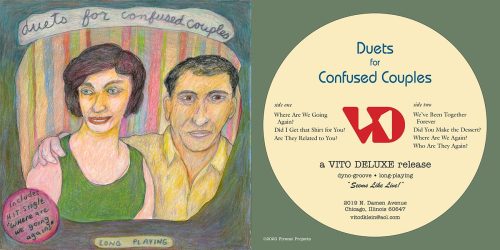
By opening night the installation of Vito Desalvo’s rare public showing of his drawings was completed and the exhibition opened without a hitch. It will be showing, through December 31 at Greenkill Gallery in Kingston, NY. With the help of Mariah Karson, we were able to present his work in a manner that he found acceptable. My main task other than that was convincing him to attend the opening. After a great deal of bargaining, Vito not only showed up but was also surprisingly charitable in his conversations with guests. No one hurt, no foul. In the weeks following the opening, I was asked to interview Vito about his state of mind and thoughts about his work. Last Monday night after considerable liquid consumption, he responded to my inquiries. Our housemate Leo took the dogs—Tina, Louise, and Jack— out for an extended walk so we wouldn’t be distracted. Here are some excerpts of our chat, flaws and all.

A picture containing text, scene, gallery, room Description automatically generated

Saba Farhoudnia: Reflection at Jamaica Center for Arts & Learning

In conversation with Adèle Eisenstein and Saba Farhoudnia

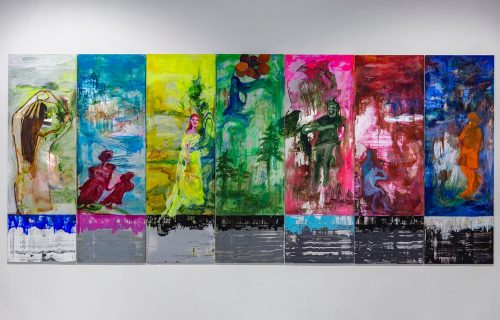
Reflection, the solo show of Saba Farhoudnia in Jamaica Center for Art & Learning, highlights the cruel and tragic practice of so-called “honor” killing, by way of individual stories which give the victims their voice back, and shed a light on this reality for far too many women, girls and LGBTQ+ (taking at least 5000 lives annually per the United Nations Population Fund). The ensemble of individual panels and stories welcomes the visitor into a colorful and intriguing landscapes. Adèle Eisenstein, the curator of the show, says that the layers of paint reveal a reflective surface, which delivers a direct message to the observer—this might have been you. While dishonor killing is the most extreme end of the spectrum, the subject addressed also touches upon and exposes stratified layers of gender-based violence.

whispered conversations at Stand 4

Curator Jennifer McGregor in conversation with the artists

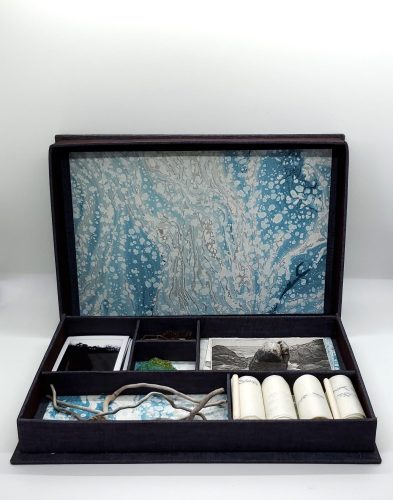
Artists Kate Colyer, Lorrie Fredette, and Megan Porpeglia talk with curator Jennifer McGregor about their framework to create whispered conversations, on view at Stand4 Gallery and Community Space in Bay Ridge, Brooklyn. The collective was active during COVID via Zoom reading about the natural world. They created bundles in response to their individual trips in 2021. These were shared through the mail to instigate a series of new artworks. Jennifer McGregor was brought in as curator to help shape the exhibition.

Map Description automatically generated

Field Notes at Metaphor Projects

Art Spiel Photo Story

Metaphor Projects is an artists-run space for contemporary art and culture founded in 2001 by two working artists. Directors/ Curators: Julian Jackson and Rene Lynch have mounted more than 100 solo and group exhibitions presenting the work of hundreds of artists and spent two decades developing what they call “the social sculpture that is Metaphor.”

A picture containing indoor, wall, floor, room Description automatically generated

Mary Ann Unger: To Shape a Moon from Bone at WCMA

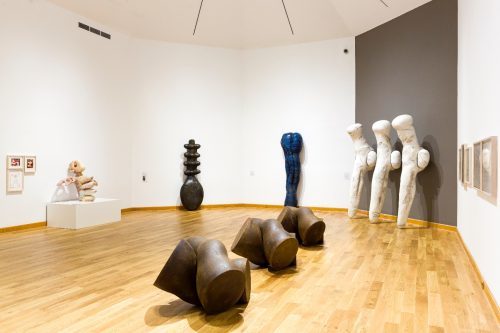
Power. Power, not bravado, not ego, but the power of intelligence, skill, fortitude, and vision is what Mary Ann Unger possessed and that is what is on exhibition at Williams College Museum of Art (referred to as WCMA). Throughout her life she defied limitations frequently imposed overtly and subconsciously on women. Attending Mt Holyoke College in the mid-60s, she studied biochemistry when few women were found in science departments, then transferred to studio art taking up welding, casting and carving. This was not the typical route for women during the mid-to late 60s. She traveled on her own to North Africa and this journey greatly influenced her work. Returning to New York she completed an MFA at Columbia and launched her career as a post minimalist sculptor, finding herself in the minority amongst a sea of men.

Myth Catchers: Manju Shandler, Rithika Merchant and Jacqueline Shatz

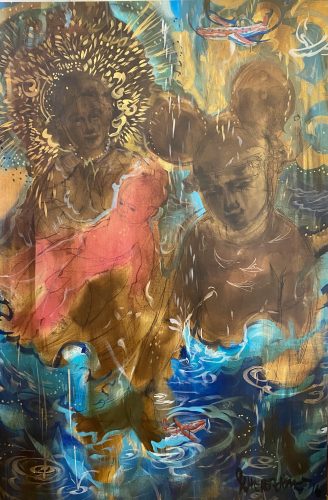
Luckily, or to many art-mavens’ chagrin, our 21st century art world—in line with the global techno-culture and socio-political processes—seems to have abandoned crusades of “right” or “wrong” related to artistic form (though sometimes that does not apply to content). We are experiencing a dizzying array of aesthetic expressions, where often fast-pace visual trends replace ideologies of form. Unlike some passing trends, visual narratives based on mythological iconography have been central in all art forms since archaic ages, except for the early-mid half of the 20th century when narrative impetus was largely downplayed in most of what was called the “Avant Garde” art of the time.