A painting of a pond with lily pads Description automatically generated

Dalit Gurevich: A Memory Interwoven at Amos Eno Project Space

Dalit Gurevich’s A Memory Interwoven, curated by Jenn Cacciola at the Project Space of the Amos Eno Gallery, is a vivid exploration of transformation and adaptation through depiction of mixed-media landscapes and cityscapes. The exhibit, now open to visitors, captures the shifts in Gurevich’s life from the confines of a Brooklyn apartment during the pandemic to the liberating nature of Vermont and back to the bustling city life. Her paintings tell a story of seeking space and peace in a time of global uncertainty.

Osnat Ben Dov's exhibition "Shadow of a Passing Bird" at Kibbutz Be'eri, before the attack.

Another Victim of Hamas: A Kibbutz’s Art Gallery

In Hamas’ destruction of Kibbutz Be’eri, the terrorists also came for curator Sofie Berzon MacKie and her family. They survived, but the kibbutz’s gallery was burned to the ground

This article by Gilad Melzer for the Israeli newspaper Haaretz was published in Haaretz English version on November 2, 2023.

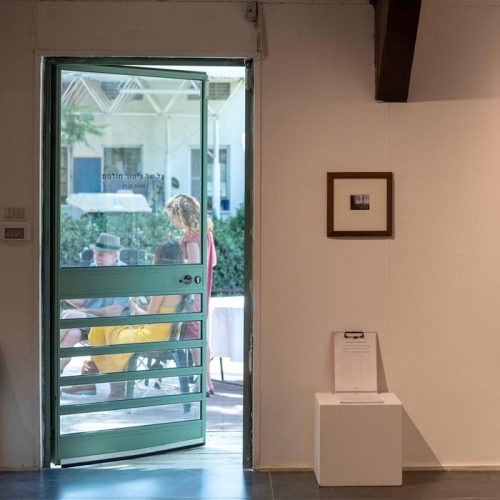
On Friday October 6, Sofie Berzon MacKie, the curator of Kibbutz Be’eri’s gallery, was busy preparing herself for a long day at work the following morning. She knew that Saturday was the last day of a week-long Sukkot holiday, and hoped that visitors would throng to the current exhibition shown at the gallery, “Shadow of a Passing Bird,” by photographer Osnat Ben Dov.

The Immigrant Artist Biennial- In Dialogue

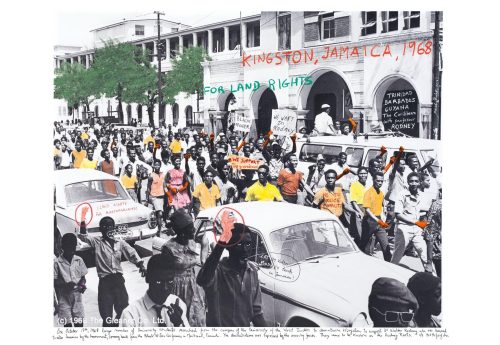
Art as Political Vehicle? Pritika Chowdhry, Marcelo Brodsky, and Rafael Yaluff

Exhibiting in Conflictual Distance at EFA Project Space within the framework of The Immigrant Artist Biennial: 2023 Contact Zone Pritika Chowdhry, Marcelo Brodsky, and Rafael Yaluff explores, in Oraib Toukan’s formulation, ‘cruel images.’ Images that contain evidence of political and bodily violence but are confronted at an extreme political or geographic distance from their events’ site of occurrence. Together with the artists, co-curator Anna Mikaela Ekstrand discusses the politics of art and how the artists approach personal histories and historical and political events before the exhibit.

A painting of a person riding a horse Description automatically generated

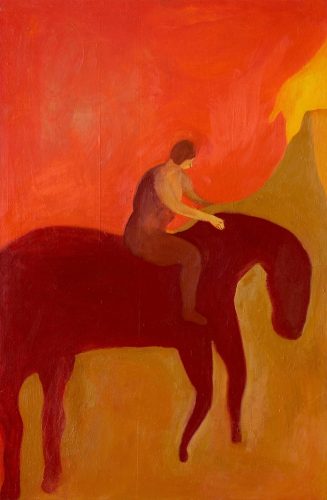
Dov Talpaz: The Sound of Longing at SARAHCROWN

Photo Story

An acute sense of yearning permeates the ten artworks showcased in Dov Talpaz’s debut exhibition at SARAHCROWN in Tribeca. The exhibition, The Sound of Longing, was thoughtfully composed by curator Sarah Corona, who selected small to medium-sized oil paintings characterized by their strikingly vivid hues. The modest dimension of the paintings enhances a sense of an intimate space, while the rich, dynamic colors seem to resonate with a loud auditory experience.

The Immigrant Artist Biennial – In Dialogue

In Dialogue with Linnéa Gad, Magdalena Dukiewicz, and Anna Ting Möller

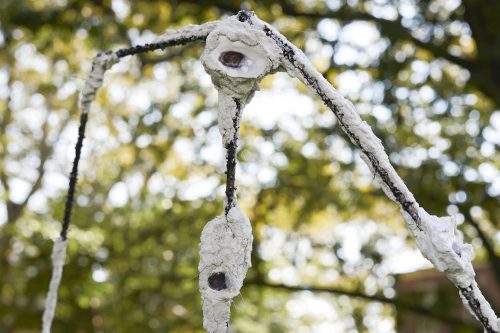
Instead of transcribing a previously established set of ideologies through scholastic mediums, Linnéa Gad, Magdalena Dukiewicz, and Anna Ting Möller engage with materials that “breathe”—materials whose lives and afterlives warrant separate biographies.

Presented within the context of The Immigrant Artist Biennial 2023: Contact Zone, Swedish artist Gad creates sculptures with limestone, oysters, lapis lazuli, and other materials profoundly connected to the Earth’s carbon cycle. On Governors Island, her sculptures, Shoals I-II, evoke humanity’s resonance with and reliance upon nature. Polish-born artist Dukiewicz juxtaposes industrial components with provocative, organic materials such as hair and blood. In the group show, Enmeshed, Dreams of Water, at NARS Foundation, Dukiewicz’s Object #6 (2023) contains decay, regeneration, and fluidity elements into beautifully translucent and sculptural artwork. Chinese-born Swedish artist Möller, whose work will be presented in Parasites and Vessels at Accent Sisters, unpacks the convoluted social history of kinship via kombucha cultures. The oysters, hair, and kombucha are not subjected to manipulating the artists’ hands; instead, the materials are collaborators in these projects, bringing their subjectivities, histories, and sociological implications into the creative process.

Together with TIAB’s co-curator, Anna Mikaela Ekstrand, the artists speak about their work about technology, materiality, and ecosystems.
Donna Zarbin-Byrne: Like Water from a Rock at Arts Fort Worth

Hot Air

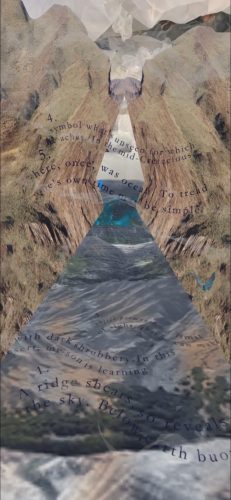
Donna Zarbin-Byrne, Like Water from a Rock. Here Once Was Ocean, still image from augmented reality animation. Photo courtesy, Donna Zarbin-Byrne

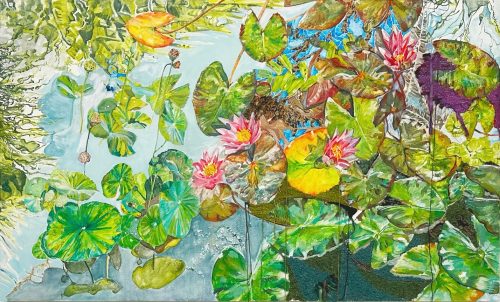
In her installation-based exhibition, Like Water from a Rock, at Arts Fort Worth, Fort Worth, TX, Donna Zarbin-Byrne responds to the landscapes of the Chihuahuan desert of West Texas and the West Maui mountains, connecting material sites with an internal process. Western art traditions often portray the landscape as an idealized place to conquer and expand. Zarbin-Byrne frames the landscape as a place to experience the sensate.

A person standing next to an older person in a wheelchair Description automatically generated

Julia Szabo: Vision and visibility

In Dialogue

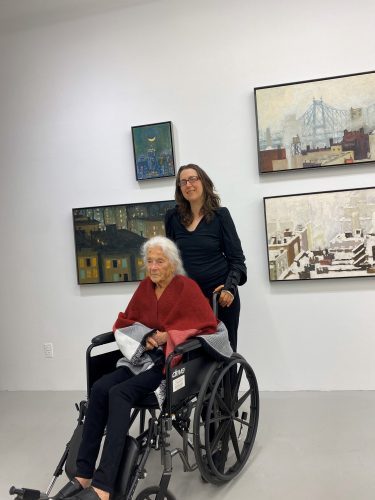
Journalist and author Julia Szabo is resolved to establish the world’s first museum to be built by women for women artists. MSeum is going to be a museum with a focus on overlooked artists (Know Unknowns), providing art storage space to creative women and their heirs and offering the most enriching museum experience for blind and low-vision visitors anywhere in the world, with a variety of tactile artworks and architectural features inviting touch, because loss of sight does not mean loss of vision.

Chromotherapy at Jack Hanley Gallery

Chromotherapy at Jack Hanley Gallery

(little) Pink Studio. Oil and acrylic on canvas. 32 x 40. 2023

Stepping into the bright and warmly lit Jack Hanley Gallery in Tribeca, I was struck by the brilliant swirl of color in Sophie Treppendahl’s exhibition of new work. The pieces seem ready to pop right off of the walls. The show exists in two connected parts, encompassing both floors of the gallery. Vibrant paintings of domestic scenes on the ground floor and small dioramas of similar domestic spaces in the downstairs gallery.

Reef Avni – This Was My Home

Reef Avni – This Was My Home

Photo Story

For 18-year-old photographer Reef Avni, photography became a way to speak at 14 when words were hard to find, a tool against his social anxiety. His father, Hagi, was not only a strong supporter but also a frequent face in his photos, becoming an integral part of the narrative Reef was creating with his camera. The other constant in Avni’s work is documenting daily life in his Kibbutz. As a fourth-generation member of Kibbutz Be’eri, his roots were as embedded in the kibbutz as the farmlands and community his great-grandfather founded in the arid Negev in the south of Israel on the night of October 6, 1946. His grandfather was among its first newborns.

A person in a striped shirt Description automatically generated

The Sublimity of Simplicity in Dai Ban’s Sculptures

On view at Carrie Haddad Gallery through November 26

Artist Profile

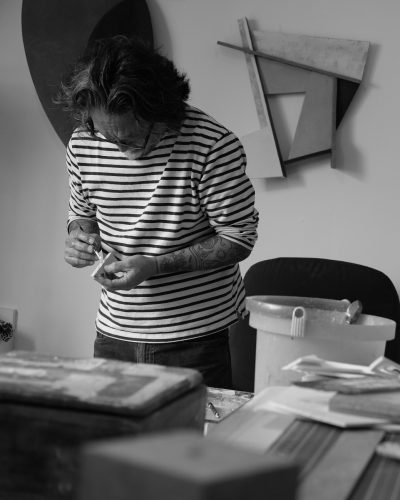
When Dai Ban first traveled from his native Japan to the United States, he was struck by the nonchalant vibrance of American street art. The year was 1985, and although the golden age of graffiti had come and gone, its ethos had indelibly permeated the fine art world. Imagery that had been considered lowbrow just ten years prior became astronomically salable, so long as it decorated a canvas and not a subway car. Ban was bemused by the transformative power of gallery spaces. “Anything you show at the gallery looks like some kind of art,” he observed.