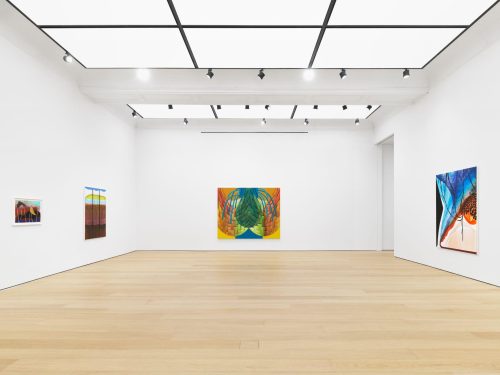
Carrie Moyer: Timber! At Alexander Gray Associates

photo story

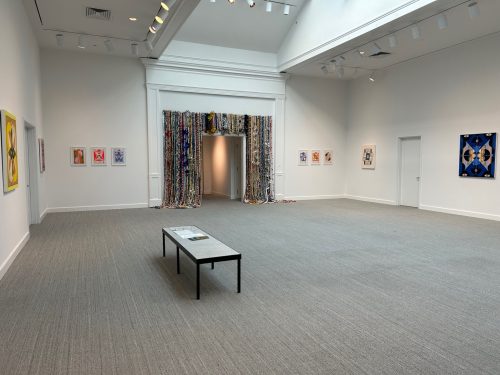
Carrie Moyer’s solo show Timber! is her debut with the renowned Alexander Gray Associates gallery in New York City. Her signature vibrant abstractions shine in the airy rooms of the Tribeca gallery space. Centering around “social and environmental instability,” this new body of work offers greater complexity and a more somber tone than Moyer’s previous work.
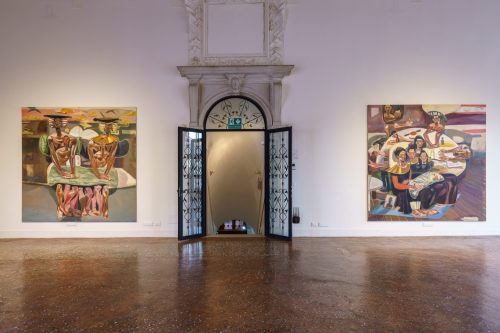
Prejudice and Belonging – the Ethiopian Pavilion in La Biennale di Venezia

The first national Ethiopian pavilion at the 60th Venice Biennale, housed in the elegant sixteenth-century Palazzo Bollani, may be challenging to find, but the effort is amply rewarded. In his solo exhibition Prejudice and Belonging, Ethiopian artist Tesfaye Urgessa presents figures that inhabit a broad and complex emotional spectrum where fragility and strength coexist. Ethiopian iconography and European modernist figurative painting converge, creating a striking visual dialect articulated throughout the ten large paintings and small portraits that fill the three interconnected rooms.

kith and kin – the Australian Pavillion at La Biennale di Venezia

kith and kin – the Australian Pavillion at La Biennale di Venezia

Photo Story

Archie Moore’s monumental installation, kith and kin, for the Australian pavilion at this year’s Venice Art Biennale, has been awarded the Golden Lion for Best National Participation. It is a recognition well-earned. This multi-layered, profound installation more than fulfills the 60th Venice Art Biennale theme of “Foreigners Everywhere.” It does so with a poignancy, depth, and nuance that are increasingly rare in contemporary mega installations engaging with heavily charged subject matter, such as the history of Australian First Nations. kith and Kin confronts colonial legacies head-on while embracing humanity’s shared lineage. It serves as both a memorial to pain and loss and an understated reminder of our common ancestry.

Art Spiel Picks: Boston Exhibitions in October 2024

Highlights

As Boston’s fall season unfolds, the city comes alive with a vibrant tapestry of exhibitions, from the creative heart of the SoWA Arts District to the bustling streets of Back Bay. University galleries join the celebration, offering a rich array of materials and themes that captivate and inspire. While the leaves change color and the evenings grow cooler, the art scene radiates warmth, keeping the city’s creative pulse strong and steady. Here are some standouts this month.

Bascha Mon’s Life and Journey of Dreaming at Tappeto Volante

In Dialogue

The retrospective of Bascha Mon’s paintings at Tappeto Volante offers a focused look at an artist whose career has been shaped by both creative achievements and personal struggles. Mon first gained recognition in the 1970s and 80s, with numerous exhibitions and critical acclaim. However, her trajectory was interrupted by health challenges that led to a long period of seclusion. During this time, she continued to work from her basement studio in New Jersey, expanding her creative vocabulary across various mediums while remaining largely out of the public eye. In recent years, Mon turned to digital platforms like Facebook and Instagram. Paola Gallio, the exhibition curator and gallery co-founder, describes this phase as “dissolving the physical isolation that had once defined her situation.” These platforms allowed Mon to reconnect with the art community and sustain an active, visible presence. Gallio emphasizes that “Mon’s modest basement studio became a metaphor for boundless creative space,” where the constraints of physical isolation were replaced by the limitless possibilities of virtual engagement. For deeper insights into the retrospective, Gallio’s interview with Art Spiel offers further reflections on Mon’s artistic journey and the significance of this exhibition.

Contours and Strokes: Between Traditional and Contemporary Art Forms

Contours and Strokes: Between Traditional and Contemporary Art Forms

When one looks at Franz Kline’s Abstract Expressionist paintings involving Gestural Abstraction, they cannot help but read a Chinese or Japanese character in calligraphic form. In fact, a relationship can be established between Kline’s “abstract” lines and marks from the calligraphic strokes of Sumi ink made by the masters of the traditional art form—Japanese calligraphy.

A Leg to Stand On—Melissa Stern at DIMIN

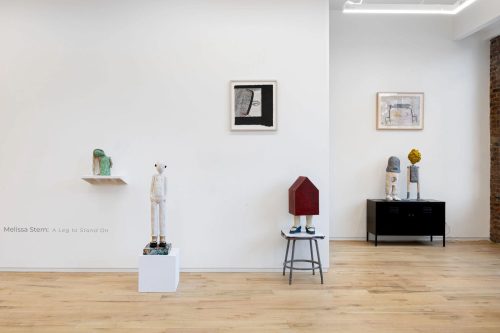
In Melissa Stern: A Leg to Stand On, the domestic meets the fantastic in the aptly named The Living Room, the front room exhibition space at DIMIN complete with a cozy two-seater sofa. Featuring her drawings and sculptures, Stern’s trademark humor and sense of play persists while the underlying thread of darkness that pervades her oeuvre feels especially heightened in this presentation. Deeply shaken by a fall during a winter walk in 2021, the artist’s works in the exhibition explore the precarious and fragile construction of the human body. Cobbling together disparate elements such as vintage shoes, wooden branches, scrap pieces of bannister railings, a doll’s lost arm, linoleum, wallpaper, resin, clay, paint cans, bolts, and screws, Stern balances absurdity with familiarity.

The Art of Being Watched: Julia Weist and Surveillance Culture

Julia Weist’s new exhibition Private Eye, currently on view at Moskowitz Bayse in LA, blends artistic practice with journalistic research to investigate how big data operates in America. In 2021, companies in the United States spent over $110 billion on big data. Weist’s work taps directly into this massive industry, which buys and sells our personal information without consent.

Gary Petersen: The Shape of Walking at McKenzie Fine Art

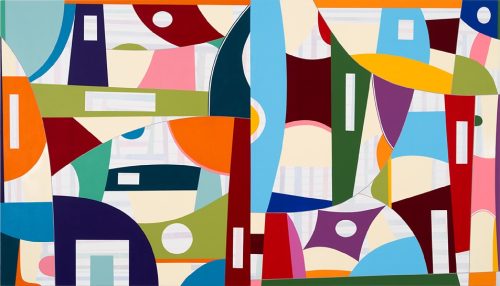
For artists working within the realm of geometric abstraction, understanding the weight of art history is vital. The hard-edge lines, a keen understanding of color theory, and structured patterns—all form part of a visual language that has evolved over a century. Artists today, when approaching geometric abstraction, face a unique tension. On the one hand, they inherit the legacy of giants such as Piet Mondrian, Wassily Kandinsky, Josef Albers, and Kazimir Malevich, whose works laid the foundation for what we understand as “geometric art.” On the other hand, the question looms large: How does one continue to make geometric abstraction in 2024?

9B594D15-35DA-4711-9356-7374553C2E66.jpeg

Fall Reads: Nine to Note

Book Review

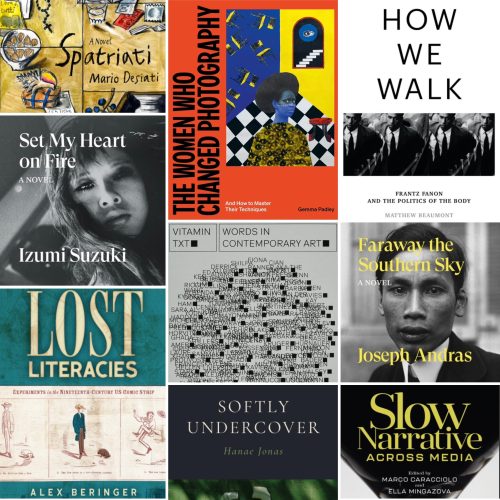
Here’s a set of reviews of nine recently published and forthcoming books I’ve enjoyed reading, reflecting on, and recommending of late. In the mix are two emotionally trenchant novels, a narratively enigmatic novella, a gauzily glowing volume of poetry, a vast survey of contemporary text-based art, a history of groundbreaking women photographers, a critical examination of the sociopolitics of walking, a collection of interdisciplinary essays about narrative slowness, and a revised historical glimpse into the early days of US comic strips. They’re all worthy titles to add to your fall reading list. Several would also make excellent additions to a fall or spring syllabus.