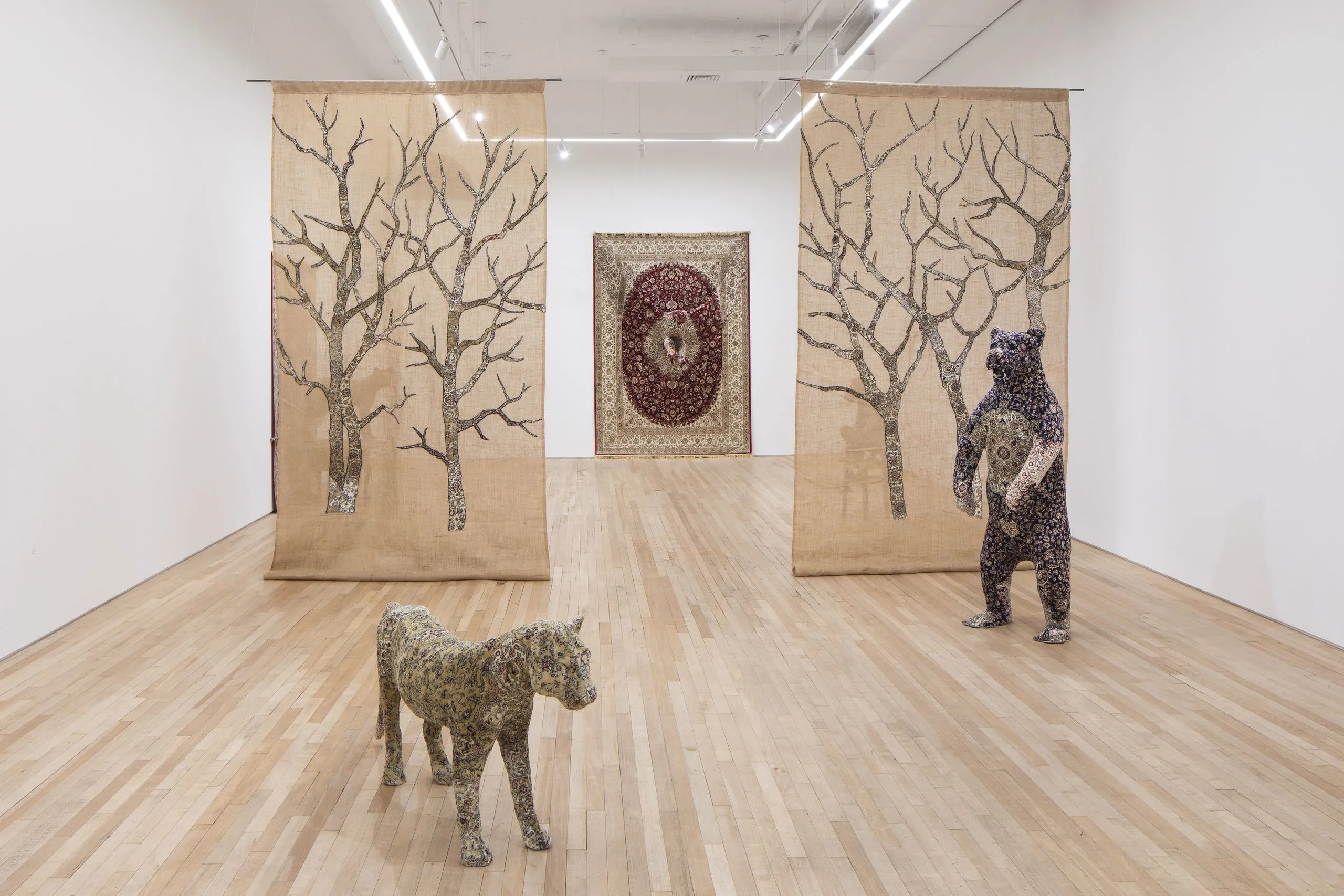
In Debbie Lawson’s sculptural universe, the domestic and the wild exist in a state of perpetual negotiation. Animals emerge from intricately patterned carpets, furniture takes on an uncanny presence, and familiar household objects appear to resist the very structures meant to contain them. Working across sculpture and installation, the British artist transforms decorative textiles and found materials into psychologically charged environments that challenge distinctions between nature and ornament, concealment and revelation, freedom and confinement. Drawing from folklore, Gothic literature, and the histories of craft and domestic decoration, Lawson considers the home not simply as a place of comfort, but as a site where social expectations, instinct, and the desire for liberation quietly collide.
These tensions were central to Lawson’s recent solo exhibition at Sargent’s Daughters in New York, where Persian-patterned carpets extended across walls, furniture, and sculptural forms, dissolving the boundaries between surface, landscape, and living creature. Her work was also presented at the 2026 Homo Faber Biennial in Venice, where her work entered a broader dialogue about craftsmanship, material knowledge, and the enduring significance of the handmade. This December, Lawson will participate in Oranges and Lemons, a weeklong group exhibition at Greatorex in London, alongside fellow artists Jo Dennis, Kevin Francis Gray, Dido Hallett, Ty Locke, Lena Pomford, and Neal Tait.
We spoke with Lawson about the relationship between domestic order and untamed instinct, the psychological dimensions of camouflage, and her fascination with objects that seem to possess lives of their own. Reflecting on her longstanding engagement with traditional craft, the ambiguities of free will, and her latest experiments with wood veneers and sculptural houseplants, Lawson offers a perspective on the fragile boundaries between the familiar and the extraordinary—and what happens when the objects surrounding us begin to assert their own agency.
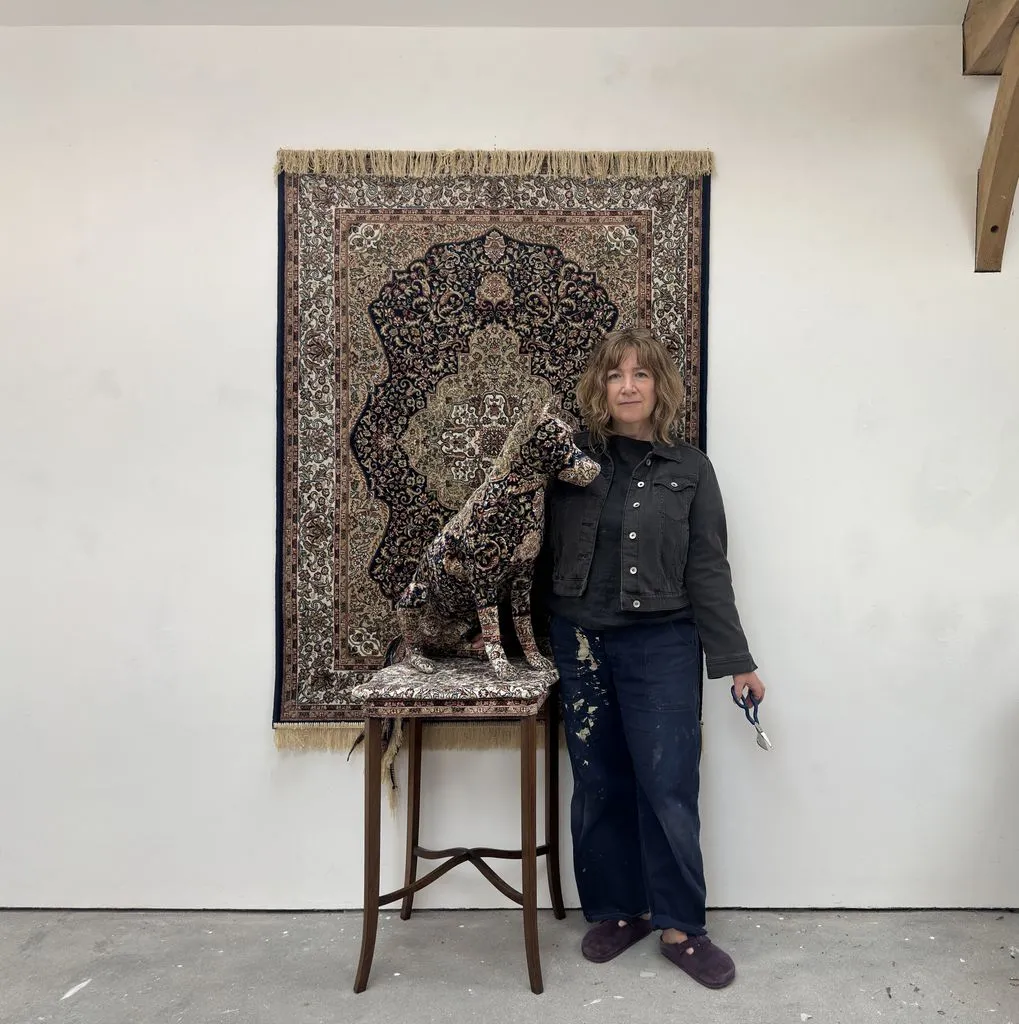
Your work often begins with objects and materials associated with domestic order, but then introduces a sense of wildness or psychological instability. Do you see this transformation as a form of liberation, disruption, or something more ambiguous?
I’m interested in the ‘unbound ’- where I use a piece of found furniture or textile relating to the home and then imagine what would happen if I removed its shackles. When I first studied sculpture I was drawn to a famous line from Rousseau: ‘Man is born free, and everywhere he is everywhere in chains.’ I became a little obsessed by it, and even managed to persuade the staff on the London Underground to read it out over and over again on their tannoy. As a sound piece, it remained somewhat unresolved, but the line stuck around and I decided to apply it to objects in the home. In that sense, the wildness was about defiance, but it is also related to the ambiguity of free will.
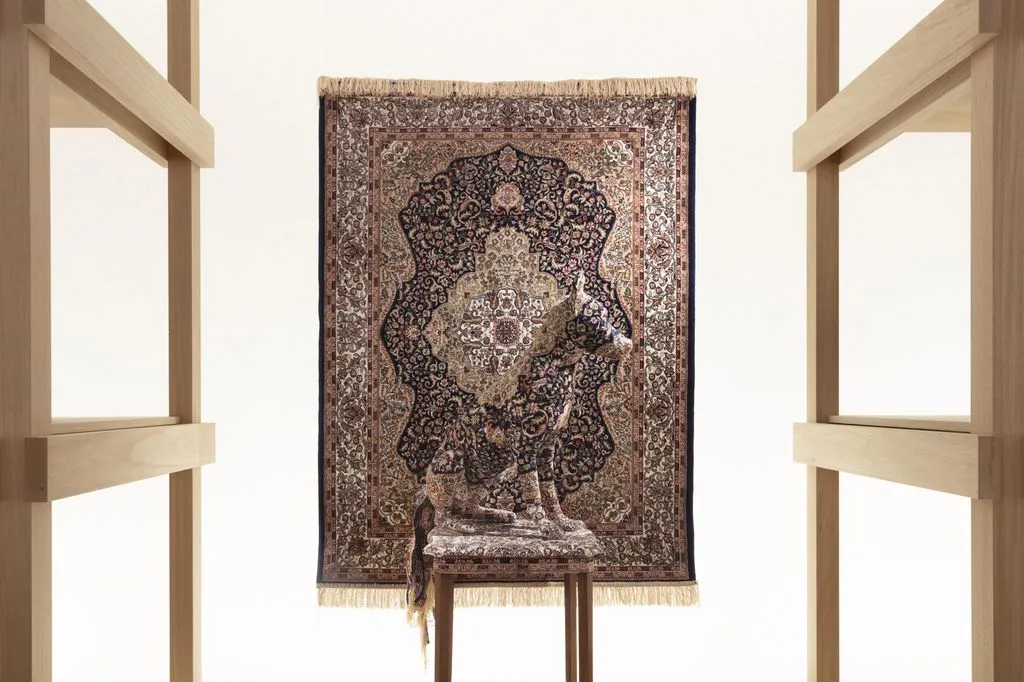
Your sculpture Wild Dog II is currently on view in Venice as part of the 2026 Homo Faber Biennial, which brings together hundreds of makers and objects from around the world. What has it meant to see your work presented within a context centered on craftsmanship, material knowledge, and the human hand?
I’ve always appreciated and loved craftsmanship and the handmade. My father is a woodturner and there have been many accomplished craftspeople in my family. The breadth of skill on show at the Homo Faber Biennial is truly awe-inspiring. Seeing my work in that context was quite a humbling experience. I spend a lot of time on the ‘finish’ of my sculptures, whether they are made from wood or textile, but that sort of attention to detail and investment in the actual process of making things by hand doesn’t mean the work has to be defined as ‘craft’ rather than ‘fine art’. There are many crossovers, just as there are in other areas of the arts, like music and dance. When does a performance piece become dance, or a sound work count as music? I’m happy to be working in the crossover space of fine art and craft or design, especially in the age of AI, when the handmade is more important than ever.
In your recent solo exhibition, In a Cowslip’s Bell I Lie, at Sargent’s Daughters in New York, Persian carpets extended across walls, furniture, and sculptural forms, becoming both landscape and skin. Culturally, these carpets carry histories of craftsmanship, trade, cultural exchange, and their adoption into British domestic life. How do you navigate these layered histories when incorporating them into your sculptures?
The rugs I use are machine-made on vast looms in a factory in Belgium, and they’re primarily viscose or polypropylene – usually end-of-the-line and pretty much deadstock. I made the decision very early on not to use real, handmade Persian rugs as it felt like I was cannibalising someone else’s artwork to make my own. To start with, these rugs were just ‘found objects’ in my stock of materials relating to the home, but I realised after a while that the pattern was very significant. I have a small collection of rugs and my preference leans towards Persian rugs, especially those with a central medallion and an intricate floral design – particularly those from Kashan. Some of my animals can be found depicted in ancient Persian carpet designs but I have added others that I don’t think you’d find, like bears and crocodiles. I don’t feel the need to follow any rules!
Camouflage also plays an important role in your work: the animal is simultaneously concealed within and emerging from the carpet’s pattern. What does this tension between visibility and concealment allow you to explore—psychologically, socially, or personally?
As a part-time introvert I sometimes find being in the spotlight tricky. I’ve never quite managed to grow out of the quiet, shy child I once was. I think one of the reasons why I make art is that it can represent me in the world. My animals are concealed in the pattern of a background rug from one angle, and revealed as objects in their own right from another angle, when the viewer walks past. In the case of my Blue Bear, a freestanding sculpture, I chose a dark blue carpet with a small, intricate pattern. I decided to put the central medallion of the rug pattern in the centre of the bear’s midriff, and have the pattern radiate from this point. I think it looks slightly funny, like I’m also poking fun at the idea of covering a bear in carpet and presenting it as a serious artwork. Small (sometimes called ‘ditsy’) prints are often used in fashion to make someone look less conspicuous, and smaller in size. This bear wears the pattern with quiet, inner confidence.
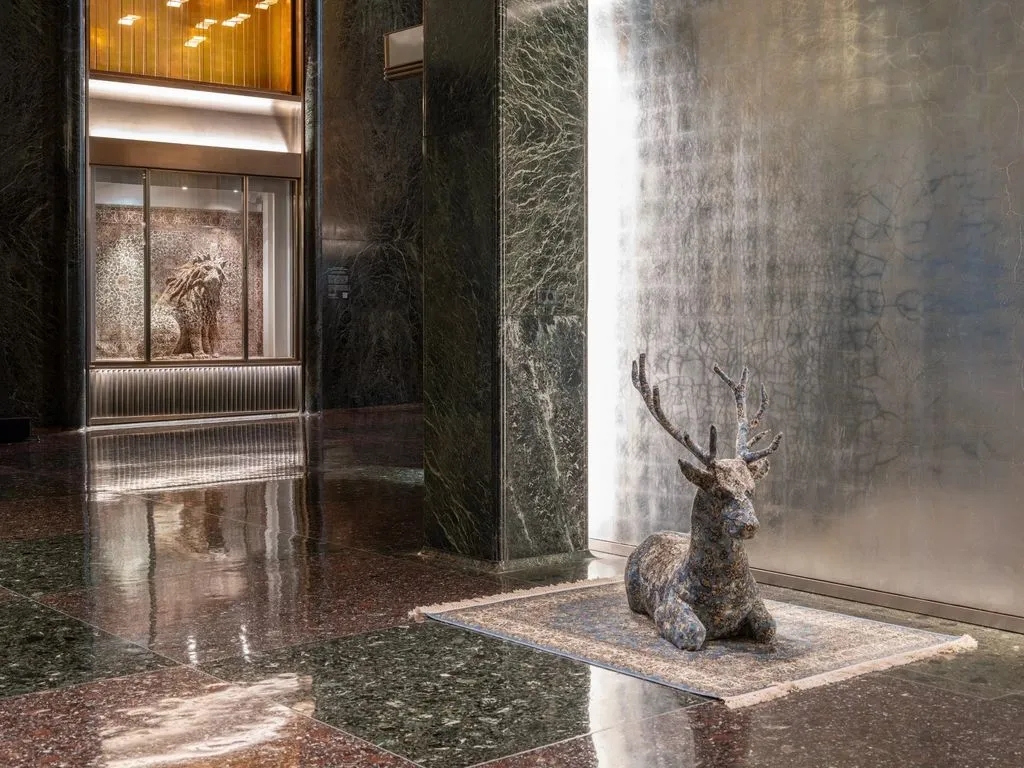
You have described domestic interiors as stage sets in which people perform the roles expected of them. This idea was particularly evident in your 2023–24 presentation at Rockefeller Center, where animals appeared within glass vitrines, evoking museum displays or even zoo enclosures. When the animals in your sculptures break through these surfaces, do you think of them as revealing something that has been repressed or hidden within domestic life?
When my animals break through the patterned surface they reveal something about the impossibility of being socialised. In order to live peacefully, humans have to relinquish their wilder natural instincts and allow themselves to be somewhat constrained. We first learn to do this as children, in our homes.
As you look toward the fall and winter, are there ideas, materials, or forms emerging from your recent work—and from the experience of Venice—that you are especially interested in developing further?
I recently started using wood veneers again, having made some very large panels earlier on in my art career. This time I’m making them into three-dimensional sculptures of houseplants, and right now I’m in the exciting experimental phase of working out the best materials and techniques to use. I visit Venice every year, and I met some really inspirational people at the Homo Faber show, including the Chinese artist Wen Qiuwen, who worked with artistic director Es Devlin to create some huge paper birds. I was blown away by the immersive scale of her work, but also her lightness of touch. I’d like my houseplant sculptures to feel monumental in size but also look effortless – as if they should always have existed, even before I made them.
Courtesy of the artist and Sargent’s Daughters. New York
@debbie_lawson_artist @sargentsdaughters
Featured Image: Debbie Lawson: In a Cowslip’s Bell I Lie, Sargent’s Daughters, New York, April 23, 2026 – May 30, 2026