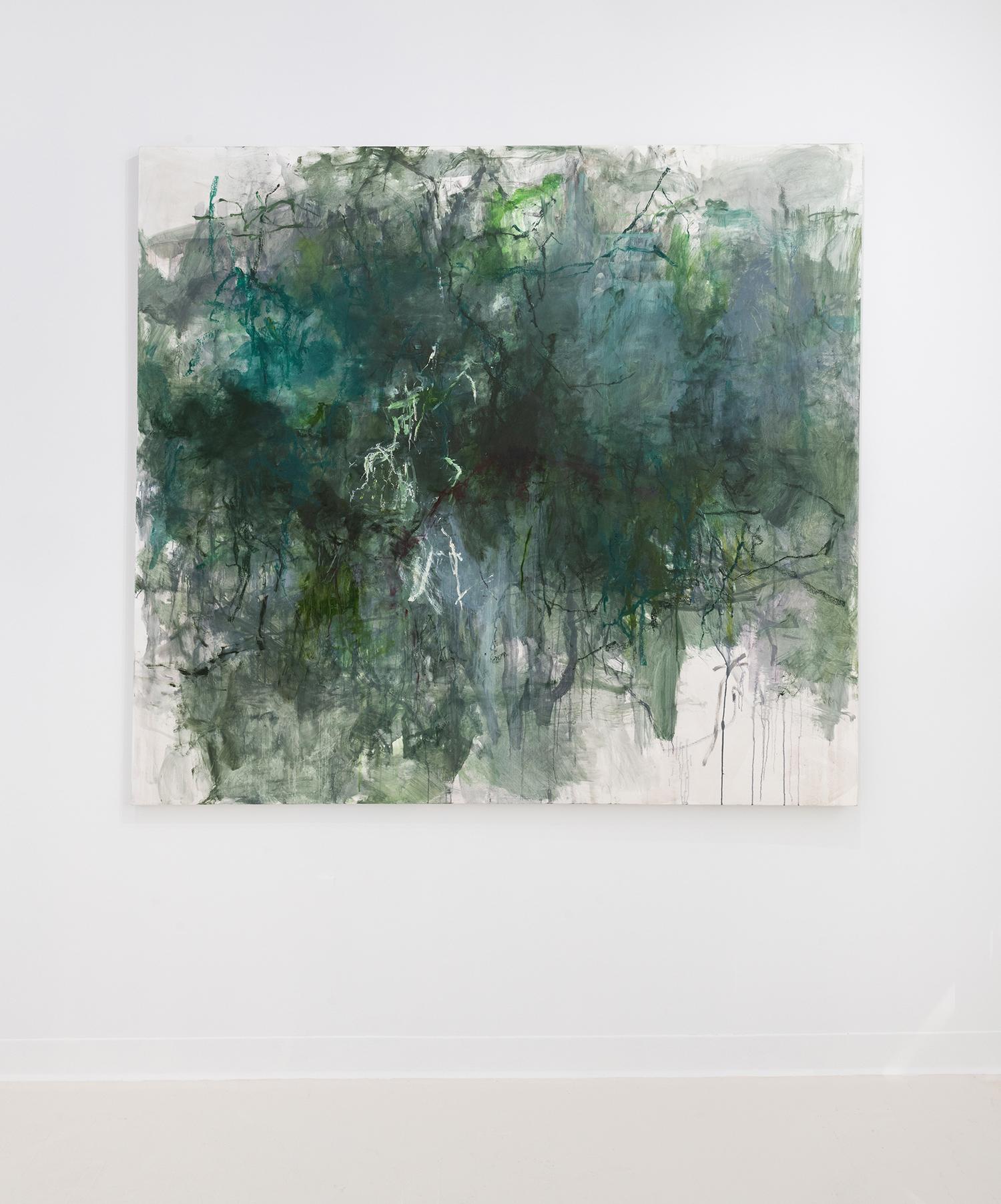
Peter Gynd, Figures which do not behave within the structure of a Story, 2023, oil on linen, 48 x 36 inches
10989 Dunlop Road features Peter Gynd’s recent oil paintings, inspired by the tranquil garden of his mother’s home in kwekwenis (Lang Bay), British Columbia. This series captures the shifting essence of cedar and fir trees that stand at the garden’s entrance, embodying themes of rebirth and spiritual renewal. Each painting serves as a reflection of Gynd’s connection to this place of refuge during a pivotal time.
‘Desire Lines’ by Stefania Urist. Image by Alexa Hoyer. Courtesy of Socrates Sculpture Park.
Founded in 1986 by artists, activists, and community members, Socrates Sculpture Park transformed an abandoned landfill into a cultural cornerstone in Queens, New York. This dual-purpose venue serves both as a public park and an exhibition space for contemporary art, targeting early- and mid-career artists. Occupying five waterfront acres, Socrates provides a unique platform for artistic expression and public engagement, offering free access to a civic space amidst the urban environment.
Laura Williams home studio 2023 by Rebekha Robinson
New Zealand-based painter Laura Williams began her artistic journey twelve years ago in her late 40s, following significant personal upheaval and loss. Turning to art as a means of coping, she replaced alcohol consumption with creativity, using her work to express and manage her anxiety and depression. Diagnosed with ADHD and Asperger’s, Williams found clarity in her penchant for patterns and symbols, which she employs as a unique language in her paintings. Her work, extensively exhibited across New Zealand and Sydney, Australia, is marked by its distinct yet universally resonant themes. The figures in her art, often women alongside men, clothed or unclothed, convey a sense of isolation despite their physical proximity. The dense and intricate patterns combined with vivid colors create an intensely claustrophobic space vibrating with charged psychological tensions.
Valérie Hallier working on the series Déflorée History in her studio during a residency with ESKFF at Mana Contemporary, NJ., 2023
Flower petals gradually became a significant element in Valérie Hallier’s artwork. Fascinated by the profound symbolism of flowers, Hallier initially struggled to incorporate them effectively into her artistic practice. Her initial approach involved photographing flowers in unique ways and settings. She also experimented with their dried components, adhering them to various surfaces. Eventually, she began to focus on pressing individual petals. Hallier discovered that working with petals was ideal for conveying complex themes such as femininity, resilience, sexuality, vibrancy, and decay. Born in Paris, France, and raised in Normandy, Hallier had a shy nature as a child. She was consumed with the ambition to draw everything in existence, a desire for comprehensiveness that continues to influence her work. Art, for her, has always been an essential means of engaging with both her internal and external worlds. Reflecting on her early art education, Hallier fondly remembers her excitement upon meeting others who shared her artistic ‘language.’
Swoon, Swimming Cities of Switchback Sea, photo courtesy of Tod Seelie
Brooklyn-based artist Caledonia Curry, known as Swoon, is celebrated internationally as one of the first female street artists in a male-dominated field. For over two decades, Swoon has explored human experiences through public art, museum exhibitions, and film. Her latest projects look at the ties between trauma and addiction, inspired by her own life in a family affected by opioid addiction. She works closely with communities, using art to show empathy and help people heal. Over the last ten years, Swoon has led important projects in places like Braddock and Philadelphia in Pennsylvania, New Orleans in Louisiana, Venice, and Komye in Haiti, tackling everything from natural disasters to the opioid crisis.
Inside Out Oculus, 2022, acrylic on mylar, 36×45.5 in.
In her Interiors painting series, American Iranian-born painter Zahra Nazari draws on prominent features in classical Persian and Islamic architecture—decorative botanical motifs, arch, and particularly, iwan, the large, vaulted hall semi-enclosed and usually walled on three sides, with one end entirely open. Many scholars believe its origin can be traced back to the Parthian era. While looking at Nazari’s luminous surfaces, it may be interesting to keep in mind the dual role of the Persian arch—it serves both decorative and functional purposes—this richly decorated key aesthetic element in Persian architecture functions not only as an ornament but also as a structural support that provides stability. It is also designed to moderate the amount of sunlight that enters space, especially in iwans or other open spaces. Nazari’s frequent use of Mylar as a surface stirs a play on the notion of external and internal light, and simultaneously, her saturated color palette invokes a hot and arid climate with bright, sunlit days and crisp nights. Repetitive and rhythmical, these motifs coalesce into energetic, translucent, and luminous surfaces, evoking an interior space in flux. Zahra Nazari elaborates on her ideas and process in this interview with Art Spiel.
Elizabeth Gilfilen’s debut solo show at YI Gallery presents oil paintings that exhibit a meticulous yet bold exploration of color and texture. Her strokes span from boldly assertive to gently nuanced, each adding to her work’s visual depth and dynamic feel. Eschewing neat conclusions, her paintings are presented as evolving works, with each layer suggesting new narratives in an unfolding journey. The synergy of color and form in her paintings creates a dynamic tableau, inviting viewers to interact with the canvas, drawing them into the active narrative of the art’s continuous unfolding.
My grandmother with a bird, 2021, silk, cotton, salt, ink, wood, 80 x 70 inches, image courtesy the artist.
Linda Sok uses in her fiber-based sculptures elaborate dyeing techniques practiced throughout Asia and imagery of her family she receives through social media to convey narratives of migration and cross-cultural pollination. Linda Sok is a second-generation descendant of survivors of the Khmer Rouge Regime, a genocidal period in Cambodia’s history that forced her family to flee Cambodia. By accessing fragments of Cambodia’s traumatic past, she attempts to recontextualize lost traditions and culture to allow living descendants to process the history through a contemporary lens.
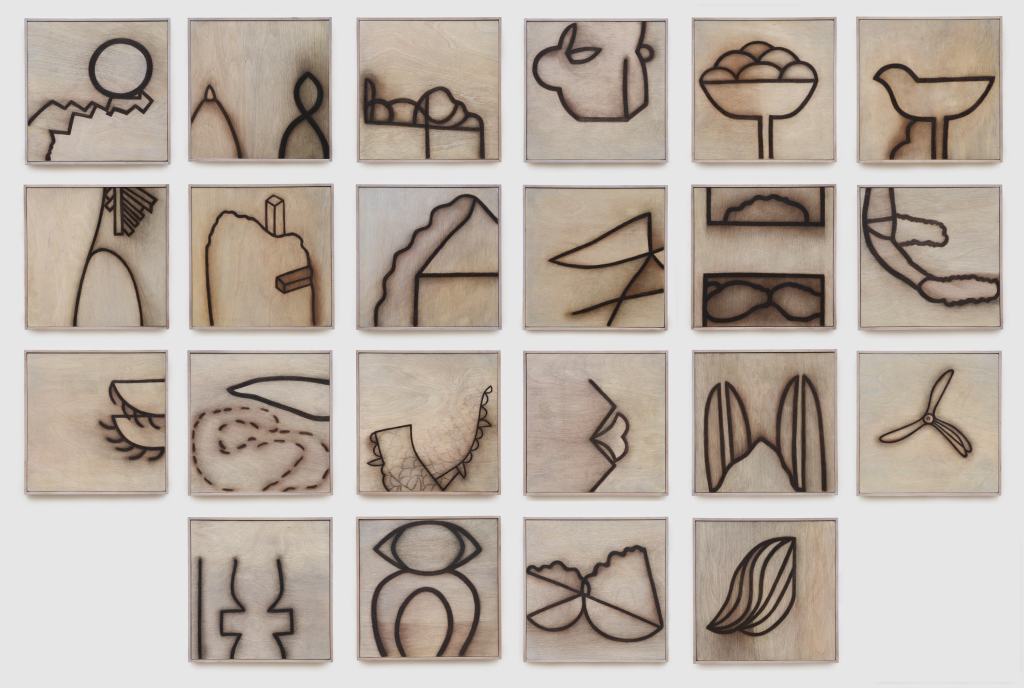
SPACELAND. Each Flashe paint and graphite on panel. 12 x 12 in. / 30.5 x 30.5 cm
Patricia Satterlee wrote this concise statement to contextualize the work she exhibits in her third solo show at Gold Montclair:
This work resists the feeling that everything is falling apart. Holding on to a real or imagined moment without the noise. A particular way of being a boat on a stream passes in time. A figuration of forms floating and morphing, rediscovered as they’re painted.
An interview with curator and gallery founder Jennifer Wroblewski gives us more insight into her curatorial vision and the featured artworks.
Dalit Gurevich’s A Memory Interwoven, curated by Jenn Cacciola at the Project Space of the Amos Eno Gallery, is a vivid exploration of transformation and adaptation through depiction of mixed-media landscapes and cityscapes. The exhibit, now open to visitors, captures the shifts in Gurevich’s life from the confines of a Brooklyn apartment during the pandemic to the liberating nature of Vermont and back to the bustling city life. Her paintings tell a story of seeking space and peace in a time of global uncertainty.