Etty Yaniv works on her art, art writing and curatorial projects in Brooklyn. She holds BA in Psychology and English Literature from Tel Aviv University, BFA from Parsons School of Design, and MFA from SUNY Purchase. In her installation work She is integrating mediums such as drawing, photography and painting to form three dimensional immersive environments. More info at: www.ettyyanivstudio.com
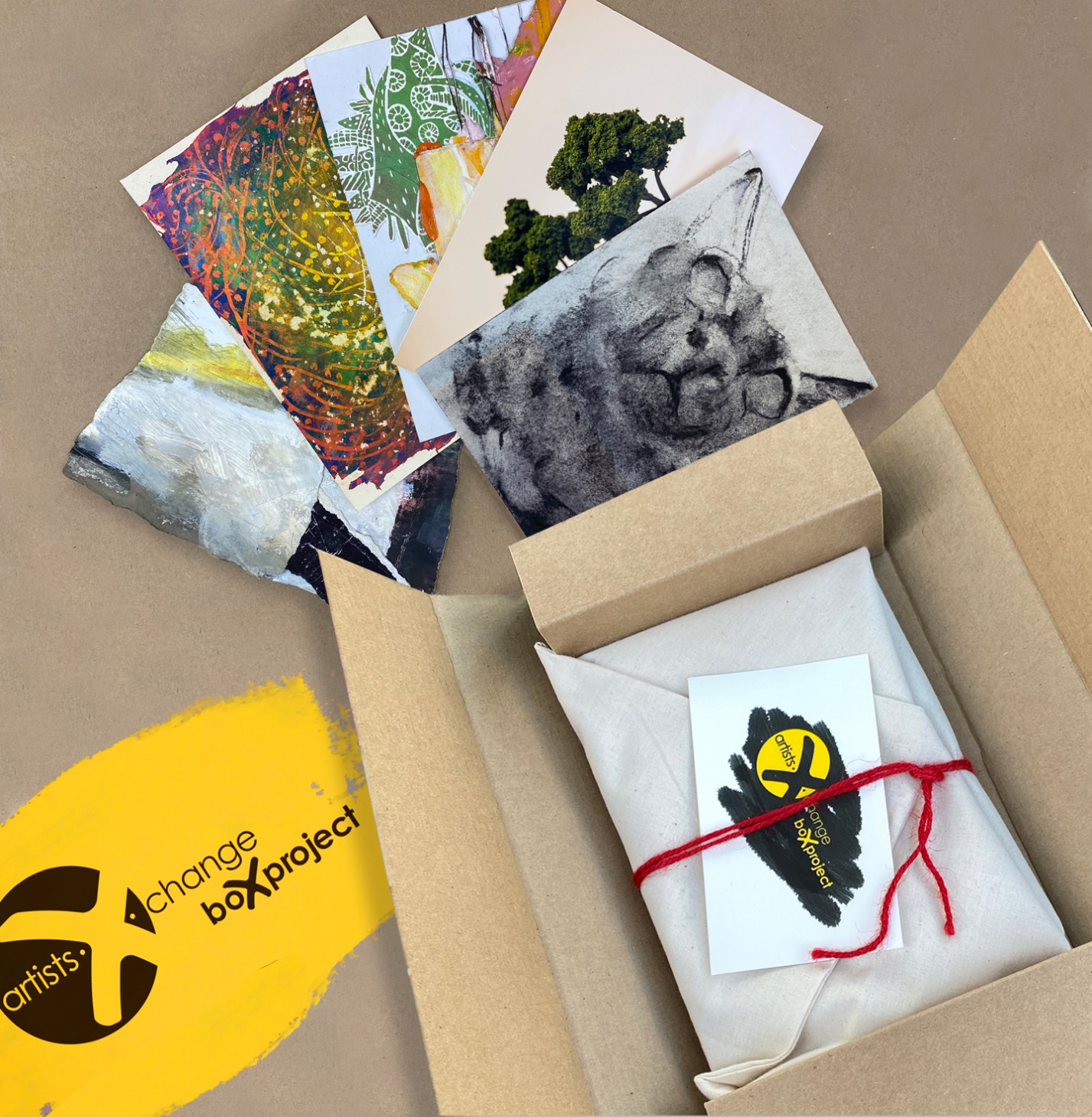
Soon after the Corona pandemic hit NYC, a resourceful and talented group of NY based artists came together to create an informal collective called artists-X-change (aXc) with the aim to alleviate the growing distress that both artists and art organizations have been facing. They were united by a sense of urgency — the severity of the situation coupled with the need to help others in their community.
May 2020. The artist lives and shares a studio with her partner, who is a musician. She is usually on the other side of her worktable, or else he wouldn’t have been able to sneak this photo of her.
For Taiwanese born artist, Fay Ku, the single, most formative event in life was immigrating to the United States. Ku says that if she had stayed in Taiwan, she would never have become an artist so she would have been a completely different person. It still surprises her how much this one event which she was too young to remember (though of course remembering all its aftershocks), shapes her work, often without her being consciously aware of the themes and issues at the time of making the work. Fay Ku shares some insights on her body of work in Domestic Brutes, the all women group show at the Pelham Art Center which engages the visitor with diverse approaches of what feminism means in American society today.
Jacqueline Shatz‘s ceramic based wall sculptures depict biomorphic forms, mostly referring to animals and humans as a single entity. An abstracted silhouette of an agile swimmer, a whimsical hybrid of horse and baby snake, a queen’s bent head fully covered by flowing hair spilling downward – each evokes a mystery associated with ancient civilizations, archetypes, and mythologies or what the artist describes as “states of being and permeable nature of time.” Jacqueline Shatz shares with Art Spiel some thoughts on her work and work process.
At the Elizabeth Murray Artist Residency by Collar Works, Granville, NY, July 2019, Photo by Monica Hamilton
Will Hutnick is an artist, curator, co-director of Ortega Y Gasset Projects in Brooklyn from 2015 to 2020 and Director of Artistic Programming at the Wassaic Project upstate NY. In his paintings Will Hutnick is using rollers, and includes other mono-printing-like methods to create repetitive passages which form playful and unexpected relationships between shapes and colors. He shares with Art Spiel some of his work process, reflections on the ways his paintings have developed, and some of his other art related practices.
Jana Astanov is an interdisciplinary artist, a poet and an independent curator born in Poland, and living in the US. She is a founder of CREATRIX Magazine, portal for creative expression focused on art, activism and spiritual practice. Her work includes photography, poetry, performance art, sound art, and installation. In her work, she utilizes spiritual traditions, somatic movement, sound art, ritualistic theatre and Astrofeminism, a term she has developed through her character Yannanda The One Who Speaks With The Stars. Together with her partner Niko van Egten she co-created an electronic music group ASTRALOOP featuring her poetry in dark electronic arrangements. She has performed at Tate Modern, Smack Mellon Gallery, Grace Exhibition Space, Venice Biennale, Documenta 2017, and many other galleries, festivals and independent venues worldwide. She is also the author of five collections of poetry: Antidivine, Grimoire, Sublunar, The Pillow Book of Burg, and Birds of Equinox. In this interview for Art Spiel Jana Astanov discusses her ideas on performance art and specifically on her most recent upcoming curatorial project ALEMBIC: Body and Spirit. Live Art as Healing Art.
Noa Charuvi’s paintings convey a distinct sense of place where narratives of the present interrupt those of the past with urgency, sometimes even violence . Yet, her places encapsulate past and present not only as a rupture but also as an ongoing flow of coinciding contradictory forces – ruin and construction, anarchy and order. No matter if the painting depicts an interior of a room or an exterior of a construction site, it frequently portrays a place that is devoid of human figures but charged with the aftermath of human actions. Even if human figures are present, they are typically placed in context of their larger environment, players in a powerful and mysterious systemic forces of history, city, society. Noa Charuvi shares with Art Spiel some insights on her ideas, work, and process.
Padma Rajendran, Along the way, 2019, Dye on silk with stitching, dimensions varied, photo courtesy of the artist
Malaysian born and New York based artistPadma Rajendran works in diverse media yet currently views paper and fabric as her primary materials. She highlights the portable nature of paper and fabric, along with their significance as “keepers of culture, comfort, and call upon the function of the decorative”. Padma Rajendran shares here some insight on her work, what brought her there and where she is heading from here.
One Tree, Two Mouthy Ghosts, 2019, Oil on canvas, 30 x 40 inches, photo courtesy Max Yawney
Meg Atkinson‘s paintings resemble puzzles open to multiple solutions. Her imagery is embedded with associative literary and visual layers, as clues to an open-ended riddle. Meg Atkinson shares with Art Spiel what brought her to art, as well as the way she has developed her approach to mark-making, space, gird, and color.
Gabriel J. Shuldiner dislikes categorization of his work to the point that he invents new “isms” to describe its allusive hybridity – its DNA can be traced to abstraction with elements of minimalism, expressionism, and Arte Povera. While Shuldiner’s use of material is extensive , his use of color is restricted to mostly black, with tinges of other colors at times. Gabriel J. Shuldiner shares with Art Spiel some of his thought and work processes.