Etty Yaniv works on her art, art writing and curatorial projects in Brooklyn. She holds BA in Psychology and English Literature from Tel Aviv University, BFA from Parsons School of Design, and MFA from SUNY Purchase. In her installation work She is integrating mediums such as drawing, photography and painting to form three dimensional immersive environments. More info at: www.ettyyanivstudio.com
For Cathouse Proper’s second ensemble exhibition, More Time Less, curator and gallery director David Dixon brought together five artists — Zac Hacmon, Elana Herzog, Aga Ousseinov, Tim Simonds, and Nari Ward — whose installations, wall-based work, and sculptures reflect our changing perception of ‘normative time.’ David Dixon describes his curatorial process, gives us a closer tour of this ensemble exhibition, and shares some background on his diverse art practices.
Patricia Fabricant, Jo Yarrington, Katherine Jackson, Ellen Hackl Fagan, Alexandra Rutsch Brock, Patricia Miranda (missing Josette Urso) – watching President-elect Joe Biden’s victory speech Nov. 7, 2020 – after our gallery reception. Photo courtesy Dustin Malstrom
The group exhibition In Accordion Time, Unfolding : A Pandemic Archive marks the opening of Ursa Gallery, an experimental gallery showcasing contemporary art and design located at the historic Arcade Mall in Bridgeport, Connecticut. This art venue was founded by Cris Dam and conceived in collaboration with Dustin Malstrom. Cris was also cofounder of Dam Stultrager in 1998 – one of the earliest galleries in Williamsburg, Brooklyn. Co-curated by Alexandra Rutsch Brock and Patricia Miranda, the exhibition features mail art in the form of accordion-fold books and digital dialogues by the London Calling Collective over the challenging past year. It runs through February 12th, 2021.
Joyce Yamada, Portrait, 2019, photo courtesy of Nila Onda
Painter Joyce Yamada grew up on the west coast. She spent her childhood vacations in the beautiful national parks of the US and Canada where pristine forests and the Pacific coast were imprinted in her visual memory. She recalls that although as a teenager she realized that art is her task in life, struggling to survive by minimum wage work led her to medical school which she completed and then subsequently became a diagnostic radiologist. This science background has fed her mind and artwork ever since. Yamada says she is a painter because she conceptualizes in images rather than in words — “when puzzled, my mind juxtaposes or fuses unexpected images, often leading to new work,” she says. For instance, an early series, Body, Earth, came to her in art school — while looking at the hills across the bay from San Francisco she saw the low rounded hills as the reclining body of a woman. The juxtaposed imagery meant to her that we are intimately and indivisibly part of earth and of nature, that what we do to the earth we do to ourselves. She has subsequently seen this idea expressed in indigenous cultures, and it became central in her work.
Marco Palli, 2020 at his studio in Kent CT, with “The Origins of Sculpture” Photo by Sandra Cafarelli
The online sculpture exhibition “FLUX : Vita Mutata” curated by Natsuki Takauji and hosted by the veteran non-for-profit artists’ cooperative Sculptors Alliance, features seventeen artists who display works made before the pandemic, throughout the closure, and beyond. The Sculptors Alliance president, Marco Palli. shares with Art Spiel how the show evolved, and how his organization transformed throughout the pandemic, while offering us a generous peek behind the scenes.
The artist in Radiator Gallery, interactive magnetic collage artwork
For Greek based artist and activist Eirini Linardaki, who had been born and raised in Athens than moved and resided in France, cognitive diversity is at the forefront of her art projects. She sees her strength in building networks with different voices which help create an environment where diverse Ideas matter more than individual achievement. Through diverse social engagement methods, she aims to show that art is activism. She strongly believes that art can create direct channels for feeling and understanding within public spaces and communities, building trust and hope.
In Dialogue with curators Monica Carrier and Jane
Kang Lawrence
In Dialogue with curators Monica Carrier and Jane Kang Lawrence Photo of Jane Kang Lawrence & Monica Carrier. Photo credit: Jeff Dietz
The exhibition Flat File 2020 at PeepSpace, features two-dimensional small works by over fifty artists who were selected through an extensive curatorial process based on both open call and invitation. After December 23rd, when the show ends, the works of art will be stored in flat file drawers at the space and will be available for viewing along with other scheduled programming through September 2021. Curators Monica Carrier and Jane Kang Lawrence who are also artists and educators, share their vision for this new art venue and some insight on the current group exhibition.
To celebrate the 100th anniversary of the passage of the Nineteenth Amendment guaranteeing women’s voting rights, Women to the Fore, the current group exhibition at the Hudson River Museum features more than forty female-identifying artists, spanning one hundred and fifty years. The two curators, Laura Vookles and Victoria Ratjen, selected diverse artworks across media —paintings, drawings, prints, photographs, collage and sculpture— from the Museum’s permanent collection, regional artists, galleries, and collectors. The exhibition includes works by renowned artists like Marisol, Judy Chicago, Louise Nevelson, and Mary Cassatt among many others, and less recognizable contemporary and 20th century artists. For instance, one of the highlights in this show is Anna Walinska’s self-portrait which not only marks her first return to the walls of the Hudson River Museum in over 60 years, but also brings to light her significant role in the art world of her time, including her dedication to promoting the work of other artists, like Arshile Gorky, who got his first New York City solo show in the mid-30s at the Guild Art Gallery, an art venue she founded and ran.
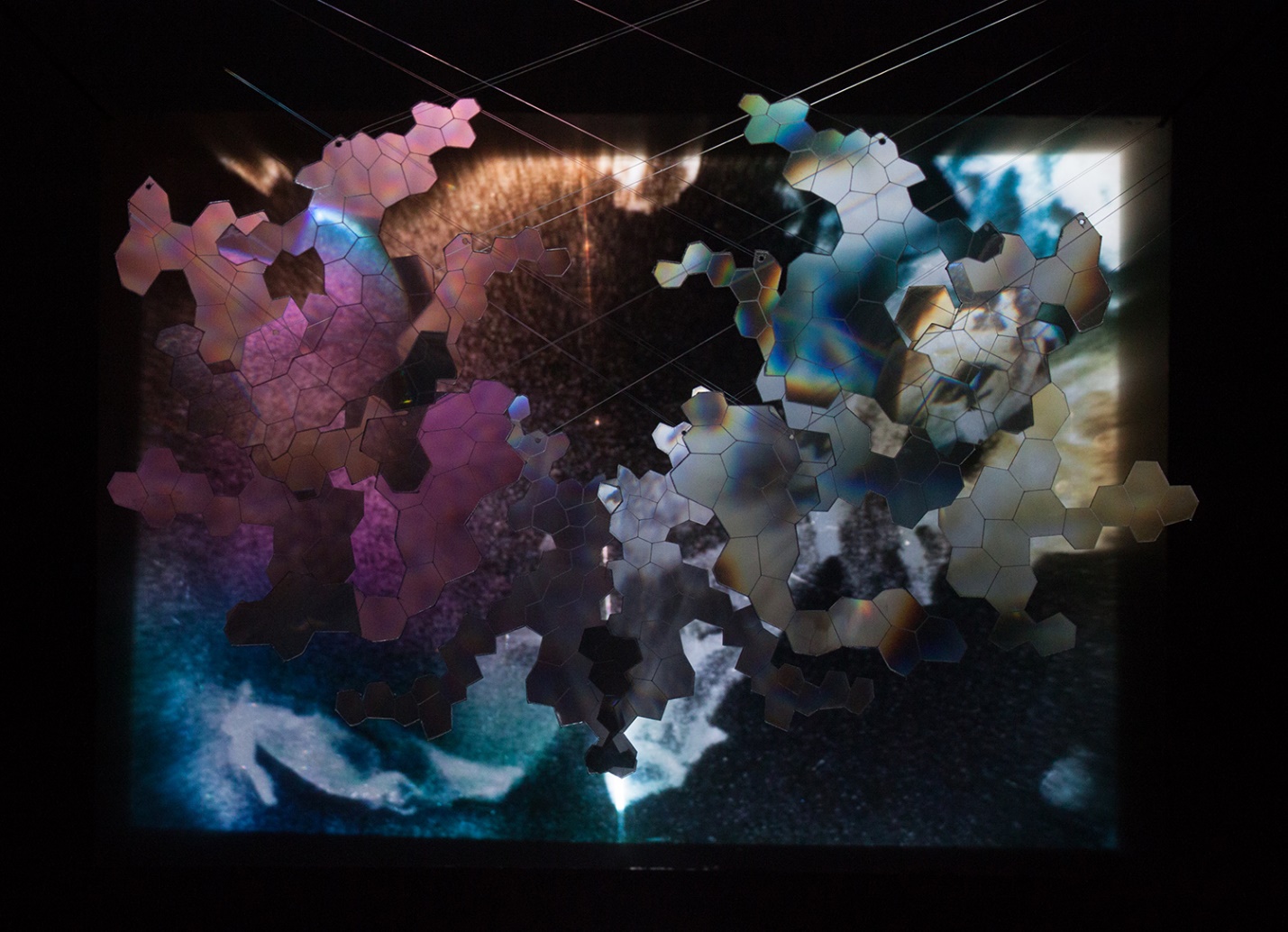
Jess Holz, Borderlands, 2020. Installation with laser cut Fresnel lenses and video of the artist’s skin being examined under the scanning electron microscope at the HoloCenter exhibition EDGE OF LIGHT
The Edge of Light began with the intent to create a group exhibition of artists who work in light. Jonathan Sims, a light artist himself and the curator of this group show at Plaxall, says that although there are a very large number of artists currently working with light as a medium and a material, but their chances to exhibit, particularly in a group setting, are limited.
In Dialogue with Eric Fallen, Founder and Executive Director
Duet, 2020 76.5”h x 84”w x 53”d Canvas, acrylic paint, wood, furniture parts, wheels, and hinges
Amy Butowicz solo show Boudoir Theatre at Peninsula Art Space features a collection of domestically scaled sculptures staged as a group of characters which are readily associated with notions of sensuality, ornamentation, and haute couture. Bulging cushion-like forms, meticulously hand-stitched over wooden structures, display intricate patterns and rich material suggestive of bedding, vanities, corsets and human anatomy. Bold and tender simultaneously, these anthropomorphic forms defy the disdain and fear that are frequently imposed upon feminine artforms, spaces, and bodies. Eric Fallen, founder and executive director of the Red Hook based Peninsula Art Space elaborates on Amy Butowicz’s exhibition and on his art venue.
Michele Brody, working in home studio in The Bronx on handmade paper body sculpture for Annual Earth Celebrations Eco Pageant, paper made from recycled linen table cloths and caning, 2020. Photo by Olivier Marcaud
A fourth generation NY builder, artist Michele Brody loves working with materials. She recalls how her father groomed her early on to become an architect so that she could continue the family tradition of builders and land developers. Although she excelled in the study of Architecture, she was not attracted to pursue it as career. ” I prefer building with my own hands,” she says. So in 1994, instead of getting a degree in Architecture, she graduated with an MFA from the School of the Art Institute of Chicago from the Fiber and Material Studies Department.