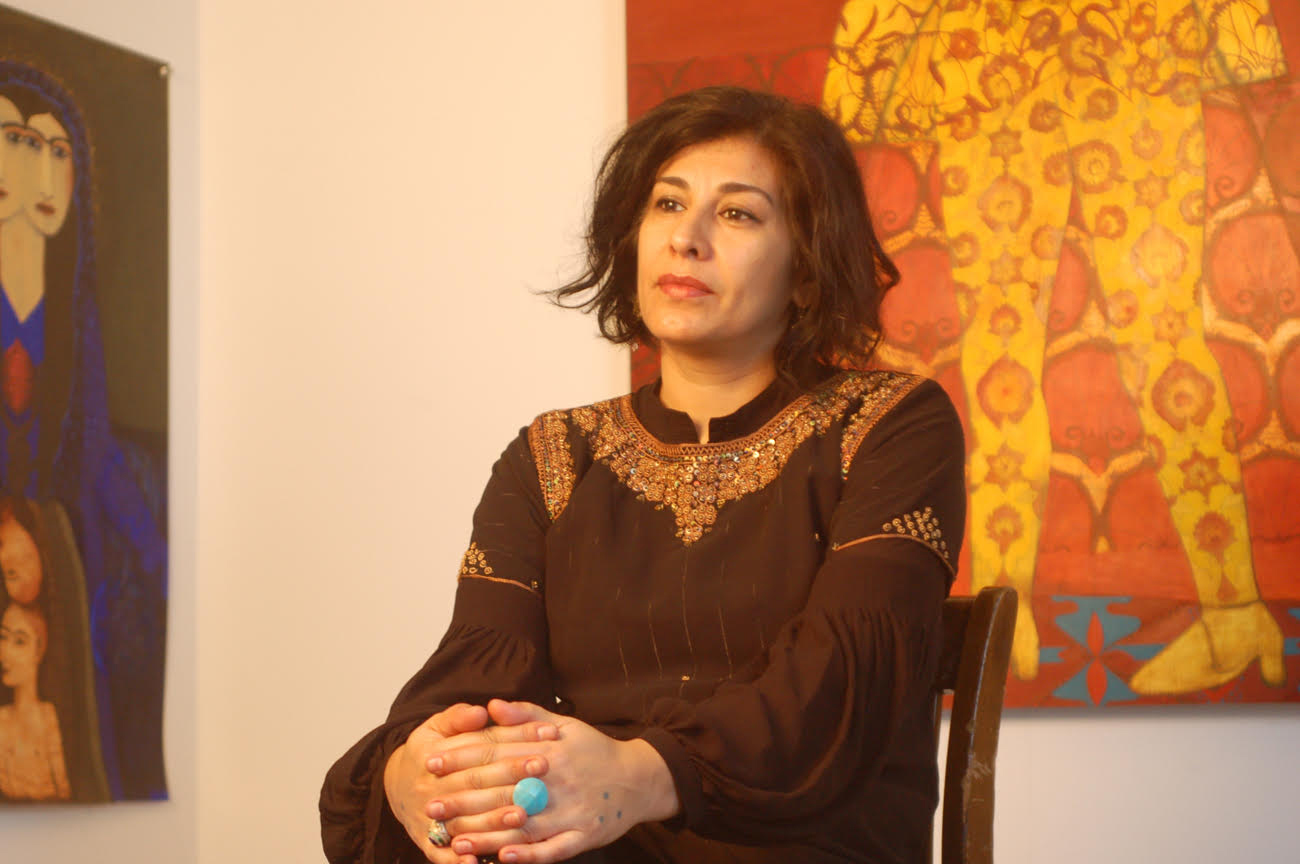
Etty Yaniv works on her art, art writing and curatorial projects in Brooklyn. She holds BA in Psychology and English Literature from Tel Aviv University, BFA from Parsons School of Design, and MFA from SUNY Purchase. In her installation work She is integrating mediums such as drawing, photography and painting to form three dimensional immersive environments. More info at: www.ettyyanivstudio.com
This Two, Sun You’s first solo show with Geary, takes place concurrently at Geary’s two locations: Bowery in the Lower East Side and Main street in Millerton, New York. Geary features You’s clay- based work which includes oven-baked polymer clay forms mounted on painted wood panels, sculpted clay forms in cardboard boxes, and a separate body of sculptures made of mixed media — metal wire, razor blades, beads, and artificial flowers “held by magnets and gravity”, as described by Michael McCanne in the press release. The show runs through March 5th, 2021.
Mary Ann Lomonaco began her artistic life as a papermaker after majoring in Fiber art at Parsons School of Design . Ultimately this led to exploring the kitchen mop as a cellulose fiber she could use when making pulp. One day she started noticing the mophead itself as a potential sculptural element on its own. This insight subsequently led her to explore other recycled materials. Mary Ann Lomonaco recently completed commissions for Delta Airlines for their Executive Lounges in San Francisco, London, JFK, Seattle and Atlanta as well as a large piece for their Atlanta Headquarters. Her installation at the Westchester County Airport is comprised of 55 multiple pieces. Her work is also in the collections of the Neuberger Museum, Neutrogena, AT&T, PepsiCo and the World Bank Library among others.
Crowded Places / Open Spaces installation Betty Cuningham Gallery
Greg Drasler came to be a metaphorical figurative painter when he lost everything he owned in a fire in 1978, except for two paintings. At that moment he decided to focus exclusively on painting — he was a painter and painting would be everything he needed. He began to rebuild his pictorial world with scenes from the self-help DIY magazines and for over 40 years has continued to explore and expand his visual vocabulary through several bodies of work. Greg Drasler says he identifies with the subjects of his paintings “as personal questions, metaphors, and allegories often responding to social and cultural topics.” His current solo exhibition at Betty Cuningham Gallery includes both works from his lengthiest series, the Hats Paintings, and some from his most recent series, the Road House paintings. Sparked by the effects of social distancing due to the pandemic, the paintings overall assume another layer of meaning.
Krista Svalbonas has been capturing images since her first darkroom photography course in high school. The camera in some form — as an integral part of the work or as a reference — keeps playing a central role in her artwork, which takes shape in diverse forms such as painting, ceramics, and sculpture. Her first solo exhibition at Klompching Gallery in Dumbo, Brooklyn, features work spanning a six-year period.
Debbie Hesse, Laboratory for Healing, 2018, Immersive installation at Yale West Campus, Photo Courtesy of Graham Hebel, Artspace
Debbie Hesse, the CT based artist, makes plexiglass sculptural constructions and video installations. Her sculptural installations, or “spatial paintings” are typically made of multiple planar Plexiglas and wood cutout shapes layered to create complex shapes which bring her ideas to life through light and color.
Fellow Travelers, PeepShow Space’s fifth and final exhibition, features the work of Joshua Rosenblatt, Jason Phillips and William Norton. The three artists reflect on travel, which at this moment is impossible in their lives as they shelter, wait and dream about places that no longer exist, except in memory.
Christopher Ulivo, the LA based painter, takes us in his vivid paintings to imaginary places, from time travel to ancestral family spirits to rewritten myths and histories. His worlds are filled with idiosyncratic, wildly imaginative narratives, where you can sense the painter’s presence as a prolific storyteller.
Yvette Molina in residence at the VACNJ before shutdown. Photo credit: Ettienne Frossard.
Big Bang Votive, Yvette Molina’s collaborative storytelling art installation has evolved over fifteen weeks, utilizing the Mitzi and Warren Eisenberg Gallery at the Visual Arts Center of New Jersey through January 18th, 2021. Yvette Molina creates an immersive audio-visual experience — accompanied by a 30-minute surround sound composition played on a loop, her installation includes three hundred paintings of starry skies, some with votive symbols of delight or love taken from stories gathered from the public, a work-table with the artist’s materials, and an on-going “story catcher” project involving public participation.
Samira Abbassy’s paintings and drawings portray mysterious iconic figures, primarily female, who inhabit an ambiguous space. While her pictorial world resonates with archetypal imagery from eastern and western cultures, it equally pulsates with an urgent psychological core, creating an invigorating tension which prompts the viewer to search and discover rich layers for meaning.
Margaret Roleke, Margaret Roleke: Made Visible, 2020, window installation of cyanotype banners and mylar, Creative Arts Workshop, New Haven, CT., photo courtesy of Rashmi Talpade
When Margaret Roleke finished her MFA, she was a sculptor and installation artist. From early on she created installations dealing with issues of water, sound and light and after becoming a mother to four children, notions of motherhood and domesticity became central in her work. As her children grew, current political events became increasingly part of her visual expression. For instance, around 2002 she started including toy soldiers in her sculptures, referencing the Iraq war, and also around this time for a public art project in Brewster, NY, she made seating for the day-laborers who were regularly gathering on that site. She continued to make work that spoke to issues that were important to her, mainly gun control, domestic abuse, and immigrant rights. She says she had no intention to be an activist artist, but became one in the course of making art and exploring her true voice — “The Trump presidency led me to march on the streets and register voters, but I feel I can be a better activist when I create work which starts a dialogue on these important subjects, as this seems to be what comes naturally to me,” she says.