As one enters the space, the air changes first.
Nag champa. Sage. The faint illusion of burning wax.
The scent settles low and heavy, as if the room itself is breathing. The atmosphere feels dense and slow, yet charged. Fixed and fluid at once. Calm and alert. Sacred and unsettled.
This is not simply an exhibition to be viewed. It is a room to be entered with the whole body.
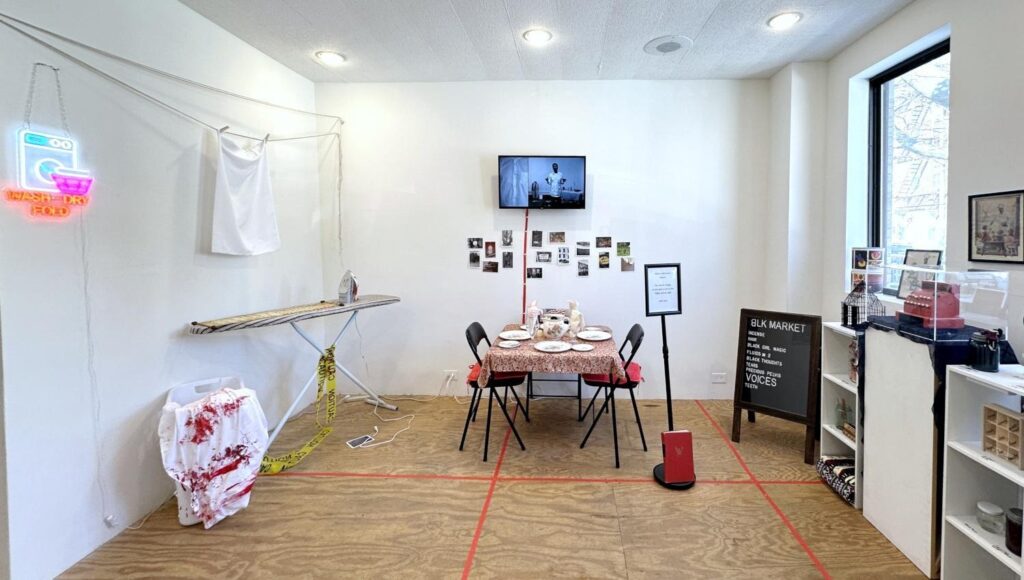
In Pieces of Yourself (There), poet, educator, and interdisciplinary artist Anastacia-Reneé, working in collaboration with co-curator Alverneq Lindsay, unfolds a multisensory, immersive environment that refuses the clean distance of spectatorship. Instead, the viewer is asked to move carefully, to breathe differently, to slow down. Memory accumulates. Clarity dissolves. Fragments appear, disappear, and return altered.
The exhibition unfolds in lived spaces.
It is organized as a spatial progression rather than a collection of isolated works. Each room functions as a distinct register of labor, memory, and relation, moving the viewer from sites of commodification and extraction toward spaces of rest, sanctuary, and reflection. Market. Table. Laundry. Porch. Altar. Debrief. The walk itself becomes the argument — what begins in exposure slowly turns toward care, what begins in erasure slowly becomes presence.
To move through the gallery is to move through a history.
The first encounter is BLK Market.
The artist describes it as a meditation on the gentrification of the Black body, and specifically the Black woman’s body and neighborhood. “Absurd” items line the market, drawing attention to commercialization, appropriation, capitalism, and erasure.
It reads like a storefront and an archive at once.
Bits and bobs. Trinkets. Fragments. Gathered elements marking time, the body, and the past. Fluids. Remnants. Voices. The body is not metaphorical here. It is material. Vulnerable. Present.
These pieces do not decorate. They testify. In their accumulation and refusal of spectacle, they recall conceptual strategies found in the archival practices of Adrian Piper and Pope.L, where objects function less as display than as evidence.
A self-assembled from residue. Unity built from what survived. Community built from what could not be taken.
The market makes visible what Cedric Robinson names racial capitalism — a system that does not merely exploit labor but differentiates, extracts, and discards. Rather than reproducing that logic, the installation exposes it. Black life is assigned value only through consumption, culture reduced to commodity, memory treated as product. The viewer stands inside that structure, not outside it.
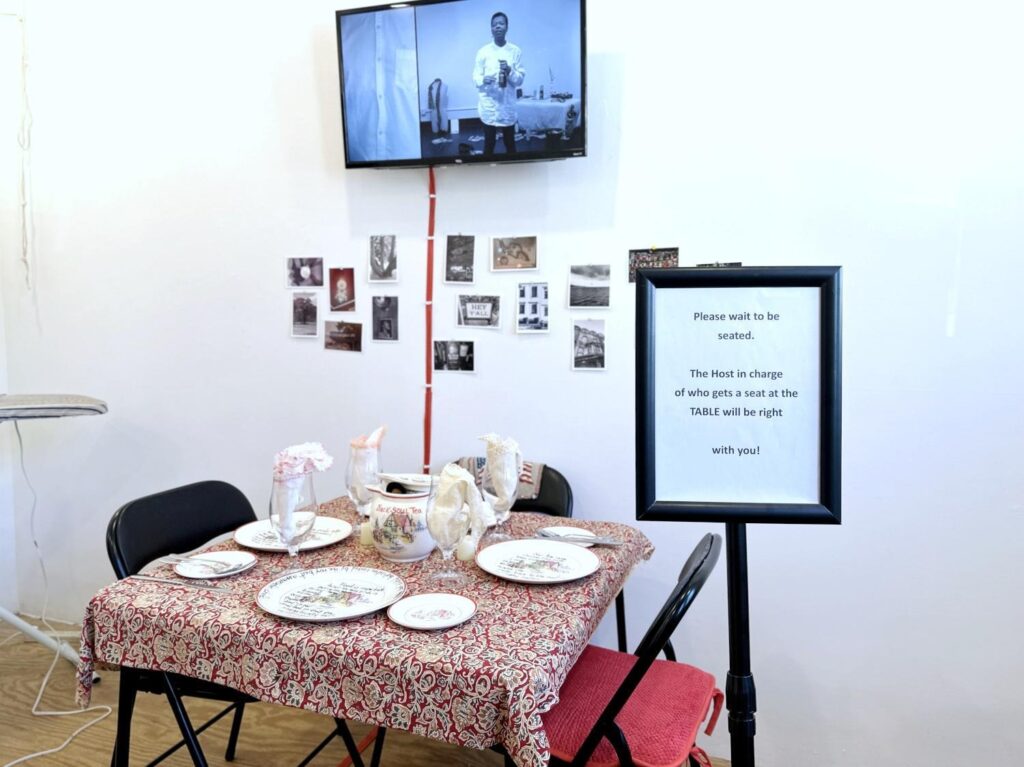
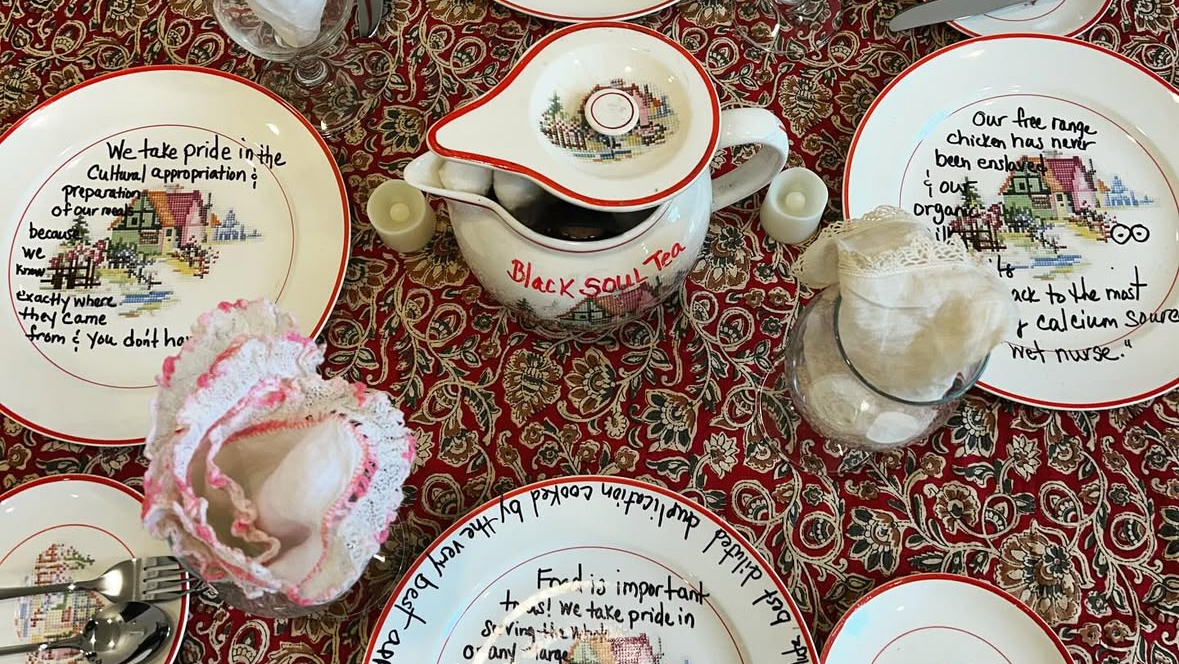
To the left, BLK Market Dinner House extends the argument into the domestic and culinary.
A table is set. But not fully.
A seat is missing.
The installation traces redlining and culinary appropriation, asking who gets invited to the table, who labors in the kitchen, who serves, and who claims authorship. “Soul” tea. Recipes stripped of their makers. Histories minimized, renamed, or erased.
The viewer leans in to read plates and view photographs.
Hunger surfaces as one waits to be seated.
The realization that appropriation runs deep — farm to kitchen to plate to mouth.
Food here is not comfort. It is evidence. Evidence of reproductive labor — domestic, embodied, and intergenerational — passed down through generations, then severed from its origin. As Angela Y. Davis argues, the most essential forms of care work sustain life while remaining structurally devalued. This room makes that contradiction visible.
Care is consumed. Rarely credited.
Further inside, we encounter Wash, Dry & Fold.
Laundry as metaphor. Laundry as violence.
America’s habit of folding things neatly and setting them aside — dirty histories, hidden agendas, emotional stains, murderous erasures.
Baskets. Fabric. Irons. Text.
To clean or to erase. The line is thin.
The labor of washing carries a double edge. Care and disappearance blur together. What is being tended? What is being scrubbed away?
This room resonates with Silvia Federici and her insistence that unwaged domestic labor underwrites the entire social order. Laundry is maintenance, but it is also containment — a mechanism through which care is turned against the body. A system designed to make the world appear clean while absorbing its harm into Black women’s bodies.
The ironing board becomes a text. The room becomes a record.
Then, unexpectedly, a pause.
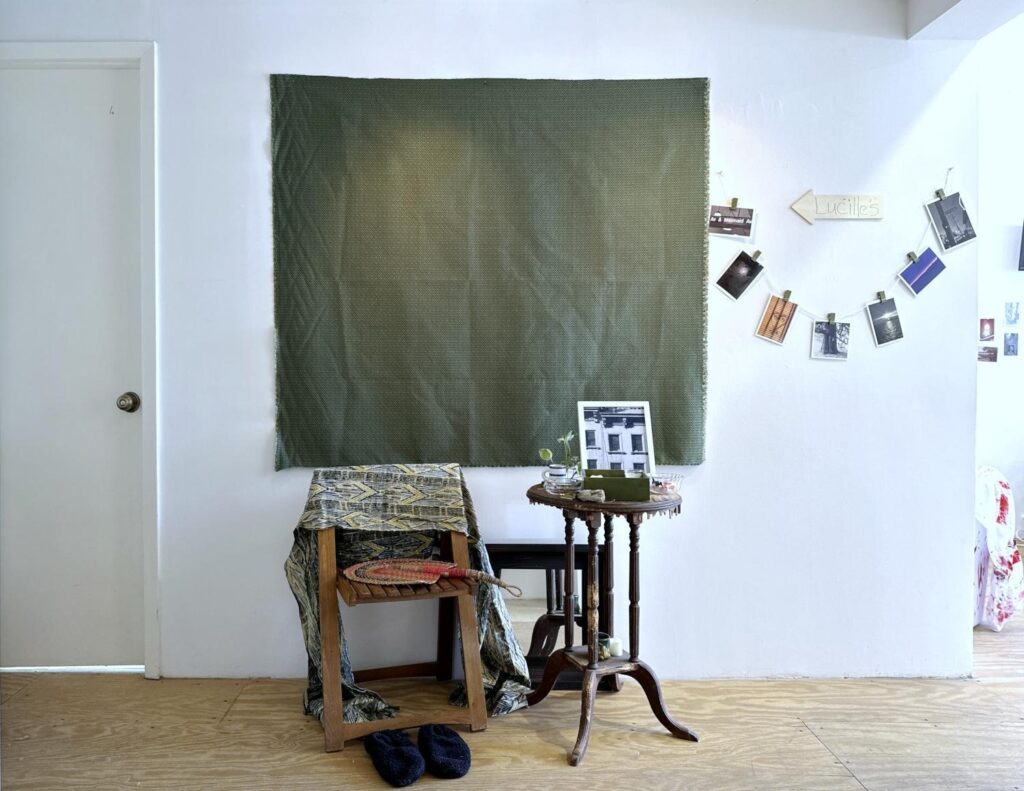
Lucille’s Porch.
Lucille has gone inside to check on her biscuits. The porch waits.
After the density of the previous rooms, this space opens like breath.
A sanctuary.
She sits.
Resting. Reflecting. Pausing.
Stillness reveals itself as labor too. The slow, ongoing work of being. The domestic not as servitude but as refuge. Time thickens. The nervous system recalibrates.
What looks like quiet is not retreat but maintenance — the daily, repetitive work of keeping oneself and one’s people alive.
Sitting still and yet still doing the hard work of the domestic.
Permission matters here. Greeting. Asking. Entering gently. The porch refuses spectacle. It insists on relationship.
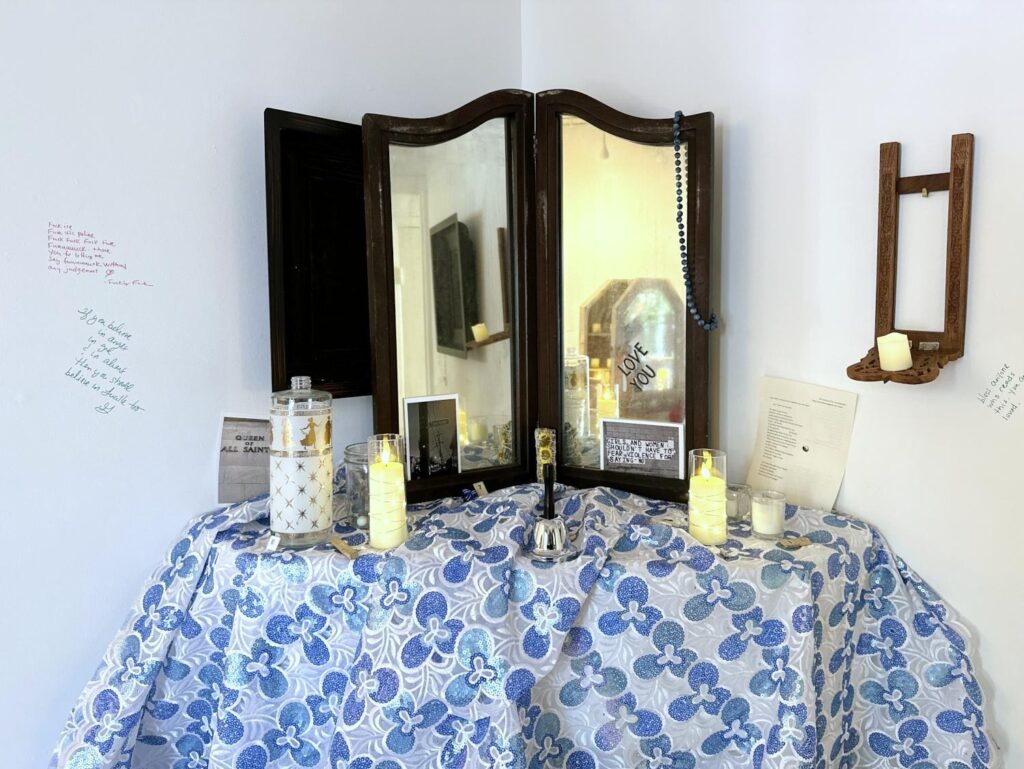
Beyond the porch lies Lucille’s Altar — The Black Woman’s Altar.
Inside, the space shifts from porch to sacred interior.
Notes. Mirrors. Offerings. Gratitude. Anger. Secrets.
Visitors leave burdens. Leave prayers. Leave thanks. Some stand. Remain. Reflect.
Mirror to mirror.
Self to self.
Person to person.
Community to community.
The altar operates as both spiritual and political infrastructure — a site where Black women are not extracted from, but honored. Not observed, but centered. It recalls the ethic of presence articulated by Audre Lorde — care as survival, rest as resistance, the personal as political. The gallery becomes less a site of display and more a site of collective tending.
Here, nothing is for sale. Nothing is demanded. What is asked is presence.
That asking is radical.
At the end, the path narrows into the Debrief & Think Space — a small, solitary room.
One at a time.
Write. Reflect. Address a future self. Leave a note behind.
Archive as offering.
The exhibition ends not with spectacle, but with interiority. Contemplation alone. Lost and found. Near and far.
The viewer becomes participant. Witness becomes contributor. The future becomes something handwritten.
Across these rooms, the logic of gentrification expands beyond real estate into the intimate. Bodies are commodified. Recipes are appropriated. Histories are laundered. Care is extracted. Memory is displaced. A calculated and deliberate assault on the foundations of neighborhoods and the sanctity of life in communities historically targeted for displacement.
Pieces of Yourself (There) renders that assault tactile and proximate. The gallery becomes a neighborhood of memory. The body becomes a site of contested development.
Yet the exhibition does not stop at critique. It proposes another way of being.
It builds sanctuary.
It builds rest.
It builds relation.
In this sense, the work participates in a broader lineage of institutional critique — not simply exposing the dominant, violent, and extractive logics of cultural space, but reworking them from within. Here, the archive is not behind glass. It is breathed, touched, and inhabited. The rearrangement happens through scent, time, domestic gesture, and proximity.
The question is no longer simply what art can challenge.
The question becomes how art can hold.
Pieces of Yourself (There) remains on view through February 28, 2026, with gallery hours held Saturdays from 12–3 pm. Programming extends the installation into collective practice — pop-up poetry nights, writing workshops, meditation and sound healing, artist talks, and readings — shifting the exhibition from object to gathering.
Less a museum.
More a commons.
Not a place to consume culture, but a place to breathe together.
Pieces of Yourself (There) at Stand4 Gallery, 414 78th St, Brooklyn, NY 11209.
On view through February 28, 2026, Saturdays from 12–3 pm.
Programming:
February 13, 7–9 pm — Reception & Celebration II, featuring Pop-Up Poetry at 8 pm and a writing workshop with Anastacia-Reneé
February 21, 5:30–6:30 pm — For Crying Out Loud: Writing with Audre Lorde, prompt-based workshop (RSVP required)
February 21, 7–9 pm — Reception & Celebration III, featuring Pop-Up Poetry at 8 pm
February 28, 3–5 pm — Self-Love Meditation & Vocal Sound Healing with Naa Akua (RSVP required)
February 28, 7–9:30 pm — Closing Celebration, artist talk with Anastacia-Reneé and Co-Curator Alverneq Lindsay, plus a reading from Here in the (Middle) of Nowhere
About the writer: John Ros (they, them) is a queer, non-binary, multiform conceptual installation artist working between Eastern Connecticut, New York City, and Boston, Massachusetts. They are currently a Ph.D. student at Tufts University and hold an MFA from Brooklyn College, CUNY, and a BFA from SUNY Binghamton. John’s mixed media conceptual installations focus on ritual as performance, space/place, light, and time. Their work has been exhibited internationally and is held in collections worldwide. They are the director of studioELL, a space for radical education in studio art practice, which they founded in London, England, in 2015. Johnjohn also teaches at the School of the Museum of Fine Arts at Tufts University in Boston, MA, and Naugatuck Valley Community College in Waterbury, CT.