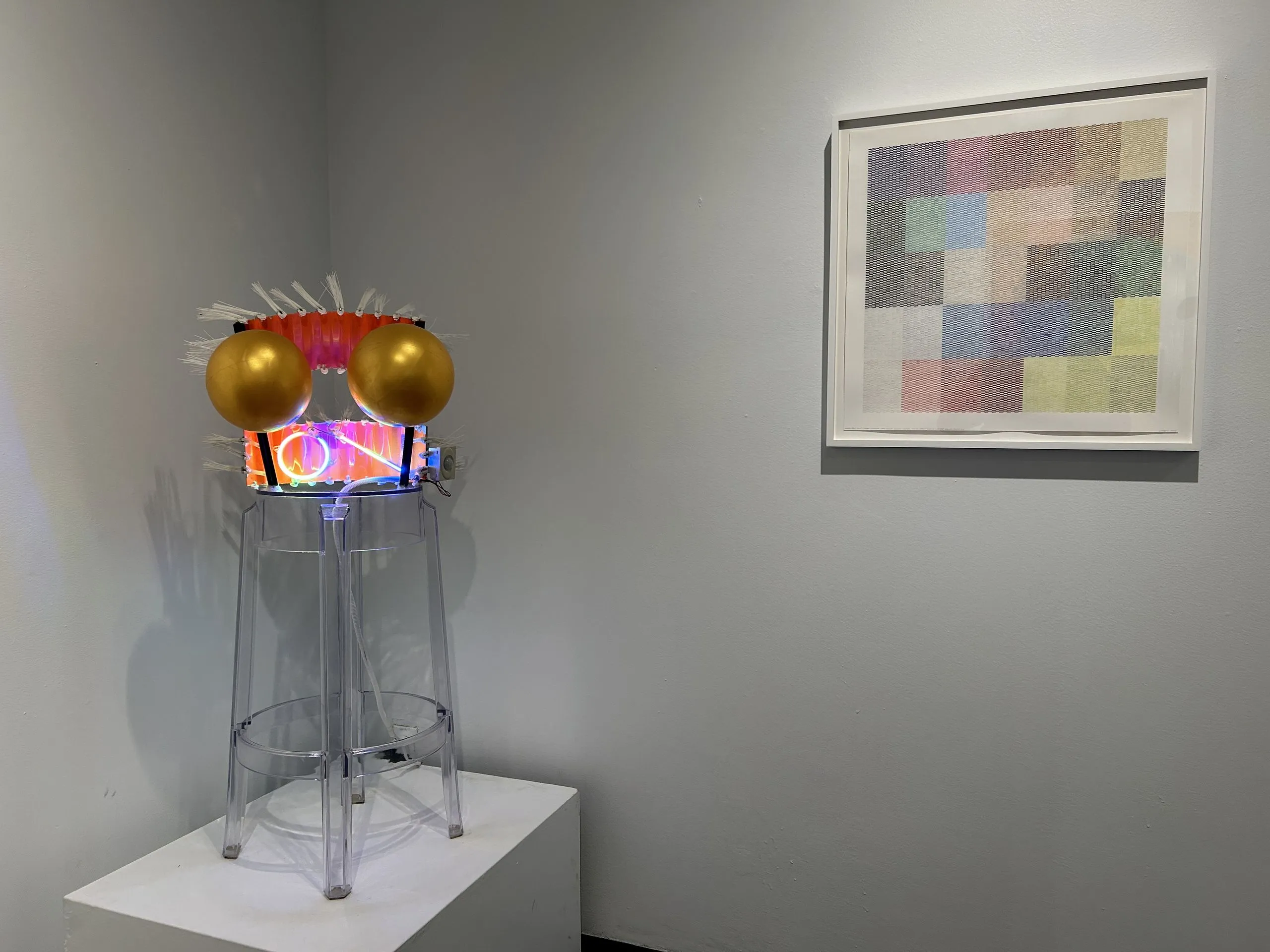
Entering the exhibition Candyland Americana, you are welcomed by a plethora of mediums, colors, and expressions. Full of humor, satire, joy, and everything in between, the exhibition brings together a curated group of artists who explore the parameters of American culture as an experiment in liberty and self-governance. They also highlight an aspect of the country that routinely flaunts its status as a deeply unserious place, where the American Dream varies from person to person. The ten artists in this exhibition draw from the fabric of American society: several examine commodification, others tackle politics, history, and identity, and many synthesize multiple themes. Like Betsy Ross stitching together the first American flag, the exhibition is a crazy quilt of folk art, pop culture, mass media, pioneer spirit, crazy-interesting alternative facts, and the sacred and profane sprinkled into the multiple conversations.
These artists create visual connections between elements that might not typically coexist or are unexpected in the settings they are placed in. This is especially true in the work titled Life, Death and Dinnertime in Horse World by Rachel Jackson, where horses have replaced humans in a household setting. A family is seen at a funeral while another horse in the adjoining room is enjoying a meal- breaking the usual conventions of the funeral, but living in the conventions of the Horse World. Perhaps because the horse is eating the meal too early, the other horses look on in shock as if the usual human rituals and etiquette of the funeral occasion are being bypassed.
This feeling of the unexpected and the unconventional is matched by experimentation with many materials across the works. The pieces utilize traditional mediums like oil paint, ceramic, and textile, alongside others that carry hot pads, neon lights, epoxy, glass beads, and textured paints or glitter embedded or placed upon the surfaces. Such as the piece by Yen Yen Chou titled Double Rainbow that is made of an icing-like piping of candy colors to form a puffy, playful landscape. Chou’s other works also make the canvas expand into playfully looping lines, where a two-dimensional space starts tiptoeing into three-dimensional.
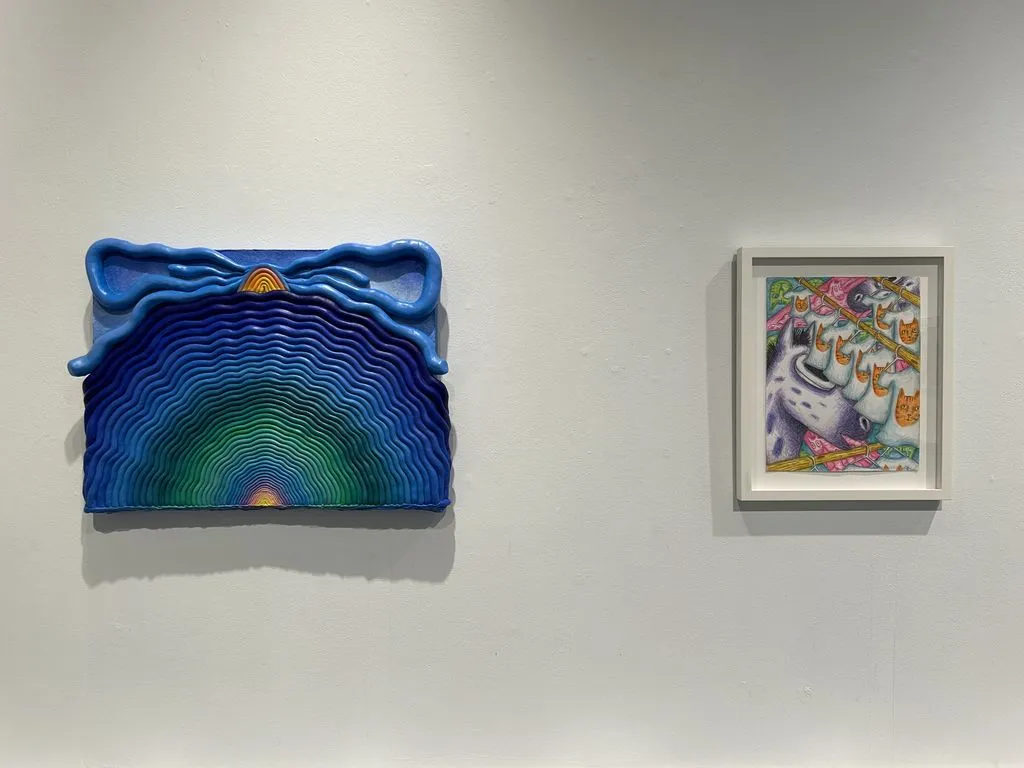
The show carries an air of experimentation and fearlessness. A wonderful sense of both play and discovery emanates from each piece. Some common themes across the exhibition are the metaphorical signs and structures of board games, icons of America, along with hints of consumerism and pop culture; countryside, suburbia, and cities that intertwine within the whole country. Suburban life is illustrated playfully through the works of Michael Gac Levin and Allison Reimus, who draw on domesticity and the nuclear family in bright, colorful compositions that evoke everyday scenes. A celebration of Americans, in a way.
For example, in Maypole High, Gac Levin places us at a picnic in a park, with fruits being assembled; from their perspective, we see the fruits enjoying each other’s company. The smaller fruits play behind them, symbolizing a picturesque family. The images of vacations, mealtime, and cross-country trip motifs are infused with overt craft and folksiness, full of charm and humor. We notice perhaps a darker edge, as some of the fruit appears to have been eaten, but we do not know by whom. This darker side that looms underneath the humor parallels reality quite well, as we often have to use humor and lightheartedness to get through the current state of the world
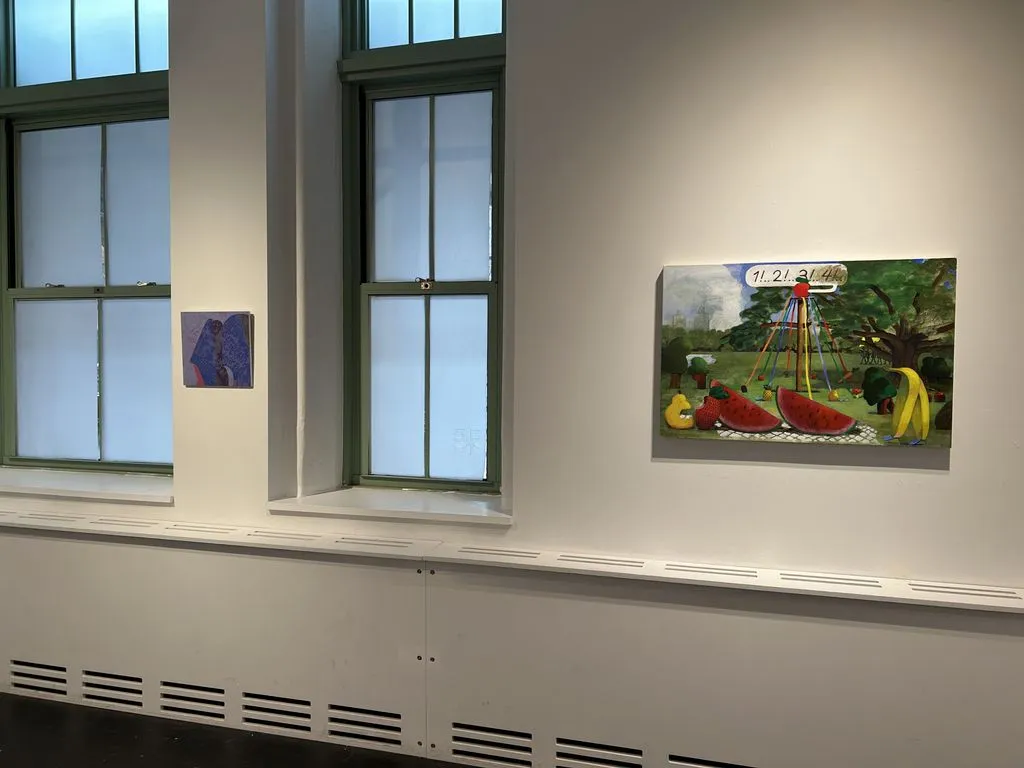
Stemming from this push and pull between humor and darkness, Alyssa Fanning ruminates on existence and nature’s resilience through candy-colored landscapes such as the piece titled Garden in July after Fragonard, which is filled with trees that multiply into the distance in a whimsical, pop-infused world of mounds and reflecting ponds. A greyscale piece of hers, Dancing Orbs by the Glass Pond, offers a darker setting. Fanning’s works pull together both micro and macro environments, serious and lighthearted, and even settings that jump from reality to fantasy. Other artists patch together symbols and spaces, such as Allison Reimus’s quilted painting At Peace Side Piece.
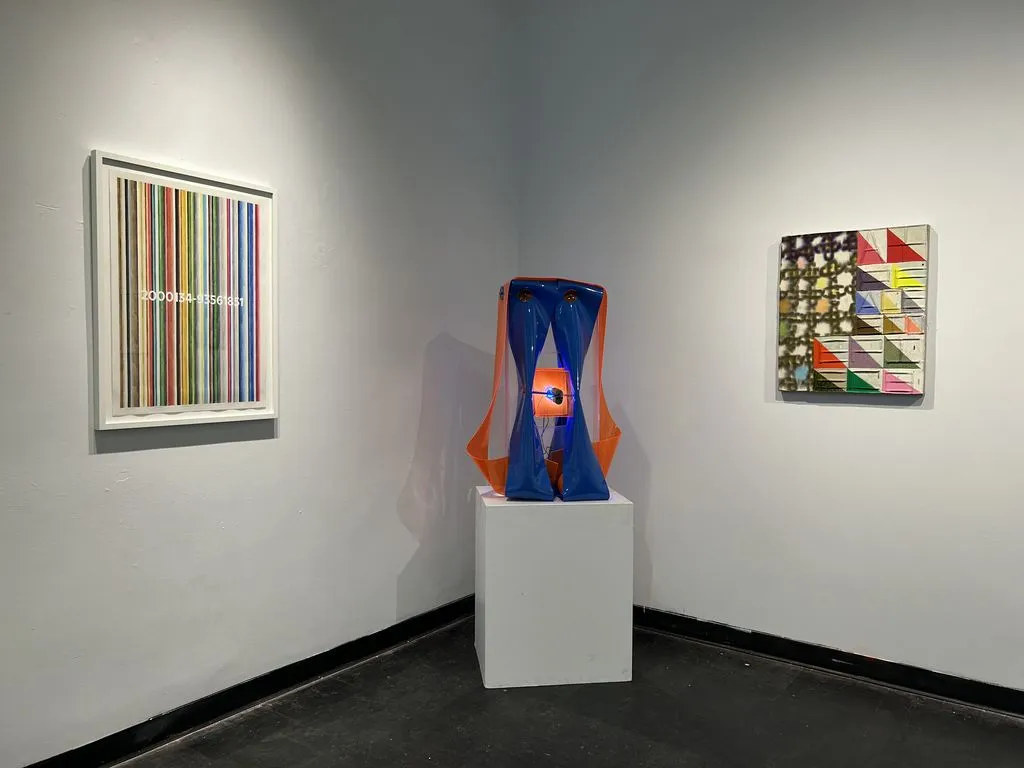
Symbolism is an important theme within Americana, and within this exhibition it is a foundation. This is especially true with Allison Reimus’ quilted work and Marcy Rosenblat’s large paintings, which offer brightly colored layers and patterns to explore. Side Line gives us the opportunity to discern what meaning we want to place onto the intricate surfaces that also appear to glow from the bottom layer. Through a mash-up of various glyphs and symbols, the art history and icons compete with today’s headlines, which are well-known representations of the present and ongoing “art history”.
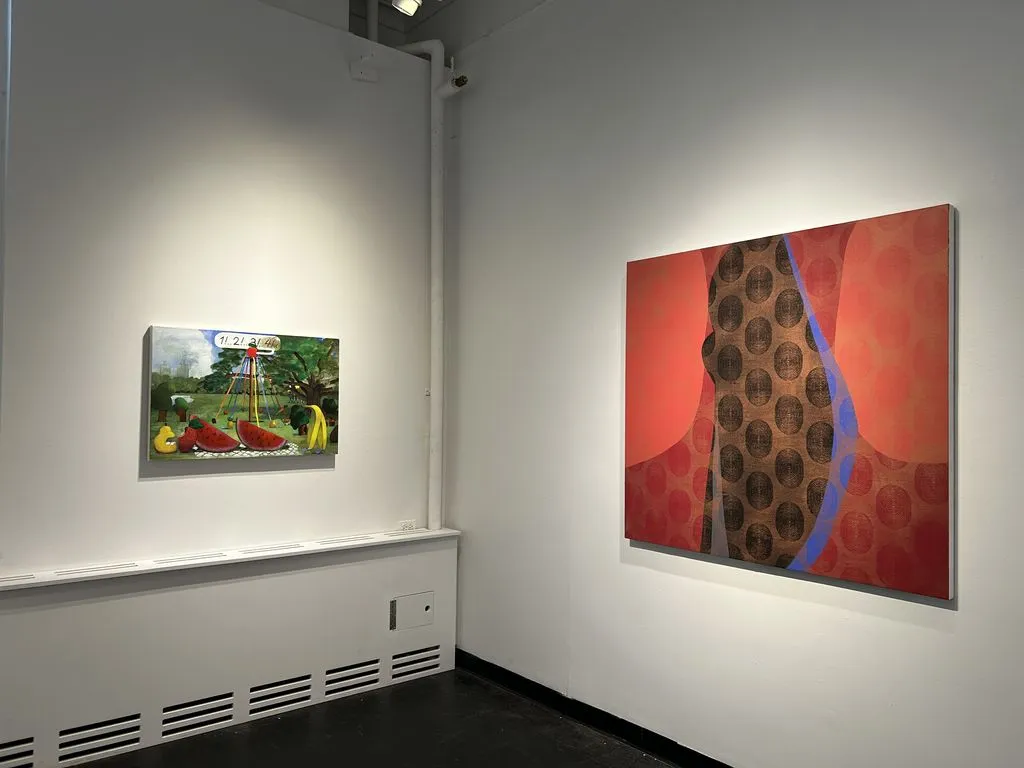
Set within the PS122 space, a former public school now home to a residency program on the floor above, this show is filled with multiple layers of meaning and timelessness. At first glance, the show is playful, bright, and full of experimentation and foils: such themes of chaos and control, or absurdity and despair, all the while humor, satire, familiar symbols, and brightened colors permeate the darkness to bring forth a little bit of light. Once you dive deeper into the details, the familiarity starts to feel edgier.
The humor becomes darker, and the pressures of the present day seem to seep in. It’s similar to the opening scene of David Lynch’s Blue Velvet, showing us a white picket fence surrounded by the most blood-red roses. Many people assume this suburbia is quaint and plain; however, hidden “underground” below is a darker world, one where humor still resides, but the light doesn’t often come in. As Dean Stockwell’s character continues to sing “Candy Colored Clown” as if it fades into the distance, we get to explore what these artists feel Americana has become. The journey of today isn’t completely perilous, but it certainly takes a lot of creativity, experimentation, and a good bit of humor to overcome- and this show shows us exactly that kind of courage and freedom within it.
Photos provided by Patrick Neal
PS122 Gallery, 150 1st Ave, New York, NY 10009 (Entrance on 9th Street between 1st & Avenue A). On view November 7th – 29th. Hours: Thursday -Saturday, 1 – 6 pm and by appointment, closed on Thanksgiving, contact Show&Tell at [email protected], www.showandtellarts.org / @ showandtellarts
Curators: Alyssa Fanning – @alyssaefanning Emma Fanning – @starryfaces
Patrick Neal – @nealpaintingnow
Featured Artists: Liz Ainslie– @liz.anslie
Richard Garrison – @richardgarrison_studio Jim Clark
Michael Gac Levin – @michael_gac_levin Allison Reimus
Marcy Rosenblat – @o.rosenblat Jane Fine – @janemfine
Yen Yen Chou – @yenyenflamongooo Rachel Jackson – @jacksonrschela
Emma Fanning, Alyssa Fanning, Patrick Neal
Make your tax-deductible donation today and help Art Spiel continue to thrive. DONATE
About the Writer: Taylor Bielecki lives in Gowanus, where her studio is, and works at Pratt Institute, where she earned her MFA. She also studied at Penn State, where she earned a BA in English and a BFA in Fine Arts. She finished as a finalist in the Kennedy Center’s VSA National Emerging Young Artist program for 2017, where she earned an award of Excellence. She has shown prints internationally in a print exchange in Australia and exhibitions in Dubai, India, and the Glasgow School of Art. She has also shown paintings internationally in Gallery 24N, PhilaMOCA’s juried exhibitions in Philadelphia, Pa., Perry Lawson Fine Art in Nyack, NY, BWAC in Red Hook, and IW Gallery in Brooklyn. Taylor works for Two Coats of Paint, TUSSLE Magazine, and has joined Art Spiel as a contributing writer. @Taylor.Bielecki
Featured Image: Candyland Americana, Installation view