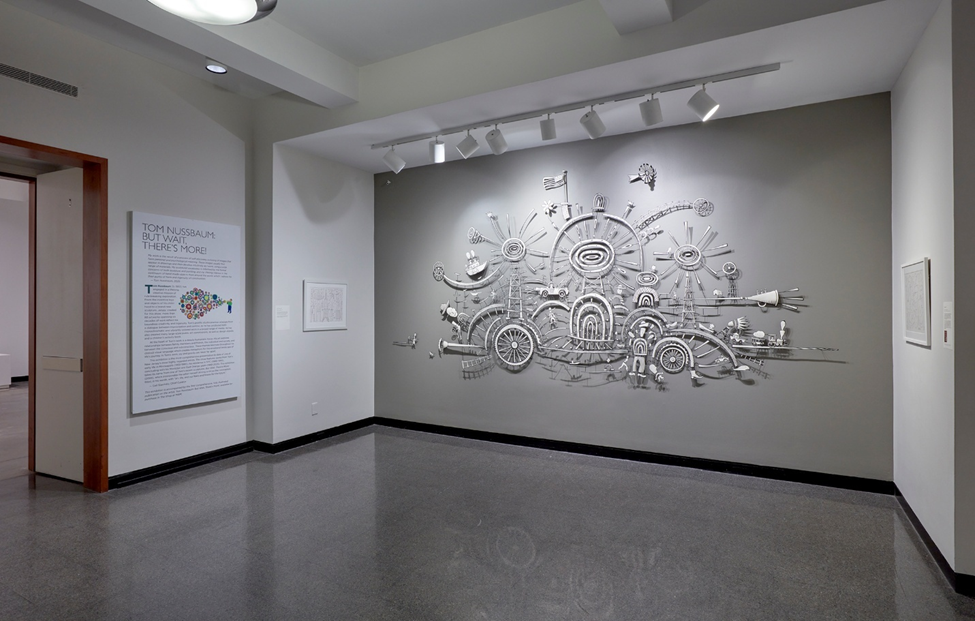
Tom Nussbaum: But Wait, There’s More!, Montclair Art Museum, installation view, photo courtesy of Jason Wyche
During her more than thirty years at the Montclair Art Museum, Dr. Gail Stavitsky, Chief Curator, has shaped the institution’s vision through exhibitions that deepen public understanding of art history while highlighting under-recognized artists. Her work extends beyond the galleries to publications that introduce new scholarly perspectives — including the recent catalogue accompanying Tom Nussbaum: But Wait, There’s More! In this interview, Dr. Stavitsky discusses her curatorial approach and the ideas guiding the Museum’s current exhibitions by Tom Nussbaum and Christine Romanell.
Zoe Beloff, Model for Drive-In Dreamland by Albert Grass (c. 1945), 2012, Wood, paint, plexiglass, found objects, 67 × 27 ⁵⁄₁₆ × 19 ³⁄₈ inches, 170 x 70 x 48.5 cm., photo courtesy the artist and Astor Weeks
When my mother was very old, I wanted to tell her what it was like to be in the art world. I said, “It is a little like joining the carnival.” While not affording her much comfort, I tried to convey the disorderly balancing act of the ridiculous and the transcendent, the illusory and the real, the sincere and the piratical. I wanted to suggest a midway of precarious lives, thrill rides, and a dubious game of chance.
Katie Hudnall: The Longest Distance between Two Points at the Museum for Art in Wood, installation shot, image courtesy of the gallery
I always love that Earth Day is situated right when the city is exploding with new flowers and life. These spring exhibitions show appreciation for our planet by working with found and repurposed materials, honoring their origins while building something new. At the Museum for Art in Wood, Katie Hudnall constructs delightful and “mechanically improbable” animals and curiosity cabinets of found objects in her show, The Longest Distance between Two Points. Drexel University’s Pearlstein Gallery showcases CONTEMPORARY RUIN future visions, a collection of work that meditates on the realities of decay in our cities, offering both a poetic reflection on our everyday lives and practical approaches toward building a more resilient future. South of the city, Lavett Ballard’s solo show at Rowan University, The People Who Could Fly, features striking mixed-media collages that recast stories of African-American folklore and history using layers of imagery.
Installation view of Marisol: A Retrospective at the Dallas Museum of Art. Courtesy of the Dallas Museum of Art
Marisol: A Retrospective at the Dallas Museum of Art (DMA) presents a comprehensive overview of the artist’s career, ranging from works she produced in art school in the fifties to her last works. In doing so, the exhibition centers and decenters Marisol’s status within the Pop art sphere, where she never fully situated herself. Her works are too brutal and too strange (in the best sense of the word) for Pop. She was undoubtedly exhibiting with Pop artists and part of their networks, as her films with Andy Warhol included in the exhibition attest. However, she was somewhere else, too. Her works contain the brute force of politics, history, culture, and climate change, and, in her practice, she engages with how those forces take place primarily upon the bodies of women. The body morphs and sometimes breaks under these forces.
Caída del peñón, 2024, Acrylic and polyurethane on wood, 15 67/100 × 20 7/25 in
In a recent conversation at Barro Gallery in New York, the Sue and Eugene Mercy assistant curator Ana Torok (MoMA, prints and drawings), likened Matías Duville’s artistic process to “throwing a lance” at the canvas. Indeed, Duville is not kind to his materials. His artistic oeuvre is replete with scratched metal and burned wood. For his paper works, charcoal is inflicted, not applied. When I had the good fortune to speak with the artist about his current exhibition at Barro Gallery, Vertices of Time, I asked what kinds of materials he had used for his paintings. One material stuck out as particularly harsh: “heat gun.”
Beverly Fishman, I dream of Sleep, 2020. Installation. Courtesy of the artist and Miles McEnery Gallery
This is part of a series of articles for the upcoming exhibition, The Greatest Emergency at the Circulo de Bellas Artes of Madrid. The exhibition is based on Santiago Zabala’s book, Why Only Art Can Save Us: Aesthetics and the Absence of Emergency. In this exhibition, ten contemporary artists rescue us into our greatest emergencies, that is, those we do not confront as we should. Each article in the series will contextualize these artists’ practices and explore how they are linked to Zabala’s aesthetic theory and the exhibition’s themes. The first article in this series highlights the work of American artist Beverly Fishman.
Unlike many art historians and art critics, philosophers do not look for works of art that are necessarily beautiful or interesting. Most of us—at least those educated in the continental tradition of Hegel, Nietzsche, and Arendt—instead look for works that disclose a theoretical stance. Martin Heidegger’s writing on Van Gogh’s shoes paintings, Arthur Danto on Andy Warhol’s Pop Art, and Jacques Rancière on Alfredo Jaar’s photographs are paradigmatic examples. This does not mean we do not care about the artist’s effort in creating such work; rather, we focus more on whether the work discloses an aesthetic notion, political idea, or anthropological concept that has meaning for society at large. Artists, for us, have the same ontological purpose as scientists or politicians. A great work of art, new scientific discovery, or progressive policy can change people’s relationship with reality. If these works, discoveries, and policies change this relationship, it is not necessarily because they are “better” than others but because they touch our existence to a greater degree.
John Cino, curator of Eccentric Abstraction at MoCA L.I, first encountered the works of Eva Hesse, Jackie Winsor, and Linda Benglis during his undergraduate years, an experience that deeply influenced him. He draws a throughline from their pioneering works to the current exhibition, “For each of the artists in the show—Stephanie Beck, Sky Kim, Christina Massey, and Sui Park—the process of making is a visible element of the work, and the forms they create are evocative with minimal narrative, Cino explains.
Frenchtown in the Delaware river Valley NJ is home to a fantastic new arts center with cutting edge programming: take note art lovers, ArtYard has come to town. ArtYard is a not for profit, state-of-the-art facility with two floors of exhibition space, sculpture lawn, black box theater with chic little bar and a tiny store. It is spacious, light, and beautiful: everything about this place is “feel good” and functional. It overlooks the river where bikers and hikers pass on the Delaware Raritan Canal State Park Trail an old railway track. The facade is a sophisticated blend of metal overhang elements (think Chelsea Meatpacking) and smart graphics with a large welcoming entrance. The pitch perfect brick building, designed by architects Ed Robinson and William Welch, was inspired by 19C industrial factories. The new center weaves itself perfectly into the historic fabric of Frenchtown NJ.
Noel Hennelly’s solo show at PeepSpace, wrapped up the first year of programming at this new venue in Tarrytown, NY, founded by artists Monica Carrier and Jane Kang Lawrence. The exhibit featured sculptures and wall pieces made of mixed materials, manufactured components, wood, metal, fabric, as well as painted and photographic elements. Hennelly’s work highlights the tension between the natural world and the urban environment, mediated by mythical language and devotional ideas as vectors for the way we perceive, process, and store memory and experience.


 at Griffiss International Sculpture Park , Rome, NY


