Join us Dec 19 for the Art Spiel 2025 Brooklyn fundraiser featuring 200+ artists’ works RSVP here

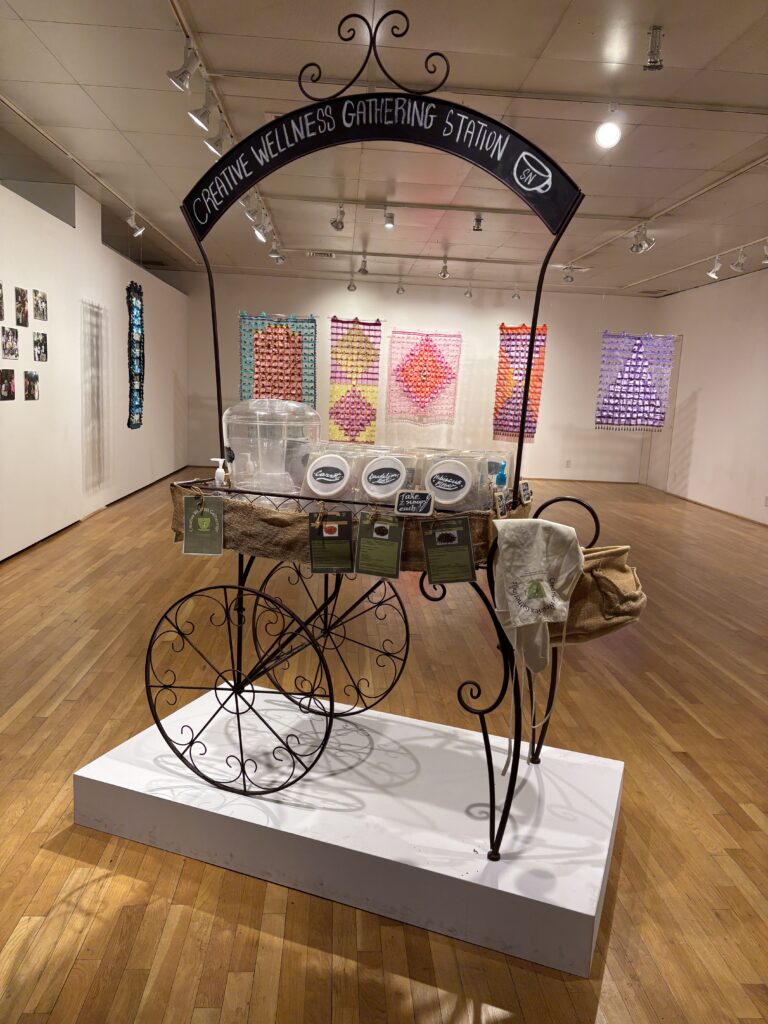
Shervone Neckles: Steeping Memory

Installation view

We do rely on art for healing purposes, but art that directly heals often requires a performative component. That is not to say that it delivers results, but there needs to be an interactive element in which the art appears to “give back” to the viewer.  I visited the shrine of St. Anthony in Padua, for me, it was mostly to see the Donatello altarpiece and the Antonio and Tullio Lombardo friezes, but it was impossible to ignore the numerous worshippers at the shrine, their foreheads resting against the saint’s sarcophagus, inserting small pieces of paper with requests for St. Anthony.  For nine years, Shervone Neckles has wheeled her healing cart — the Creative Wellness Gathering Station throughout the five boroughs and dispensed potions to fascinated and grateful onlookers. 

Continue reading “Shervone Neckles: Steeping Memory”
Getting to the End of the Line: Sol LeWitt and Phong Bui at Craig Starr

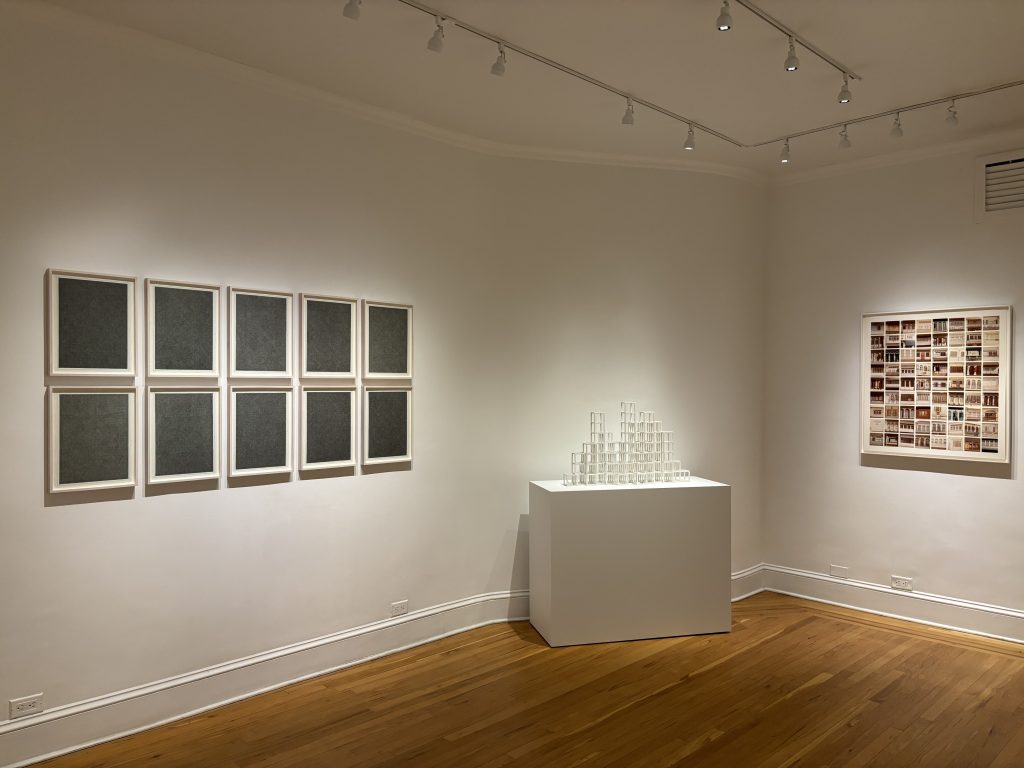
Installation View. Phong H. Bui and Sol LeWitt. Craig Starr Gallery (1)

For both Phong Bui and Sol LeWitt, the line is a democratizing gesture. The line as a line:  a mark; steering focus towards the method of an image’s creation rather than convincing the viewer of the realism of its ultimate subject.  And, at least for both of these artists, this means we begin to deal with units. With LeWitt, the unit is the geometric shape — a square, cube, or even a diagram-a nugget of information, often placed within another diagram, offering multiple levels in the narrative of the work’s process and arrangement.

Continue reading “Getting to the End of the Line: Sol LeWitt and Phong Bui at Craig Starr”

Into the woods – Immi C. Storrs at The Century Association

Immi Storrs, Trees with Man and Birds

Immi C. Storrs is obsessed with depth: she manipulates it, refusing to render it as-is. Instead, her adventures in depth-perception range from steeply sloping forests—her favorite subject— to thickly layered glass light-box dioramas, and to truncated and oddly meshed animal forms in bronze. While the animals merge together into multi-legged seemingly mythological beasts, or emerge pseudo-two dimensionally from a bronze cube, it’s less about the creatures themselves—horses, sheep, and oxen, but more of a slow-down lugubrious space in which forms melt together and time becomes unpredictable.

Continue reading “Into the woods – Immi C. Storrs at The Century Association”

Up: Janet Goldner’s Zigzags at FiveMyles

Janet Goldner, installation view at FiveMyles

A cavernous cubbyhole with a variety of enigmatic gunmetal stalagmites emerges from the relative monotony of the urban backdrop of St. John’s Place in Crown Heights.  Janet Goldner’s collection of sculptures, called Zigzags, populate FiveMyles’ exterior space, and while the viewer can enter this space through the gallery, the initial impression of jagged edges, pent-up energy, and the cold solidity of the welded metal objects makes one relieved there is a metal gate between us, the viewer, and them, the sculptures.

Continue reading “Up: Janet Goldner’s Zigzags at FiveMyles”

Accommodating the Object: Elizabeth Yamin and Bosiljka Raditsa at The Milton Resnick and Pat Passlof Foundation

Opinion
A room with art on the wall

Description automatically generated
Installation view. Photo courtesy of The Milton Resnick and Pat Passlof Foundation

The exhibition Accommodating the Object of paintings by Elizabeth Yamin and Bosiljka Raditsa is presented by The Milton Resnick and Pat Passlof Foundation in New York and was curated by William Corwin, who describes this exhibition as an intimate survey that offers the viewer an opportunity to compare the works of these two artists, who were active during the latter part of the twentieth century without attaining prominent careers.

Continue reading “Accommodating the Object: Elizabeth Yamin and Bosiljka Raditsa at The Milton Resnick and Pat Passlof Foundation”

William Corwin – Flattening of Time

Pazuzu, 2018, hydrocal. Photo courtesy the artist

Experiencing William Corwin’s sculptures may resemble opening a time capsule filled with mysterious objects made of familiar materials like sand, rope, clay and wood. By drawing on references ranging from architecture to archaeology, totems to teeth, Corwin’s sculptures resonate with archaic civilizations — removed yet urgently present. William Corwin shares with Art Spiel what brought him to sculpture, takes a look at some of his projects, and sheds some light on his curatorial and art writing practices.

Continue reading “William Corwin – Flattening of Time”