Curator Fran Beallor presents Water’s Voice and Our Fragile Moment at Hudson Guild in Chelsea, two exhibitions that focus on environmental damage—melting ice, polluted waters, deforestation, plastic waste, extreme weather, and species extinction. The goal is to make these vast and often abstract issues accessible to the wide public.
Water moves. It reflects, absorbs, distorts. It never repeats itself. River-Rising, a four-channel video installation by Ellen Kozak and Scott D. Miller, is built on these elements. Filmed along three river estuaries—the Garonne in France, the Bilbao Estuary, and the Hudson River—the work isolates the shifting surfaces of water.
Susan Hoffman Fishman, The Earth is Breaking, Beautifully VII: Dead Sea Sinkholes, acrylic, oil pigment stick, cyanotype and mixed media on paper, 51” x 51,” 2023
Susan Hoffman Fishman is an artist who has addressed climate change for many years both in context of her own work as an artist and in her writing on other artists’ work in that arena. Hoffman was first interviewed with Burning Worlds about four years ago and has recently been interviewed there again on her latest series of paintings depicting coastline sink holes and other landscapes impacted by climate change,
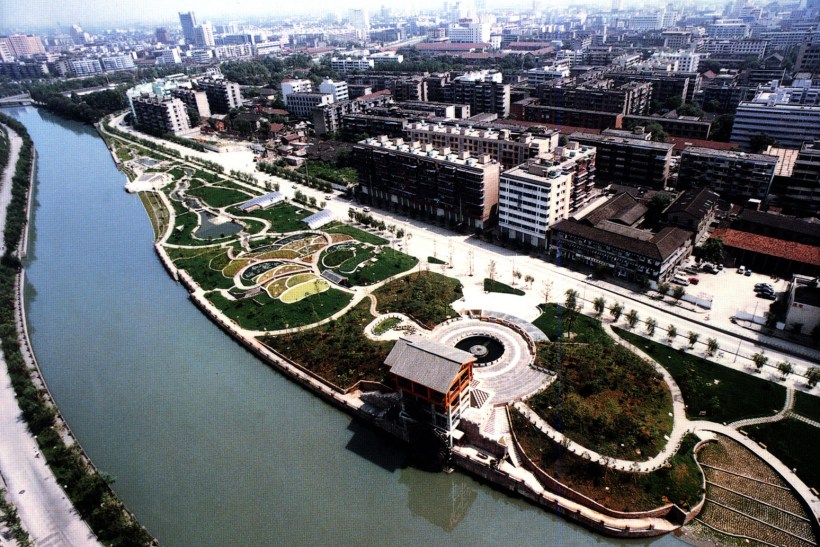
For the last 50+ years, eco-artist and environmental activist Betsy Damon has devoted herself to community building – the coming together of individuals to achieve a common purpose. Since the 1980s, after a decade of engaging the public through public performances in New York City, she has worked at the intersection of art and science, focusing on the topic of water and on creating models for communities in the United States and China to know and become stewards of their own water sources. The brief descriptions below, highlighting four of Damon’s many exhibitions, ecological and sustainable design projects, publications, and organizations are only a brief glimpse into her prolific and important body of work.
L to R: Judy McElhone (founder and director of Five Points Arts), Susan Hoffman Fishman, Krisanne Baker and Leslie Sobel (three of the four Water Women) at the Center in June, 2022, amongst components of their upcoming multi-media installation, Flood 2.0.
In July of 2021, artist Susan Hoffman Fishman began talking with Canadian photographer, Joan Sullivan about the eerie similarity between future apocalyptic flood predictions and the ancient story of Noah and the world’s first apocalyptic flood. The two artists have known each other through writing, both serving as core writers for the international blog, Artists and Climate Change. Both artists have been working on issues relating to water and the climate crisis and are equally interested in mythical stories related to water that resonate in contemporary culture. That led them to weekly conversations throughout 2021 when they decided to collaborate on a multi-media installation project, which they eventually called Flood 2.0.
49th Uranium Mining Legacy, Remembrance Day and Action Day, Navajo Nation, Grants Mining Belt, New Mexico, USA, July 12, 2018 .
Irish visual artist and researcher Anna Macleod has spent the last 15 years exploring the environmental, economic, spiritual, political, and scientific aspects of water through interdisciplinary collaborations, performance, public interventions, and socially engaged activism.
Águas do Futuro, detail, mokuhanga on washi scroll(handmade Japanese paper), installed in Bahia, Brazil, 2018
For Brooklyn-based printmaker Florence Neal, water has always been a dominant presence in her life. She grew up in Columbus, Georgia, near the Chattahoochee River, which straddles the southern half of the Alabama and Georgia borders. There she developed an appreciation for the Native American stories about the river as well as first-hand knowledge of the negative impact that the cotton and iron mills of the past and the pervasive industrial pollution had had on its health.
On May 13, 2020, in the middle of the global pandemic, the NYU Abu Dhabi Arts Center in the United Arab Emirates hosted a streaming event consisting of a four-and-a-half-hour filmed version of HOLOSCENES, a durational performance installation that was originally presented there live in November of 2016. The event also included a conversation with Lars Jan, artist, writer and project director, as well as members of his team. HOLOSCENES is comprised of performers going about common, every-day tasks while the aquarium in which they are confined fills and empties with water. Although conceived as a commentary on “states of drowning” – rising seas, melting glaciers, intensifying storms, floods, and their impact on daily life – the project takes on additional meaning as we struggle with our own physical and psychological confinements during the great global quarantine.
sTo Len, detail of FOAM (FutureOfAMaterial) installation. Gomitaku print, sumi ink on linen, 64” x 360,” 2020.
Since June of 2017, artists Jarrod Cluck, Gina R. Furnari, sTo Len, Leslie Sobel and Rachel Wojnar have been on an intense physical, emotional, spiritual, and art-making journey, which culminated with their MFA Thesis Exhibition, Confluence, on view at the Joseloff Gallery of the Hartford Art School, University of Hartford (Connecticut) from September 10-19, 2020. They are the third cohort to complete the Nomad Interdisciplinary MFA program. Founded by director Carol Padberg in 2015, the program uses an innovative field-based model and offers a curriculum that includes art, ecology, the study of place, indigenous knowledge systems, and technologies. Encompassing two hands-on residencies per year, the Nomad MFA provides courses in El Salvador; New York City; New Mexico; Mexico; Oakland, California; Miami; and Minneapolis.
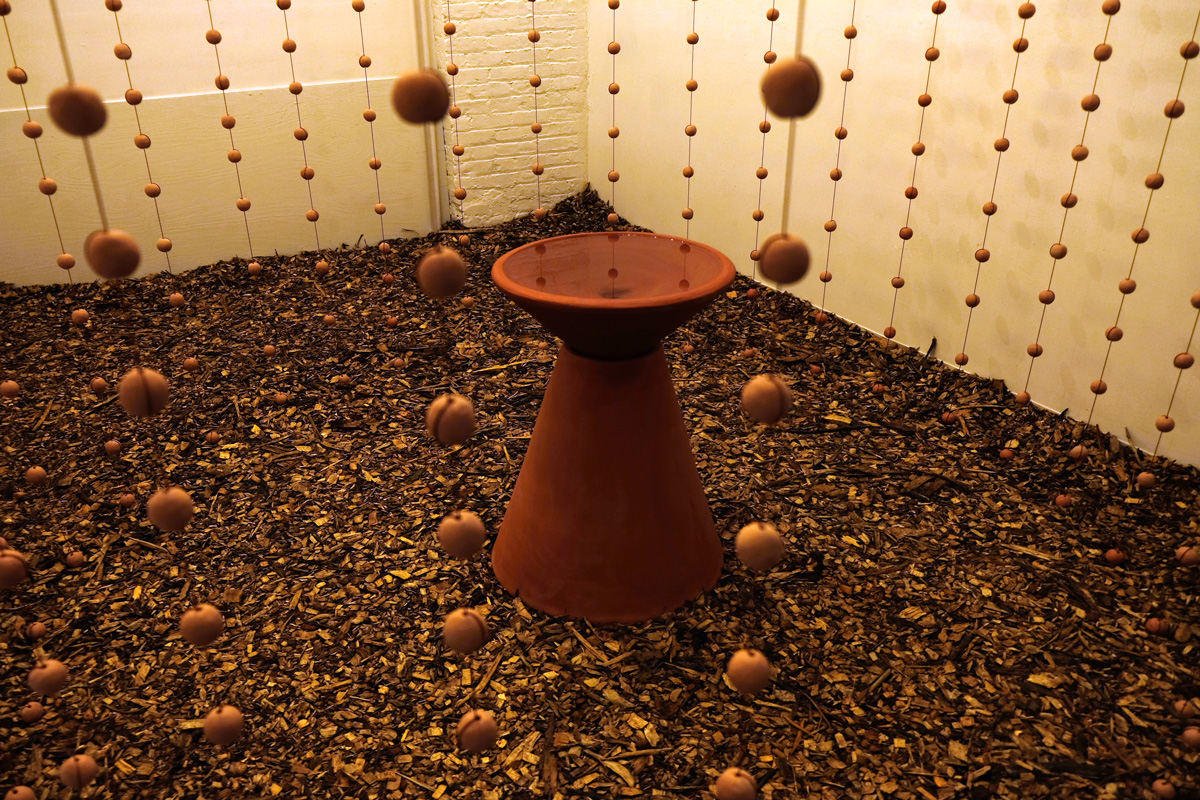
Installation view. “To Ripple with Water” at The Border Project Space, 2021. Image courtesy of the artist
In unstable and changing times, haunted by a pandemic and conflicts unfolding worldwide, the installation by artist Bel Falleiros creates an introspective space that allows us to pause and reflect on how we relate to ourselves and the environment. Presented at The Border Project Space and curated by Jamie Martinez, “To Ripple with Water” is an invitation to be present, to disconnect from the frantic times we live in, and reconnect to our bodies and to the earth, in a quietly performative experience.