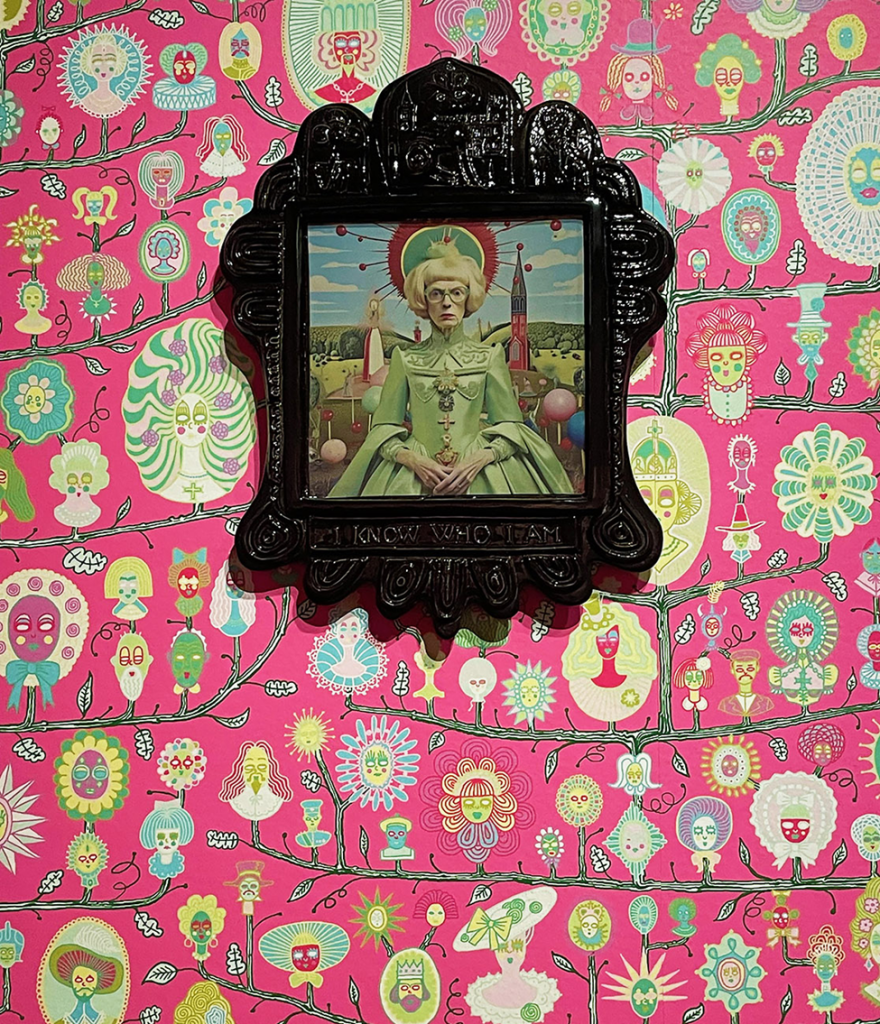
Delusions of Grandeur -Grayson Perry at the Wallace Collection

Totally Unique Thing. AI generated image, glazed ceramic. Installed on bespoke wallpaper, designed by Perry and produced by Liberty of London

The Wallace Collection, a storied historic mansion in London that houses an extraordinary, far-ranging collection of art and objects, invited the artist Grayson Perry to embed and create an exhibition that responds to their collections. Collected during the18th and 19th Centuries, the museum is dripping in Rococo, houses breathtaking Old Master paintings, amour, ceramics, medieval relics and sculpture. It would be, for a lesser artist, a daunting assignment.

Continue reading “Delusions of Grandeur -Grayson Perry at the Wallace Collection”
Reinventing the Grid: A Conversation with James Gold

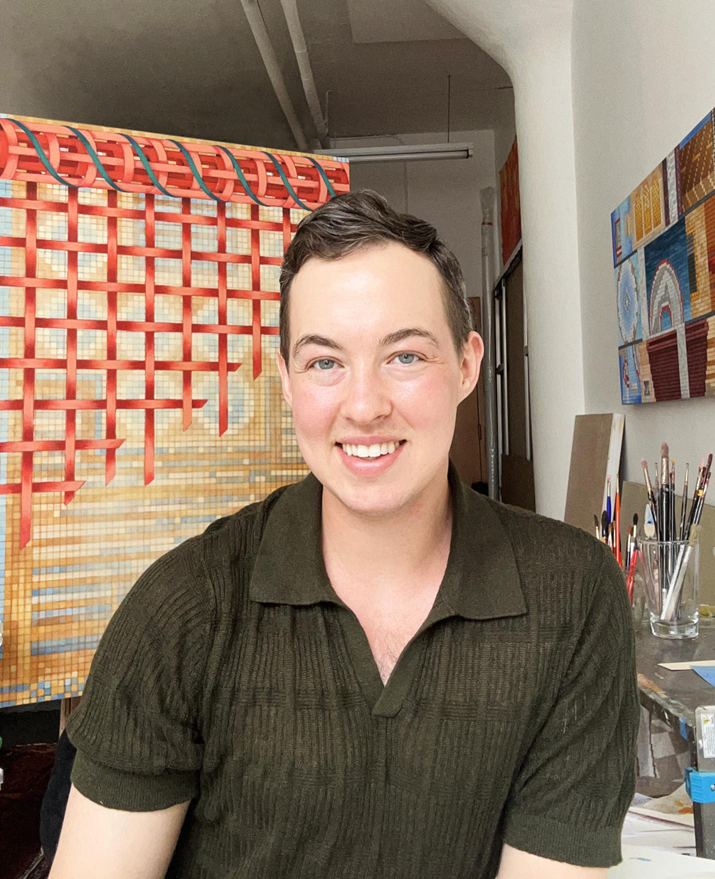
Portrait of the artist

The paintings in James Gold’s solo show, Infinite Scroll, act as intermediaries between past, present and future. These glimmering grids at Morgan Lehman gallery toggle between his deep reverence for history and his active aesthetic imagination. Talking with the painter about his wider practices in collaged artist books and archeological renderings revealed new means of perception and applications of art-making.

Continue reading “Reinventing the Grid: A Conversation with James Gold”

Pat Lay at New Jersey City University

photo story
A yellow and orange art piece on a white wall

AI-generated content may be incorrect.
Installation view of Pat Lay’s exhibition at the Lemmerman Gallery, NJCU

At first sight, Pat Lay’s vertical scrolls sit comfortably within the soaring Gothic-style Lemmerman Gallery at New Jersey City University. Their mosaic or tapestry-like forms, in glowing red, blue, and gold, echo the tall grided window panes and the elaborate ceiling. Yet once it becomes clear that these scrolls are entirely digital, the contrast generates a sense of fertile dualities.

Continue reading “Pat Lay at New Jersey City University”

Art Spiel Picks: Boston Exhibitions in September 2024

Highlights
Dali: Disruption and Devotion at the Museum of Fine Arts, Boston

September in Boston is all about “back-to-school,” and this year, the art scene offers its own rich set of lessons. Along with some beloved galleries closing, a number of outstanding exhibitions are on view around the city. At the Museum of Fine Arts, a small but captivating Dalí exhibition pairs his works with those of Velázquez, Goya, and El Greco. The Harvard Art Museums are unveiling an exhibition dedicated to German identity, exploring the country’s complex cultural narrative through a variety of artistic expressions. Beyond the museums, Boston’s galleries showcase an exciting range of shows, from many different artists exhibiting a wide range of work. Here’s a look at some of the standout shows happening now.

Continue reading “Art Spiel Picks: Boston Exhibitions in September 2024”

Womanhood 102: Lesley Bodzy and Katie Commodore Challenge Gender Norms

Installation view Womanhood 102 (with Lesley Bodzy’s Soft Embrace I, 2022. Acrylic. 69 x 43 x 11 inches, on the left and works by Katie Commodore in the middle and on the right). Courtesy of the curator.

A golden, shimmering drapery cascades from the wall—the skin-like surface of Soft Embrace is from Lesley Bodzy’s experimental work with acrylic paint. She uses the liquid pigment as a sculptural material, shaped into a malleable cloth, reminding of Lynda Benglis’s poured latex on the floor or Eva Hesse’s visceral and alluring sculptures. The sensuous object evokes a tactile experience, an imagination of how touching it might feel, through looking. Matter surprises, entering a threshold between fluid and solid, elasticity and delicacy. Jamaica Kincaid’s 1978 story Girl tells a mother-daughter dispute about how a girl should behave. “…on Sundays try to walk like a lady and not like the slut you are so bent on becoming…” The mother’s advice seems endless and castigating, instructing every aspect of daily living. Side-by-side, Bodzy’s curved drapery recalls ‘how girls should behave,’ as it seemingly hides things beneath and its smooth surface presents an image of flawless elegancy, concealing feelings in a muted position.

Continue reading “Womanhood 102: Lesley Bodzy and Katie Commodore Challenge Gender Norms”

Ophelia Arc: we’re just so glad you’re home at 81 Leonard Gallery

A close-up of a piece of art

Description automatically generated
Ophelia Arc

In her 2014 essay Grand Unified Theory of Female Pain, Leslie Jamison examines the literary phenomenon of women’s suffering being depicted in almost luxuriating detail, as much an object of fetishization by men as it is a subject of shame by women. Jamison recalls a boyfriend accusing her of being a “wound-dweller,” or fixating on her own afflictions to an unhealthy, self-centered degree, to which she initially reacts with umbrage. Ultimately, she reworks this pejorative into an argument that women’s tragedy, disease and self-harm should be viewed through an empathetic lens, that women should be inclined to give themselves the space to “dwell” on their wounds as a pathway to solidarity and recovery.

Continue reading “Ophelia Arc: we’re just so glad you’re home at 81 Leonard Gallery”

The Immigrant Artist Biennial, In Dialogue

Maya Hayuk and Kathie Halfin Discuss Ukrainian Heritage and Identity

Still from Kathie Halfin’s performance Body, Land, and Water at Enmeshed, Dreams of Water on October 6, 2023. Photographed by flaneurshan. studio. Courtesy of The Immigrant Artist Biennial.

Having forced nearly one-third of Ukrainians to flee their homes as of 2022, the Russo-Ukrainian War has been a potent reminder of the absolute necessity to uphold peace, justice, and international solidarity in times of humanitarian crisis. Both being part of The Immigrant Asrtist Biennial 2023, Maya Hayuk and Kathie Halfin are artists who are inspired and empowered by their shared Ukrainian identity and heritage. Hayuk’s processes involve “set and setting,” mapping, and traditional design techniques, which is echoed by Kathie Halfin’s performance and hand-woven tapestry shown at Enmeshed: Dreams of Water. Together with TIAB’s writer-in-residence Xuezhu Jenny Wang, they speak about how their art grows out of cultural and political convictions.

Continue reading “The Immigrant Artist Biennial, In Dialogue”

Myth Maker: Laleh Khorramian at SEPTEMBER Gallery

Installation view. Photo courtesy of Alon Koppol

Finally! What a joy to meander through a show that is not just a formulaic scaffolding rendered to execute a marketing plan rather than make art. Walking into the building that houses September Gallery’s new space in Kinderhook, NY, The first thing you see is not a wall or architectural ornamentation but a monumental scroll that immediately hints you might be here for a while. This colossal collage introduces Myth Maker, the second exhibition at September Gallery by Laleh Khorramian.

Continue reading “Myth Maker: Laleh Khorramian at SEPTEMBER Gallery”

Dianna Frid: pre-knowing / un-knowing and Lucas Simões: Luscofusco at PATRON in Chicago

Lucas Simões, Dormentes n.2, galvanized steel, nylon ties, rope and pulley, 94 ½” x 67” x 8”, 2023 (left), and Dianna Frid, Weave, canvas, paper, embroidery floss, silk, aluminum, fabric, paint, 78” x 60”, 2015 (right). Photos: Barbarita Polster.

In two side-by-side solo exhibitions by artists Lucas Simões and Dianna Frid, both currently on view at PATRON gallery, the artists appear to pursue possibilities of meaning via symbolic pluralism; however, each artist could stand to learn from the approach of the other. In Luscofusco, Lucas Simões employs the metaphoric notion of twilight, positioned as the moment when light “shifts from presence to absence,” to examine persistent symbols recurrent throughout architectural history and their subsequent phenomenological shifts within unstable temporal contexts. In pre-knowing / un-knowing, Dianna Frid abandons linguistic text in its nominal sense, instead returning in her embroidered canvases to repeating patterns that form a material foundation for legibility – the marks made by the plunging and reemerging of the needle echo the repeating geometric shapes and fragments of Roman characters, allowing pattern itself to suspend the direct relationship between symbol and text. For both artists however, adherence to a dualistic approach to symbol and material, whether limited to form in the work of Simões or “text” in that of Frid, forms an impediment, preventing either from approaching the multiplicitous possibility they seek.

Continue reading “Dianna Frid: pre-knowing / un-knowing and Lucas Simões: Luscofusco at PATRON in Chicago”