Simphiwe Mbunyuza’s ceramic sculptures are a powerful synthesis of ancestral traditions, personal history, and contemporary expression. His recent exhibition, UMTHONYAMA, at David Kordansky Gallery in New York (January 16 – February 22, 2025), presented a body of work that transforms the physical space of the gallery into one of spiritual reflection, cultural storytelling, and artistic innovation.
Elizabeth Insogna, Veil, 2024, Glazed ceramic, 15×15”
Large-scale, multi-piece sculptures standing balanced by their own weight accompany ceramic tablets colored cream and periwinkle, which hang along the walls of Anne Reid ‘72 Gallery, echoing in their sudden coalition the deeds of a goddess from centuries ago. Hekate is her name, and she is a Greek goddess associated with fire, witchcraft, and transformation. In our search for the spiritual, returning to the philosophies of ancient times lends fresh wisdom, lighting compelling paths forward.
Mapping the Invisible, the final show of the ’23-’24 season at the Flinn Gallery in Greenwich, Connecticut, showcases the work of Laura Battle, Jaq Belcher, and Amy Myers, each of whom contemplate and explore the mysteries of our existence through the lenses of science, math, and geometry. Co-curated by Francene Langford and Caren Winnall, the show runs till June 19, 2024. Langford elaborates on the curatorial process and highlights the work in this show.
Installation view, detail, photo courtesy of Etty Yaniv
Sharon Horvath’s paintings in Small Myriad, her current exhibition at Bookstein Projects, create a sense of an alluring universe where dazzling colors, interflowing shapes, and tactile surfaces merge, meander, and as a group form an enigmatic universe unified by a mysterious code. Horvath’s spiraling lines and patterned forms create ebbing and flowing movements echoing Theodor Schwenk’s anthroposophical approach to the unifying principle of all movement and form. In his book Sensitive Chaos: The Creation of Flowing Forms in Water and Air, Schwenk posits that water movements reveal fundamental, archetypal patterns in natural and human-made environments. This deeper order finds resonance in Horvath’s paintings, but simultaneously, her imagery and use of collage also lean toward the enigmatic, paradoxical, and absurd.
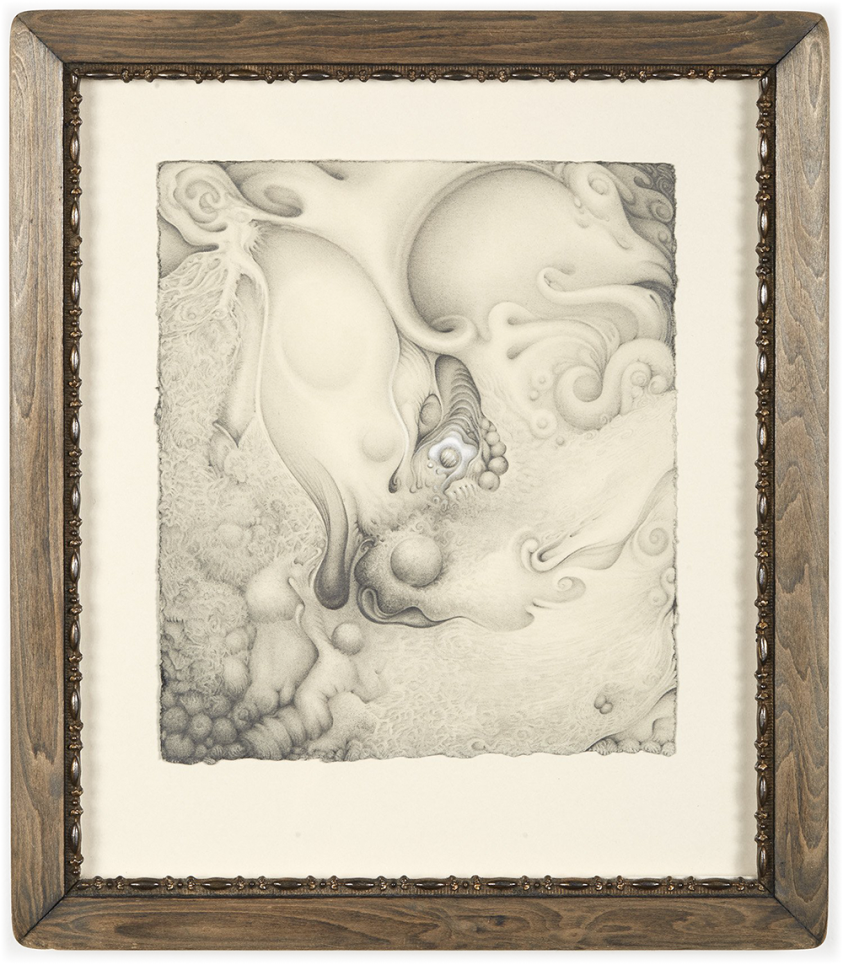
Welcoming Good Fortune 2012 graphite 24.8 x 28.6 x 0.8 in. Antique frame hand finished by artist
Frances Smokowski’s intricate drawings are currently receiving their NY debut at Cavin-Morris Gallery. EDGEWALKERS: Sacred and Profane presents a dynamic array of contemporary works. Randall Morris and Shari Cavin have gathered a diverse, international group of artists for this rather groundbreaking exhibition. Randall notes the select do not respond in any intentional way to mainstream movements or trends but for sidestepping, ignoring or living in honest unawareness of them. “These artists are not Outsiders,” he explains. “They are vitally connected to this world, whether spiritually, socially, or politically. We look for the place where labels become irrelevant and the work remains urgent, immediate and singular.”
Installation view, Ahavani Mullen: Across Centuries and the Earth, 2023. Dennos Museum Center, Traverse City, MI. Photo by the artist
In Ahavani Mullen’s studio, humble materials of pigment, metal, limestone, and resin transform into spiritual relics. She enters into the act of creation in silence from which paintings, sculptures, and installations evolve and become artifacts of human consciousness. In connecting the seen to the unseen, her objects hold memories of time, space, and sound, referencing the very turning of the earth with its movements and vibrations.
A central theme in my Crazy River project has been highlighting the emotional toll of the climate crisis by putting under a microscope, so to speak, my own feelings about not only the impacts of the crisis but the knowledge that humans’ actions are the cause. This series of three on-line essays, thought experiments if you like, expands that project to change the POV to non-human actors that are inextricably bound with the habitat in the Western Catskills: the black-legged or deer tick (Ixodes scapularis), the white-tail deer (Odocoileus virginianus), and Japanese knotweed (Reynoutria japonica). All three have seen their habitat change dramatically through climate change and human interventions. Using my imagination and research, I try to enter the umwelt of all three species, an impossible task, as Thomas Nagel pointed out in “What Is It LIke to Be a Bat,” for which artistic license may give us the best chance to accomplish. My intentions in doing so fall along three axes: theoretical, aesthetic, and spiritual, dimensions all essential to my own art practice. Part III looks at the umwelt–a term normally applied only to animals whose use in this instance I will explain later–of Japanese knotweed from the perspective of the Vajrayana, or Tantric Buddhism.
Installation view, David Syre: The Black Drawings, SARAHCROWN New York, 2023.
The creative process is inexplicable. It doesn’t require anything but what the creator needs or chooses to use, and there are no guidelines as to how it works: Tolstoy felt he had to write “each day without fail.” Robert Rauschenberg often had The Young and the Restless on television at his studio. Virginia Woolf used to walk miles and miles. There is no telling what will ignite the process, but like a flash of lightning or fireworks in the night sky, it contains such a force that with the right conditions, generates sublime beauty. American outsider artist David Syre found this force when he was only a child in his Pacific Northwestern family home: The intuitive act of pushing crayons on paper on the floor of his grandmother’s kitchen remained in the heart of his practice. Syre’s art evolved and transformed in time, but the pastels remained––in the end, it turned into a persistent, continuing series of over 4500 pastel drawings on black paper. 40 of these drawings are now hanging on the walls of SARAHCROWN New York, a young contemporary gallery in Tribeca, and at the gallery’s booth at the Outsider Art Fair, gathered for two concurrent solo exhibitions titled David Syre: The Black Drawings.
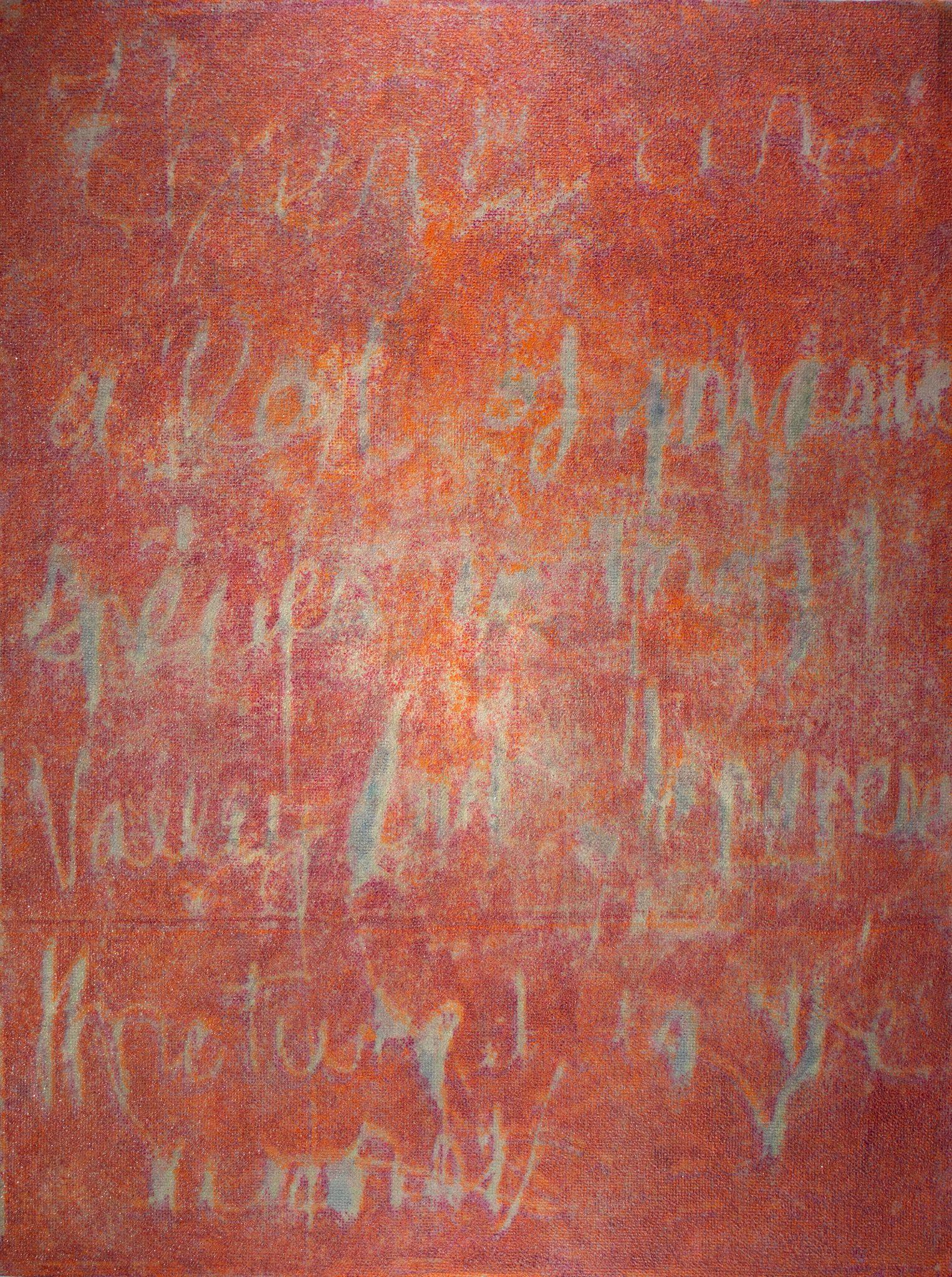
Reincarnation Des Morts 110 x 111 inchex. Beads, sequins, tassels on fabric. 2022.
Fort Gansevoort Gallery in New York’s Meatpacking District has long been one of my favorite galleries. Housed in an old three-story building, they have been presenting some of the freshest and most original shows in the city. The current exhibition, Myrlande Constant: Drapo is one of their best. Constant is a Haitian artist who works in textiles, taking a traditional form called “drapo” and rocketing it into the realm of contemporary art. Drapo is based on a 19th century embroidery technique developed in France, called tambour. Fabric is stretched tautly over a wooden frame and embroidery, using sequins and beads done from the reverse side.
A Conversation Between Christine Sullivan and Marianne Gagnier
Christine Sullivan, The Place Between, 44 x 32” oil/linen
This conversational exchange between artists Christine Sullivan and Marianne Gagnier was catalyzed by artist and writer Paul D’Agostino. He encouraged them to engage in dialogue with one another upon noting that they had both produced new bodies of work, right around the same time, featuring bird imagery. Taking this as impetus for a fertile discussion, Marianne and Christine decided to interview one another regarding themes of journeys and migration, and they discovered a number of surprising points of connection in their lives.