With only a few days left before it closes on October 4, Extreme Whether Show at Icebox4 offers a gathering of 21 artists responding to the turbulence of the present. Curated by Tom Fitzgibbon, the exhibition unfolds less as a single argument than as a shifting field of voices, unsettled, layered, and in dialogue.
OBSESSED, the group exhibition Shelby Nelson Ward curated at Zepster in Bushwick, Brooklyn, is inspired by Mariah Carey’s hit song Obsessed and the developmental impact of social media on the millennial generation. This exhibition explores how contemporary culture influences our understanding of self-worth and authenticity. Devon Gordon, the gallery founder gives us an insight into the venue and the current show, which runs through November 17th, 2024.
All persons to whom license certificates have been issued shall not lend or allow any other person to have, hold or display such certificate; and any person so parting with a license certificate or displaying the same without authority shall be guilty of a misdemeanor Image courtesy the Artist and Moskowitz Bayse
Julia Weist’s new exhibition Private Eye, currently on view at Moskowitz Bayse in LA, blends artistic practice with journalistic research to investigate how big data operates in America. In 2021, companies in the United States spent over $110 billion on big data. Weist’s work taps directly into this massive industry, which buys and sells our personal information without consent.
Throughout her career in the arts, Paddy Johnson, a writer and now founder of VVrkshop, an organization that offers professional development services for mid-career artists, has observed a consistent, disheartening reality: incredibly talented artists creating work for audiences of virtually no one. As she puts it, “It felt crushing that there wasn’t enough prose in the world to bring these artists more attention.” This frustration reached its peak with Impractical Spaces, a collaborative national project, and anthology designed to document defunct and active artist-run projects across the United States. The ambition was substantial: engage fifty cities in fifty states and compile the results into a book charting the national significance of the artist-run scene.
On paper, the project fulfilled Johnson’s vision. “It brought people together, gave exposure to unsung artist heroes, and historicized events I believed needed historicizing,” she recalls.
The reality was far less fulfilling. Outside of the participants, very few people seemed interested in reading the books, and the project lacked a funding model that would make it sustainable. Yet, recognizing the project’s shortcomings sparked a new idea. Johnson realized that connecting people on a larger scale—across states, across disciplines—was not just necessary but possible. This led to the creation of membership for mid-career artists, Netvvrk.
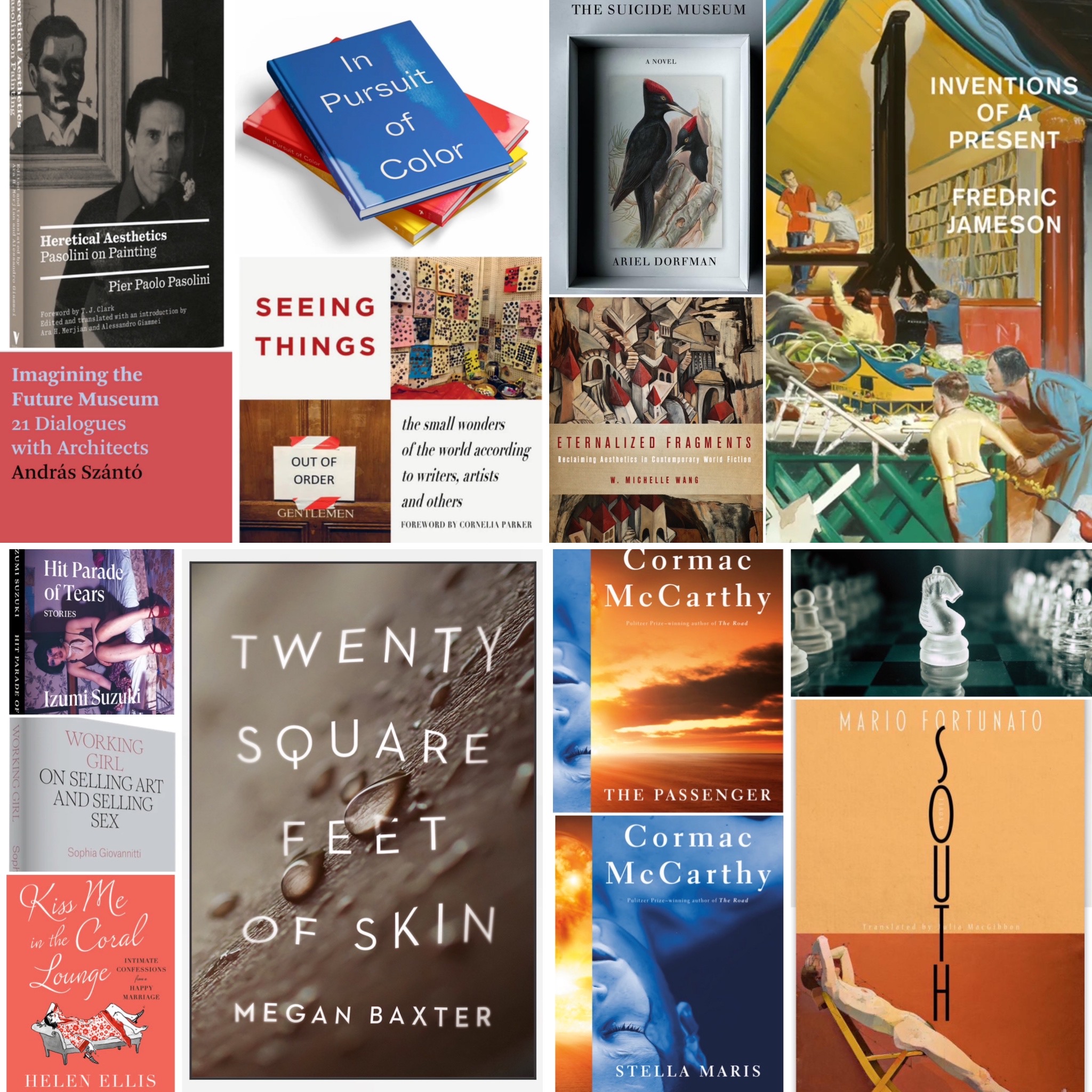
I didn’t have a mandate to compile anything along the lines of a ‘Best Books of the Year’ list, so I didn’t. There are plenty of those out there already anyway. Some even feature hundreds of titles. Hundreds! The restraint is impressive.
Nevertheless, I’d be remiss if I didn’t spread the word a bit about some books I really did relish reading this year, so what follows is a short list of standout titles and a few words about each. Limiting my picks to 12 – plus a couple brief extras I couldn’t resist folding into the mix – seemed logical enough, and they appear here in no particular order. My selections run a gamut and include fiction, nonfiction, essays, critical theory, humor, architecture, art, material history, and a charmingly assembled byproduct of social media. Additionally, several of the titles are books in translation, and ‘excellent syllabus material’ for various types of courses, especially interdisciplinary ones, would be a viable subcategory for nearly everything included here.
Installation view, Performance Anxiety, on view at the Allegheny Art Galleries, 2021. Featuring works by Eric D. Charlton, Taha Heydari, Wednesday Kim. Image courtesy of the Allegheny Art Galleries.
The three person show Performance Anxiety at the Allegheny Art Galleries in PA features videos, paintings, and sculptures by Eric D. Charlton, Taha Heydari, and Wednesday Kim, who all respond in their work to the intense digital terrains most of us inhabit, exploring how the intrapersonal and interpersonal elements interplay— how self-image is being manifested and how does it affect communication with others in an ever-shifting social media landscape? Paula Burleigh, the curator of the show and the gallery director, elaborates on the premise of the exhibition, the artists’ artwork, and her curatorial process.
In Dialogue with Naomi Lev, Rebecca Pristoop, and Sarah Crown
Left to right, Noa Charuvi, Aimee Burg, Gabriela Salazar, installation view at Naomi Lev’s home (also in the picture: Dov Talpaz, Yahm, and Naomi Lev, as part of Lev’s personal collection).
The Exhibition Private View is a bit like an artist’s game of telephone. Three curators: Sarah Crown, Naomi Lev, Rebecca Pristoop, coordinated the movement of works by seven artists (Aimée Burg, Noa Charuvi, Tamar Ettun, Julia Goldman, KB Jones, Dana Levy, Gabriela Salazar) from home to home of each of the artists. In each new space the works were rehung, re-organized, and displayed in a new environment, often with the addition of the host’s collection of art. I interviewed the curators to find out how they planned and executed this show and how it was recorded and disseminated. In a way this exhibition reversed the traditional structure of personal and private: instead of the public being able to see artworks in a whitebox gallery or museum, which has been made impossible because of the pandemic, we became spectators on an artists private space—we couldn’t be there in person, but via Instagram we were shown more than we usually get to see. These notions of intimacy, personal expression, and a safe space in times of turmoil were central to the exhibition Private View.
During the Coronavirus pandemic, Art Spiel is reaching out to artists to learn how they are coping
“We’re Going To Have To Read The Eyes A Lot Better”, 2020, oil on wood, 18×24 inches. photo: courtesy of the artist
For the past six years Laura Karetzky’s practice has examined the way technology and virtual communication is able to sustain us in various states of perspective, as it confounds our idea of autonomy and community. Toggling between painting, sculpture and video-installation, she has exhibited this work in galleries including The Lodge (NYC), Marcia Wood (Atlanta), Lehman College (Bronx), SUNY (Old Westbury) and most recently in solo shows this winter at Lora Schlesinger Gallery (Los Angeles) and Elizabeth Houston Gallery (NYC). Her current endeavor has been the subject of feature interviews and reviews in ArtCritical, ArtSpiel, ArtNowLA and Anti-Heroin Chic. Laura Karetzky is currently participating in Dumbo Open Studios Virtual 2020, July 1-31, 2020.
Hema Bharadwwaj and Eileen Ferara, USPS Art Project Collaboration
When the lockdown began in mid-late March in New York City, artist Christina Massey felt it was too soon for her to address the pandemic in her own artwork. While desperately trying to process the disorienting news shifting by the hour, she was noticing an uptick in posts calling for people to save the Postal Service by buying stamps. The idea for the USPS Art Project came to her with immediate clarity. An artist starts making an artwork and mails it to a partner to complete and vice versa.