Curatorial visions at Montclair Art Museum

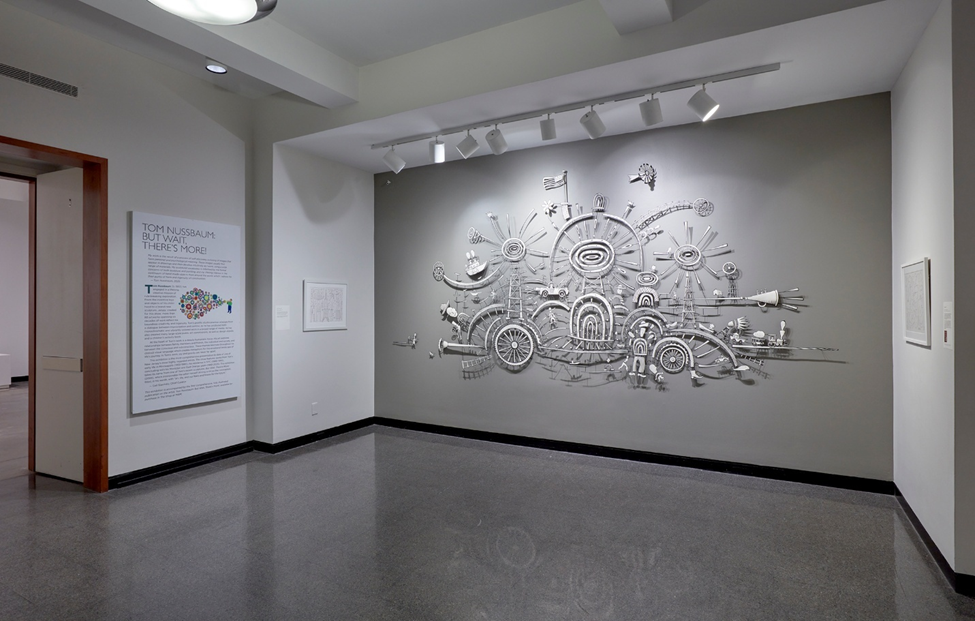
Tom Nussbaum: But Wait, There’s More!, Montclair Art Museum, installation view, photo courtesy of Jason Wyche

During her more than thirty years at the Montclair Art Museum, Dr. Gail Stavitsky, Chief Curator, has shaped the institution’s vision through exhibitions that deepen public understanding of art history while highlighting under-recognized artists. Her work extends beyond the galleries to publications that introduce new scholarly perspectives — including the recent catalogue accompanying Tom Nussbaum: But Wait, There’s More! In this interview, Dr. Stavitsky discusses her curatorial approach and the ideas guiding the Museum’s current exhibitions by Tom Nussbaum and Christine Romanell.

Continue reading “Curatorial visions at Montclair Art Museum”

Why Black Art Is Rarely Just Abstract

Algernon Miller’s work bends space, time, and expectations, redefining what abstraction means when history isn’t optional

Algernon Miller Afrofuturism and Beyond, Installation view, courtesy of Ethan Cohen Gallery

I met Algernon Miller the way I tend to meet people in the art world: by asking too many earnest questions at a panel. That day, at a Mel Edwards talk at Hauser & Wirth, I caught a smile from the soft-spoken man next to me. We chatted and clicked. Two native New Yorkers—he from Harlem, I from the Lower East Side—drawn together by chance, we followed each other with no particular reason, and what felt like nothing quietly became something.

Continue reading “Why Black Art Is Rarely Just Abstract”

Suzanne Wright: The Alchemy of Equals at Tappeto Volante

Suzanne Wright, Supreme (with arsenic), 2023, Vinyl Flashe paint, Fleur paint and Acrylic, Linen mounted wood panel, 36 × 36, photo courtesy of Tappeto Volante

Alchemy is an age-old mode of science that seeks to transform matter, turning it into something else, something new. It remains a relevant practice, prevailing as the medieval genesis of chemistry, which only went on to titillatingly promise a universal elixir to the denizens of the Renaissance. For centuries, alchemists lacked the scientific language to describe what they were observing in their experiments, as a result they projected their own subjectivity and personal processes onto external chemical operations – in this vein, the exhibition’s work at hand achieves its success. Through alchemy, lead is turned into gold, and as an 18th-century practitioner wrote with alchemists in mind: “Wherever thou art, all is brought to perfection; may the realm of thy Knowledge become subject unto thee. May our will in all our work be only thee, self-moving Power of Light! And as in the whole of Nature thou accomplishest all things, so accomplish all things in our work.”[1] Here, a connection to the material world reigns supreme.

Continue reading “Suzanne Wright: The Alchemy of Equals at Tappeto Volante”

Mapping the Invisible at the Flinn Gallery

In Dialogue
Patrick Vingo: Mapping the Invisible gallery view 1.jpeg
Flinn Gallery Installation Photo by Patrick Vingo

Mapping the Invisible, the final show of the ’23-’24 season at the Flinn Gallery in Greenwich, Connecticut, showcases the work of Laura Battle, Jaq Belcher, and Amy Myers, each of whom contemplate and explore the mysteries of our existence through the lenses of science, math, and geometry. Co-curated by Francene Langford and Caren Winnall, the show runs till June 19, 2024. Langford elaborates on the curatorial process and highlights the work in this show.

Continue reading “Mapping the Invisible at the Flinn Gallery”

Eccentric Abstraction at MoCA L.I.

Photo story
A group of art pieces in a room

Description automatically generated
Installation view

John Cino, curator of Eccentric Abstraction at MoCA L.I, first encountered the works of Eva Hesse, Jackie Winsor, and Linda Benglis during his undergraduate years, an experience that deeply influenced him. He draws a throughline from their pioneering works to the current exhibition, “For each of the artists in the show—Stephanie Beck, Sky Kim, Christina Massey, and Sui Park—the process of making is a visible element of the work, and the forms they create are evocative with minimal narrative, Cino explains.

Continue reading “Eccentric Abstraction at MoCA L.I.”

Small Myriad: Sharon Horvath at Bookstein Projects

Installation view, detail, photo courtesy of Etty Yaniv

Sharon Horvath’s paintings in Small Myriad, her current exhibition at Bookstein Projects, create a sense of an alluring universe where dazzling colors, interflowing shapes, and tactile surfaces merge, meander, and as a group form an enigmatic universe unified by a mysterious code. Horvath’s spiraling lines and patterned forms create ebbing and flowing movements echoing Theodor Schwenk’s anthroposophical approach to the unifying principle of all movement and form. In his book Sensitive Chaos: The Creation of Flowing Forms in Water and Air, Schwenk posits that water movements reveal fundamental, archetypal patterns in natural and human-made environments. This deeper order finds resonance in Horvath’s paintings, but simultaneously, her imagery and use of collage also lean toward the enigmatic, paradoxical, and absurd.

Continue reading “Small Myriad: Sharon Horvath at Bookstein Projects”

Size Matters

Chris Ketchie, “WEST”1000 Paintings of Then, 2015-2017 Ink and Acrylic on Wood, 130” x 275” x 2.5”, photo courtesy of the artist

In Size Matters artist and curator William Norton brings together seventeen visual artists and four performance artists from Japan, China, the USA, and the UAE, for whom the notion of scale is central.  The curator questions in what ways does scale impact form? How does it affect meaning? And more specifically, how is our perception of scale affected by cultural differences between Asian and Western cultures? Continue reading “Size Matters”