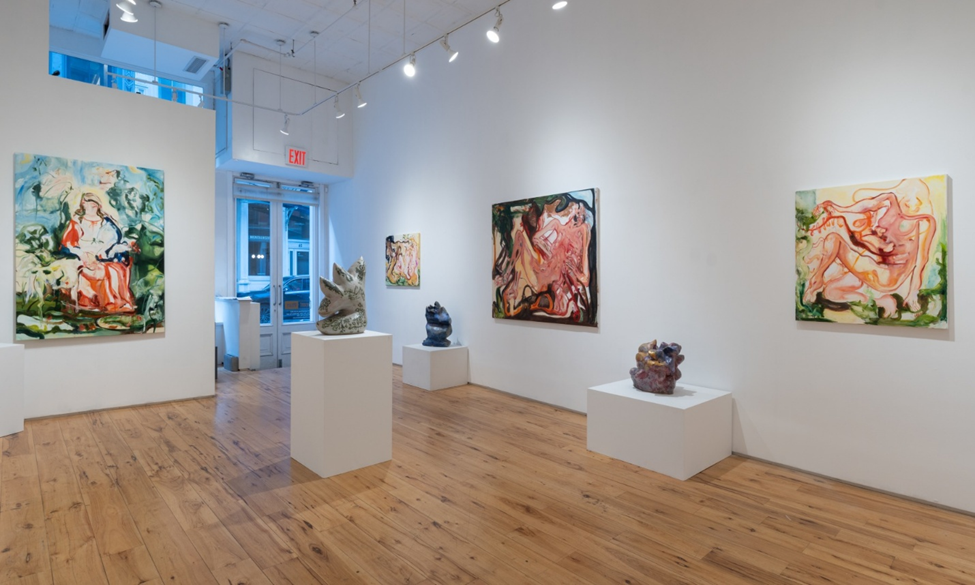
Jorge K. Cruz & Elizabeth Insogna, Divine Myth– Faith and Flesh, installation view, photo courtesy of the gallery
In the quiet hum of Freight + Volume, myth breathes anew — through clay, through oil, through the occulted pulse of memory and transformation. Elizabeth Insogna’s luminous ceramics rise from ionic pedestals like ancient offerings, while Jorge K. Cruz’s visceral canvases create a kaleidoscopic backsplash, drawing viewers into a dialogue between the sacred and the subversive.
Prior to her exhibition, Phantom Thread at Freight+Volume, Paige Beeber spoke with Amanda Millet-Sorsa at the artist’s studio in Brooklyn. Nestled into a Cube Smart storage space building in Gowanus on the edge of Red Hook, the studio is part of TI Studios. Beeber’s long family roots in Brooklyn date back to the early 1900s, as she continues to live and work in this borough. Her new work evolved from experiences she had at residencies in 2022 (DNA Residency in Provincetown, SARP in Sicily, and recently completed her fellowship at The Helene Wurlitzer Foundation). Her work exists between narration, figuration, and abstraction and largely uses the repurposing of her own past paintings that transform into new patterns, motifs, and imagery in new paintings. Ritual and community play an essential role in the stitching of new narratives.
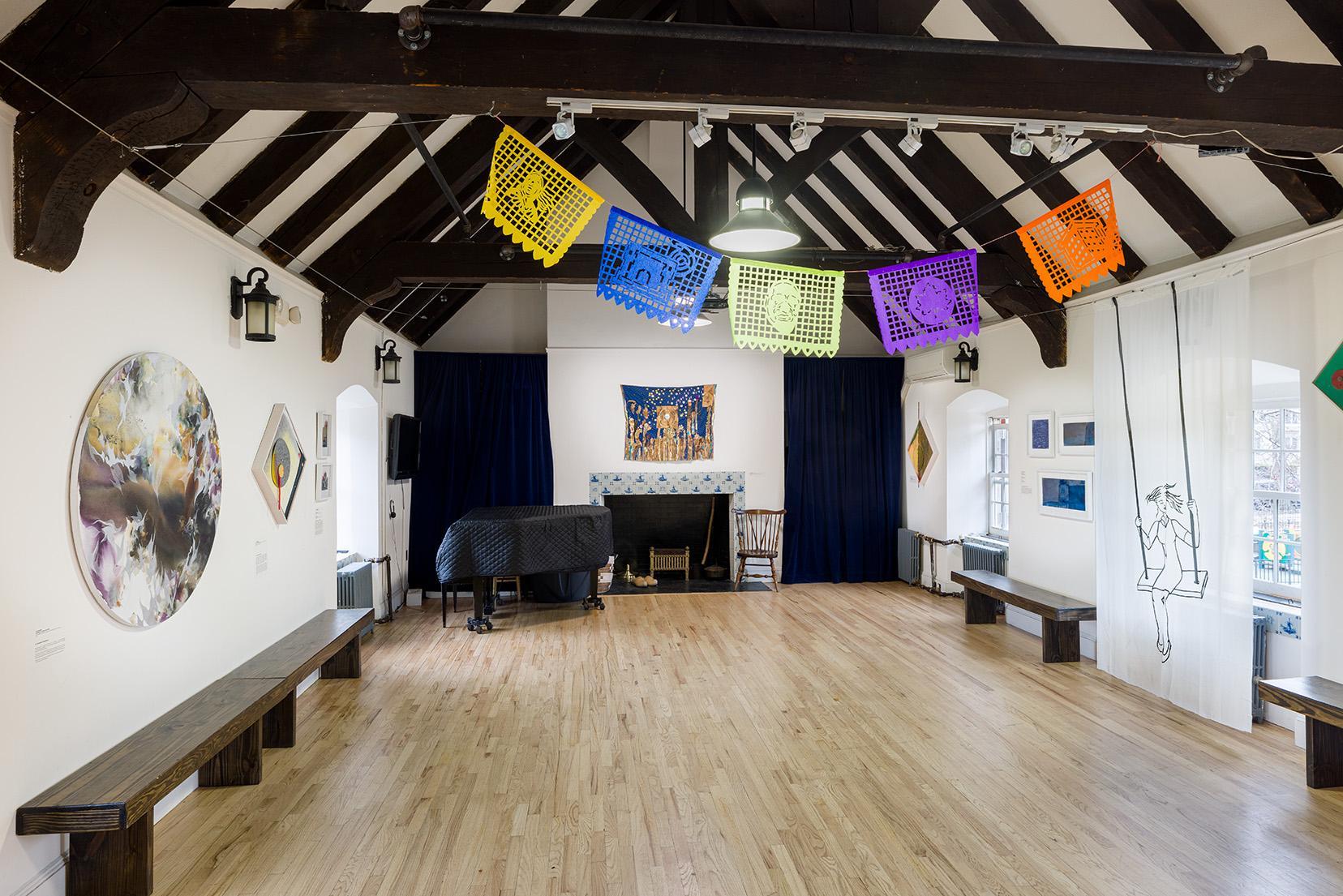
L to R: Ai Campbell, Carl Hazlewood, Angelica Bergamini, Damali Abrams, Carl Hazlewood, Angelica Bergamini, Jodie Lyn-Kee-Chow and Blanka Amezkua (center).
Finding My Folk, curated by independent curator Krista Scenna at the Old Stone House in Brooklyn, features work by seven contemporary immigrant artists whose practices embrace the folkloric in their own traditions, rituals, and customs by blending elements of their past, memories of “home,” their present, and future. The notion of Folklore underscores the show, how it is often so seamlessly embedded in daily lives that people may tend to overlook it—myths, dances, rhymes, toasts, jokes, holidays, and festivals are all essential characteristics of a community—ranging from the family unit, to a nation, to the global population. The show is on view through April 9, 2023 with a closing event on Monday, April 10th from 6:30pm – 8:00pm.
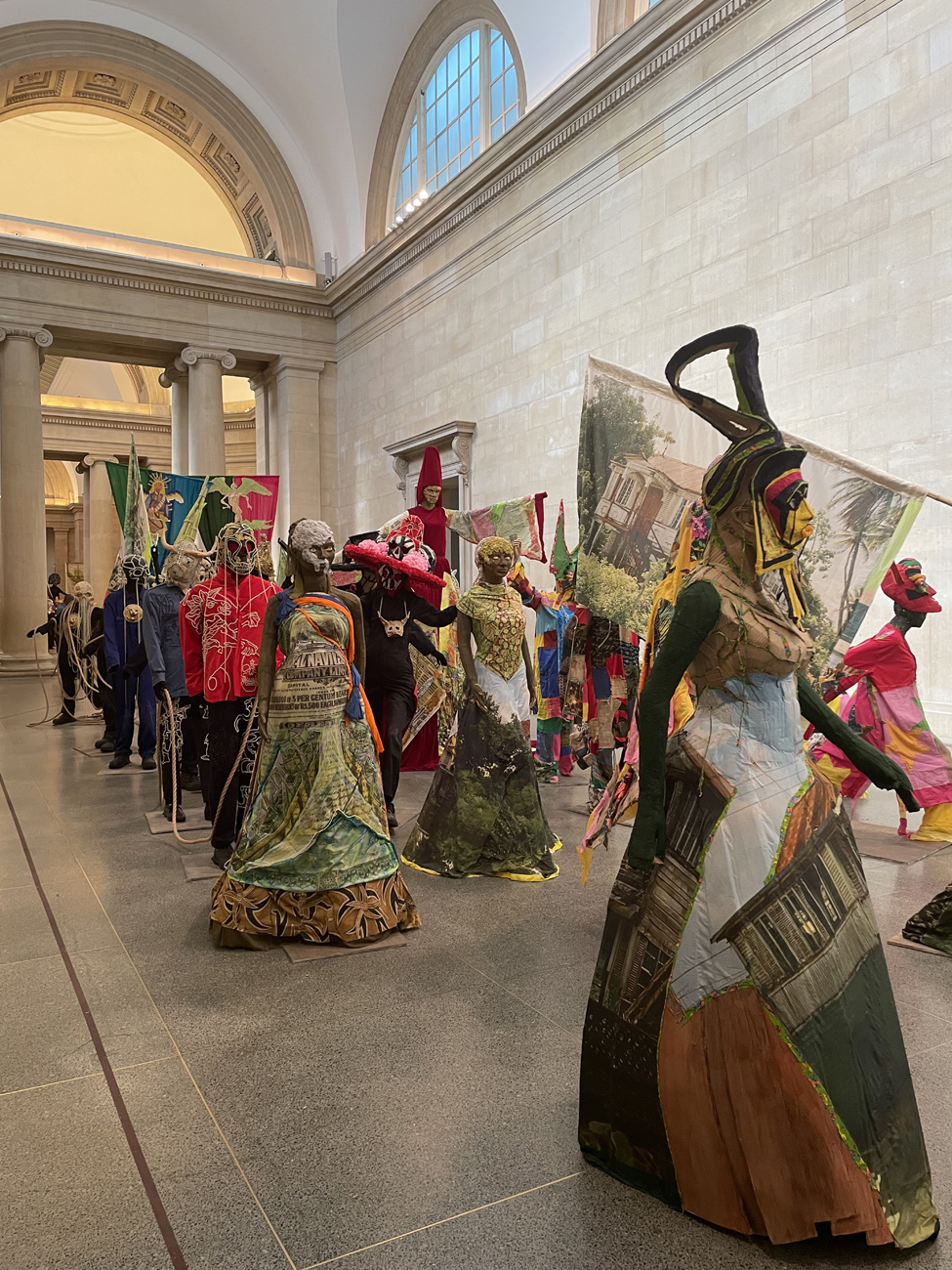
Each year The Tate Britain commissions a large-scale art installation for the iconic Duveen Galleries at the museum. This is a vast space, an art-filled hall, more than a typical gallery that winds its way down the center of the museum on the first floor. This year they tapped the Guyanese-British artist Hew Locke whose visual musings on migration, history, national identity and ritual are well known in the British art world. Locke has long worked these themes, but never on such a scale. It is a wildly ambitious vision that embraces his interests and presents a fully developed Universe.
To Have and To Hold exhibition with works by from left to right: Jean Carla Rodea; Maria De Los Angeles; Micaela Martello; Julia Justo, Maria De Los Angeles; and Jeff Kasper
Featured Project: with curators Anna Shukeylo and Yasmeen Abdallah
The group show To Have and to Hold at the Abrazo Interno Gallery at the Clemente brings together work by Maria de Los Angeles, Julia Justo, Jeff Kasper, Michela Martello, Patricia Miranda and Jean Carla Rodea, who explore in their work notions of beauty and soulful trajectories through the potency of heirloom-like objects. Co-curators Yasmeen Abdallah and Anna Shukeylo share their thoughts on their collaborative curatorial experience.
Elizabeth Velazquez, Cigar Factory Final Exhibition, 2019, installation view- 2 of 4 rooms, photo courtesy Sakeenah Saleem
Elizabeth Velazquez makes powerful installations in response to the history and geography of a site. While her work often unleashes dark secrets from a hidden past with particular sensibility to social injustice, it also elevates our gaze upwards, conjuring an essence of spirituality out of the materials she is using. The artist shares with Art Spiel the ideas and process behind her recent body of work.
Installation view of the East room: (right) david Goodman, (mid) Will Crowin, (left) Heidi Lau, photo credit Tommy Mintz
The grouping of mostly floor-bound sculptures in “Ground Histories”, the current group show curated by Will Corwin at PS122 Gallery, not only pulls our attention to the ground, but also makes us aware of what is underneath its surface – archaeological artifacts, graves, excavated memories. In the east room a triangular layout consisting of Will Corwin’s altar-like sculpture, Heidi Lau’s arched-shape ceramic sculpture sprawling, and David Goodman’s forte-like structure, create a sense of both tension and connectivity. Made of plaster and sand, painted with terra cotta and white tempera hues, and tied with rough ropes, Corwin’s “Jaw” is a rectangular free-standing sculpture that draws literally upon teeth and invokes the idea of the archaic – an architectural ruin from an unidentified culture, or an archaeological artifact with an enigmatic ritual significance. The tooth, a pivotal element in both forensics and bioarcheology, can be read in Corwin’s sculptures as a loaded metaphor for what it means to be human.
Opening night at ArtHelix, with partial view of Meltdown by Kurt Steger; photo courtesy of Vincent Romaniello
Suspended murky waterdrops on the verge of dripping from an icicle onto a sheet of paper prove to be almost hypnotic in Kurt Steger’s interactive project at ArtHelix. Utilizing elegant wooden contraptions made of a rotating large-scale low wooden table, a transportable tall crane-like sculpture, and a few low benches, Steger’s participatory performance evokes a genuine urge to behold the genesis of a fresh mark, from the first drip to the final circular tracing. The resulting drip drawings hang on the walls, mostly depicting circular forms that range from dark sepias to vibrant yellows and rusty oranges. Continue reading “A Genuine Urge to Behold: ‘Meltdown’ by Kurt Steger”