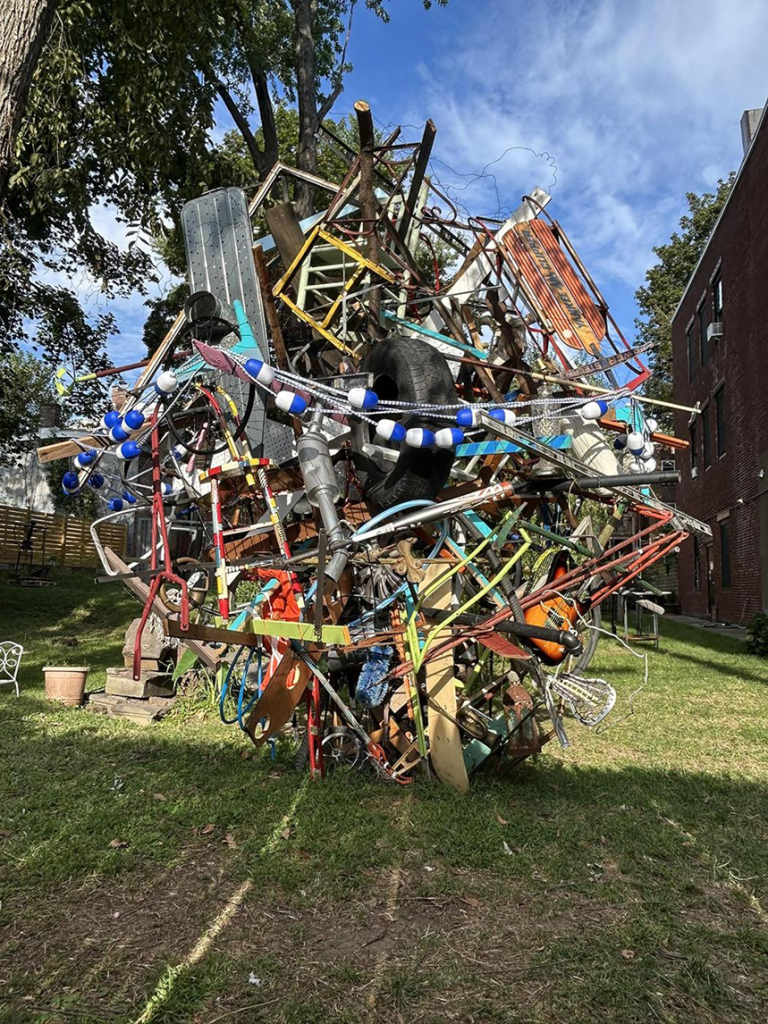
Holland Tunnel Newburgh opens its sculpture garden. Julie Lindell, Everything, 2025, 144x144x144 in. Mixed media, found objects. Photo courtesy of Julie Lindell
When artist Alexandra Limpert invited Janet Rutkowski to co-curate Reclamation in honor of her longtime friend and Holland Tunnel founder Paulien Lethen, Rutkowski accepted without hesitation. Although she had just finished curating and exhibiting in several projects, she embraced the challenge with what she describes as her “devil-may-care” approach. The exhibition’s title emerged quickly, reflecting her interest in the idea of recovery and renewal.
Julia S. Powell, Kitchen Morning, 2024. Oil on canvas
MFA Boston Curator of Painting Katie Hanson visited the studio of the landscape painter Julia S. Powell. The resulting interview gives us an insight into Powell’s artistic process and her concept of a “fiction painter,” one that creates work at the intersection of abstraction and realism. Besides references to contemporary Impressionism, the interview addresses creating thickly-layered artworks that inspire introspection and acceptance of previous experiences—especially the unwanted ones. These layers serve as metaphors for embracing past struggles without regret. Powell’s work also provides an emotional refuge as a response to a chaotic and increasingly anxious life.
Nearly a century after the Weimar Republic’s brief, chaotic existence, curator Hans-Peter Wipplinger presents Splendor and Misery: New Objectivity in Germany at Vienna’s Leopold Museum. This comprehensive exhibition, the first of its kind in Austria, brings together around 150 works—100 paintings, 40 works on paper, photographs, and archival materials—from international museums and private collections. Born from the ashes of World War I, Neue Sachlichkeit offered a stark, unsentimental portrayal of reality, capturing both the hardships and the hopes of the “Golden Twenties.” The show features a lineup of key figures of modernism, such as Max Beckmann, Otto Dix, George Grosz, and Christian Schad, alongside lesser-known artists such as Heinrich Maria Davringhausen, Karl Hubbuch, Grethe Jürgens, Lotte Laserstein, Felix Nussbaum, Gerta Overbeck, Rudolf Schlichter, and others, who each captured the era’s spirit with an unflinching eye.
Technically, Edouard Manet (1832–1883) and Edgar Degas (1834–1917 are not Impressionists; instead, they are Realists whose works owe a debt to Gericault, Goya, and Daumier and the invention of photography. Unlike Monet, who sought solace and inspiration in nature, which can be seen as a reaction to the urbanization associated with the rise of the bourgeoisie, Manet and Degas instead embraced the industrialization and urbanization driven by bourgeois economic interests. They were unconcerned with the dehumanizing effects of rapid technological advancement. Realism is aimed at depicting scenes and subjects based on the everyday lives of ordinary people.