Notice: Function WP_Object_Cache::add was called incorrectly. Cache key must not be an empty string. Please see Debugging in WordPress for more information. (This message was added in version 6.1.0.) in /www/artspiel_344/public/wp-includes/functions.php on line 6131
Group picture(Members in picture from left to right): Euijin V. Ra (artist), Julia D. Shaw (artist), Courteny Symone Staton (artist), Laura OsCam (artist), Sherwin Banfield (Program Manager), TEDF (artist), Marleen Moise (artist).
Wherever I Lay My Head, now on view at The Jamaica Center for Arts and Learning , began with an invitation to Indira A. Abiskaroon to curate the culminating ARTWorks exhibition. The offer came from Program Manager Sherwin Banfield and was formalized in conversation with Director of Program Operations Wendy Arimah Berot. Abiskaroon’s first priority was to spend time with the ARTWorks Fellows—to learn how their practices had developed over the course of the program and to hear what ideas had been resonating in their weekly sessions.
The Field is All Around Us: Scott Sueme’s Solo at Uprise Art Will Change How You See Space
Installation shot of Field in The Wind, Scott Sueme, Uprise Art, 2025
In Scott Sueme’s latest collaboration with Uprise Art, the artist asks, “If you are called to look, what do you see?” In fact, I pose the question to you right now. As you lie in bed reading this when you really should be asleep or as you doomscroll art news to avoid doomscrolling national news, Sueme calls you to look with the consideration of someone devoted to noticing the breath within the breath, the moment within the moment.
Here’s a set of reviews of nine recently published and forthcoming books I’ve enjoyed reading, reflecting on, and recommending of late. In the mix are two emotionally trenchant novels, a narratively enigmatic novella, a gauzily glowing volume of poetry, a vast survey of contemporary text-based art, a history of groundbreaking women photographers, a critical examination of the sociopolitics of walking, a collection of interdisciplinary essays about narrative slowness, and a revised historical glimpse into the early days of US comic strips. They’re all worthy titles to add to your fall reading list. Several would also make excellent additions to a fall or spring syllabus.
With Sex Depression Animals, Mag Gabbert gives form to figment, credence to the mythic, substance to shadow, visibility to the unseeable, sacrality to the profane, and fertile grounding to the errant roots of language the poet jostles loose in various ways, transplanting them into revivified metaphors and ranging contexts.
So much has happened in six years. It was six years ago that I last wrote about the work of Vanessa German for Hyperallergic. Donald Trump had just been elected, and the country was bracing itself for a trip down a new and dangerous path. Vanessa German, a poet, activist and visual artist, had mounted a powerful show at Pavel Zoubek Gallery entitled I am armed. I am an army. German filled the gallery with a fighting corps of women, armed with weaponry, poetry, history and power. It was a fierce exhibition, and one that both mourned and celebrated the power of women.
Elsa von Freytag-Loringhoven (c. 1921-22), George Grantham Bain Collection, Library of Congress Prints & Photographs Division, LC 5677-2. From digital scan of photograph.
The Baroness at Mimosa House in London is a group exhibition dedicated to Dada artist, the Baroness Elsa von Freytag-Loringhoven (1874–1927). The exhibition manifests the ongoing influence of the Baroness on contemporary artists and poets, showcasing artworks and performative contributions created in homage to Elsa von Freytag-Loringhoven or influenced by her radical work and effervescent personality. The show questions the legacy of Dada poetry and performance today, in a feminist and queer dimension in particular. How can artists navigate the art world, politics and society while creating a work which resists and disrupts the conventional canon? Elsa von Freytag-Loringhoven becomes a role model and inspiration for international artists of different generations and media of work.
During the Coronavirus pandemic, Art Spiel is reaching out to artists to learn how they are coping.
Performance still from “In America, You are Asked Why Leaves are Green,” February, 2020; from left, artists JinJin Xu, Jiaoyang Li. Photo courtesy of artists
Silkworm Pupas is a new media arts collective consisting of NYC based Chinese poets Jiaoyang Li and JinJin Xu. Our projects strive for intimate ways to envision attainable, inclusive, and bleeding-edge futures through innovative storytelling, documentary poetics practice, sound installation and video-performance art.
Jiaoyang Li is a Chinese poet and visual artist. Her literary work has appeared in LA Reviews of Books-China channel, 3:AM, Spittoon Magazine, Voice and Verse poetry magazine, and others. Her interdisciplinary practices have been supported by the New York Foundation of Art, The Immigrants Artist Biennial and others. She co-founded the interdisciplinary poetry journal 叵CLIP.
JinJin Xu is a poet and filmmaker from Shanghai invested in docu-poetics. Her work has been featured in The High Line Public Arts, The Harun Farocki Institute, The Immigrant Artist Biennial, and anthologized in Nasty Women Poets. Honors include The Poetry Society of America’s George Borgin Prize and fellowships from The Thomas J. Watson Foundation and the Flaherty Seminar. She teaches hybrid workshops at NYU where she is a Lillian Vernon Fellow.
During the Coronavirus pandemic, Art Spiel is reaching out to artists to learn how they are coping.
Heather and Raphael Rubinstein
Heather and Raphael Rubinstein divide their time between New York City, northeastern Pennsylvania and Houston. Heather’s most recent exhibitions of her paintings were at the beginning of 2020 in New York, pre-covid, with a solo in Houston at McClain Gallery. Raphael had two books come out in early March as New York was shutting down: a monograph on artist Guillermo Kuitca, published by Lund Humphries, London, as part of their Contemporary Painters Series edited by Barry Schwabsky; and Albert Oehlen: Spiegelbilder 1982-1990, published by Holzwarth Publications, Galerie Max Hetzler Berlin and Nahmad Contemporary. Planned for 2020 was a new curatorial project of theirs: an exhibition on the topic of Poet+Painter collaborations—scheduled to open at a downtown non-profit in New York (pre-covid)—and in many ways, an extension of their 2019 “Under-Erasure” exhibition that took place at Pierogi Gallery in New York. In lieu of in-person projects, Heather is working on expanding their “Under-Erasure” digital archive, publishing an Under-Erasure image-book, and a virtual Poet+Painter exhibition. Raphael is currently writing The Miraculous: New York—with episodes appearing monthly in The Brooklyn Rail —a sequel to his book, The Miraculous (Paper Monument, 2014). They are currently working towards publishing The Miraculous: New York as a public art project in New York for 2021-22.
During the Coronavirus pandemic, Art Spiel is reaching out to artists to learn how they are coping.
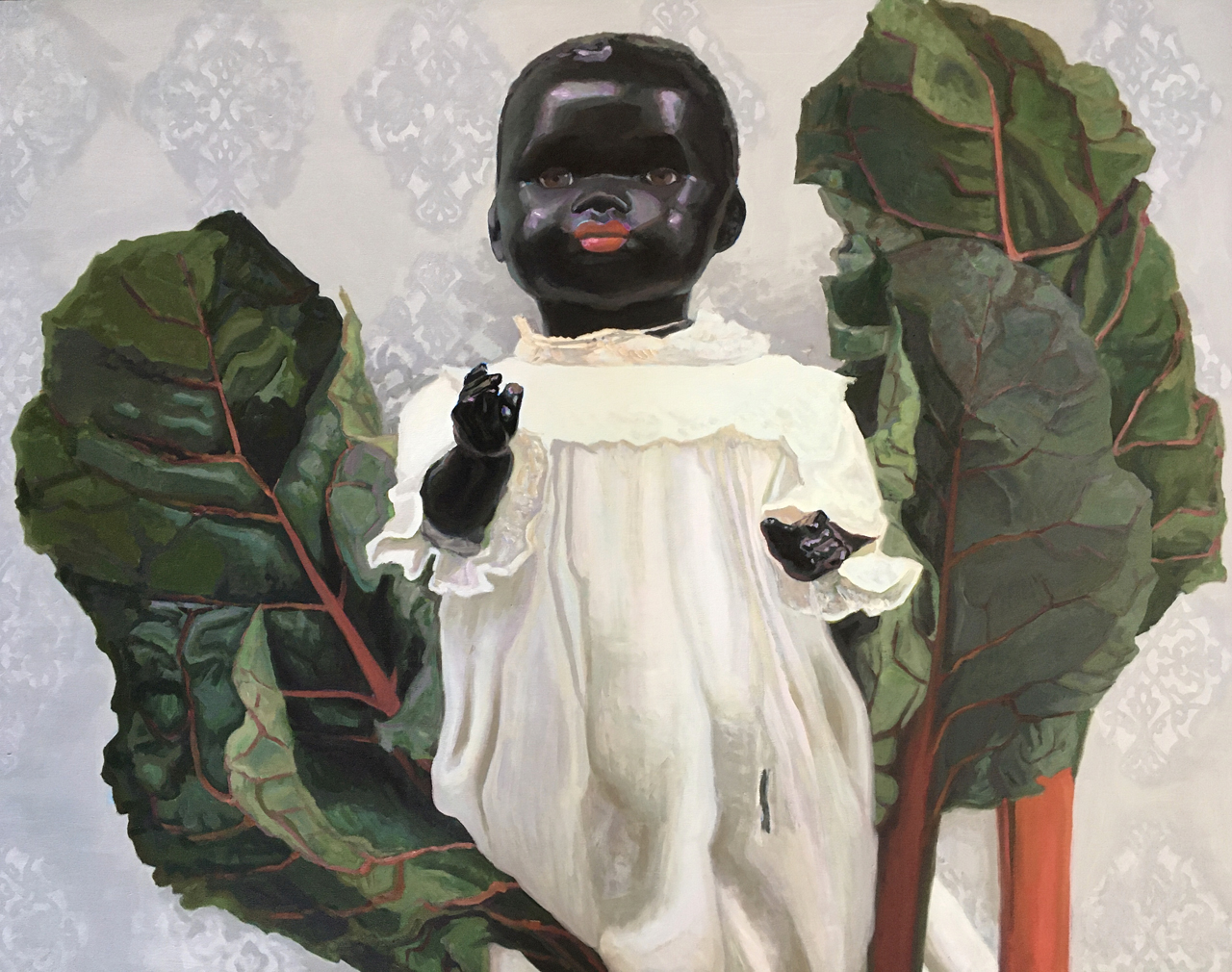
Selfie With Swiss Chard, 2020
JoAnne McFarland is an artist, poet, curator, and independent publisher. She is the Artistic Director of Artpoetica Project Space in Gowanus that exhibits work exploring the intersection of visual art and literature. She is the former Exhibitions Director of A.I.R. Gallery in DUMBO. She has exhibited her artwork nationally and internationally for over 30 years, and is the author of ten poetry books, chapbooks, and libretti. Her most recent curatorial project, co-curated with Sasha Chavchavadze, is SALLY, a multi-venue, muti-year exhibition that showcases lost histories of women artists and philosophers, and contemporary artists whose work exemplifies passionate inquiry.
Tansy Xiao is a curator, artist, writer, translator, and an overtly out of the box thinker. She shares with Art Spiel some insights on her upcoming curatorial project at Radiator, her art-making, as well as translation and writing processes.
AS: Tell me a bit about yourself and what brought you to art – writing, translation, curation and making.
Tansy Xiao: I wasn’t properly schooled, neither did I consider myself an artist when I was travelling around and painting abstract murals in exchange for food and accommodation. Now you might call it an unprompted residency. During my long trips and brief sojourns, I would write book length letters to my friends, with a mutual understanding that they were not obligated to reply. I joined and formed communities, then left them, until I have relatively settled in New York, a city with such transience that the fear of being trapped in a constricted niche no longer haunts me. That’s when I began my practice as a curator and translator. If I were to describe my status quo now, I’d quote D. H. Lawrence’s last paragraph in Rainbow: