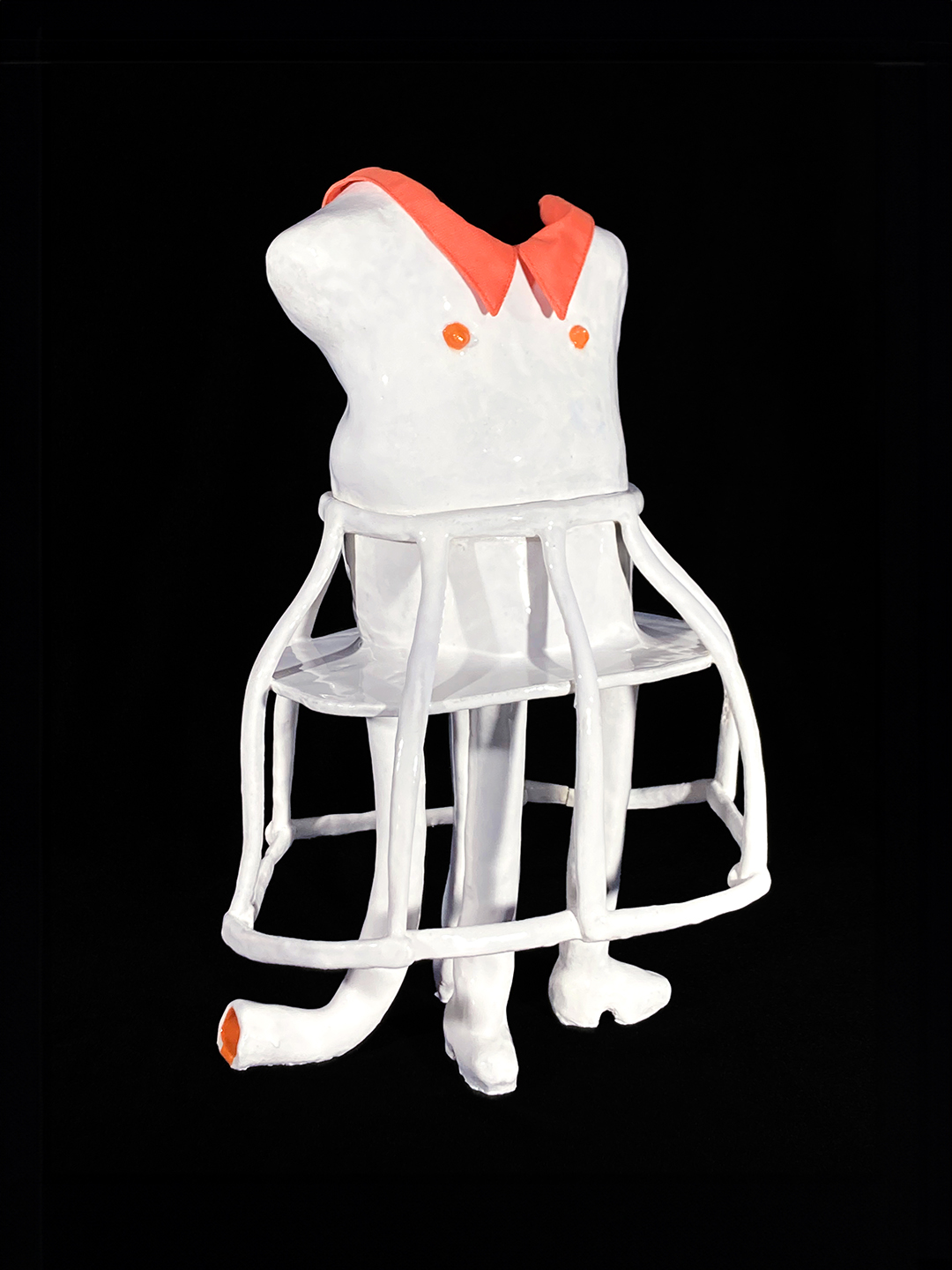
Elizabeth Insogna, Veil, 2024, Glazed ceramic, 15×15”
Large-scale, multi-piece sculptures standing balanced by their own weight accompany ceramic tablets colored cream and periwinkle, which hang along the walls of Anne Reid ‘72 Gallery, echoing in their sudden coalition the deeds of a goddess from centuries ago. Hekate is her name, and she is a Greek goddess associated with fire, witchcraft, and transformation. In our search for the spiritual, returning to the philosophies of ancient times lends fresh wisdom, lighting compelling paths forward.
3RD SPACE installation image. Image by Yasmeen Abdallah
We visited SPRING/BREAK Art Show in its new location in lower Manhattan on Varick St. We went independently, and then got together afterward to discuss our impressions of the fair, and the highlights we came away with. We have ruminated on possible trends and strong impressions that stayed with us long after the fair. Even though it has been almost a month past Spring Break Art Fair, the highlights resonated with us.
Nancy Baker Cahill, Substrate Part #1: Universum, video still, project artists Shereen Moustafa, Mark Sosa, Casper Torres, and Miguel Zavala-Lopez, Central Library Video Wall, Los Angeles Central Library, Los Angeles. On view through December 2024. Video still selected by the author.
Three Downtown Lost Angeles exhibitions use data, disaster, and a shared history to explore community connections. They tap into the past, present, and imagined future to speak about class, labor, and inequity through the use of storage systems, pride of place, and what happens when things fall apart. At Gallery Luisotti’s El Cuerpo: The (Performing) Body and the Photographic Stage Chicano/a artists use themselves as subject to connect through a shared history, at the Los Angeles Central Library Nancy Baker Cahill: Substrate Part #1: Universum uses civic institutions, cultural resources, and data storage systems to forge a connection of community driven by data and at The Museum of Contemporary Art MOCA Grand exhibition Josh Kline: Climate Change community members connect to survive the aftermath of the climate crisis.
Install image: (left to right) Bang Geul Han’s, Warp and Weft #02 – Toilet, Warp and Weft #02 – Reading, and Warp and Weft #03 – Sleeping, all from 2022, Georgia Lale’s 404,770 on Inauguration Day, 2021, Stand4 Gallery
UNCOMMITTED at Stand4 focuses on civic literacy, engagement, and social matters which affect and reflect the daily lives of folks within Bay Ridge. This local lens also overlaps with national issues surrounding the 2024 presidential election. In particular, these artists examine concerns related to health care, migration, conflict, tensions between state and federal voting rights, the role of technology, surveillance, and advocacy. Art Spiel invited the curator of the show, A.E. Chapman, to elaborate on these concerns and their relevance within each of their works in the exhibition.
Laia Cabrera and Isabelle Duverger, QUALIA – YOU MATTER TO ME, immersive installation, UltraHD, color, sound, 10 minutes, 2024. Courtesy of the artists
Throughout the group exhibition Women Heavy at the Gardens Gallery in Kearny, NJ, curator Donna Kessinger references contemporary and second-wave feminist ideas. The curator aims to create a clinical and visceral experience by investigating broad concepts and featuring among many notable others work by Charlie Spademan,Gwen Charles, Jeanne Brasile,Josh Knoblick,Judi Tavill, Kasia Skorynkiewicz, Charlee Swanson, Lauren Vroegindewey, Kristin J. DeAngelis, Michael Angelo,Richard Gaines, Suzan Globus, Vikki Michalios, A.V. Ryan, Donna Conklin King, Anna Ehrsam, and Doris Cacoilo. In our interview curator D. Kessinger sheds some light on her curatorial vision.
Installation view: Jiwon Rhie: Suddenly, Images Explain Everything at La Mama Galleria. Photo by flaneurshan. studio. @flaneurshan.studio
Jiwon Rhie often explores moments of deep personal depression, social misanthropy, and cultural alienation in her work. You would never know it, though, from first viewing. Walking into La Mama Galleria in the East Village, NY, visitors are greeted by the playful whirring sound of over a dozen mechanical toy dogs, each covered in exploding layers of colorful, fake flowers. The dogs walk across a blue moving pad, bumping into walls, each other, or the artificial boundaries Rhie erected. In the center of the moving pad, two quarter candy vending dispensers shake with the motion of encased and enflowered toys, which act, of course, unperturbed by their enclosures. Viewers are invited to borrow quarters from the gallery to dispense pods filled with custom keychains and temporary tattoos from the candy machines. Though only a corner of a room within a larger exhibition, Rhie’s Flower Dogs make it impossible to enter the gallery without stopping to smile, take a photo or video, and procure ones own custom keychain art.
Installation view, Jenny Holzer: L: right Line, May 17-September 29, 2024. Solomon R. Guggenheim Museum, New York. @2024 Jenny Holzer, Artists Rights Society (ARS), New York, Photo: Filip Wolak
“I want people to concentrate on the content of the writing and not ‘who done it.’ I want the work to be of utility to as many people as possible. And I think if it were attributed to me, it would be easier to toss.”
Quote by Jenny Holzer from Art21
Recently, I wrote an opinion piece on the suspect politics of Maurizio Cattelan’s show at Gagosian Gallery — it questioned why successful artists who make political claims for their work do not use their privilege to engage in direct political commentary and action rather than critique by analogy. I’m not suggesting they need to engage in social practices like Mel Chin or Tania Bruguera; I think artists like Cattelan can be more direct in their criticism or more like Theaster Gates, who acknowledges the contradictions and privilege that comes with his success to the degree that he openly differentiates between museums and institutional exhibits that permit him to experimentation and his gallery exhibits that afford him market engagement. Meanwhile, while those works have an implied politic, he is an activist who focuses on community development, which is realized through his Chicago-based Rebuild Foundation, which is a platform for cultural development and neighborhood transformation. This multifaceted approach enables Gates to navigate and influence both the art world and broader societal issues without collapsing one into the other.
Tianyi Sun and Fiel Guhit. “Bakery Story,” installed as part of FROM_LISTENERS, 2023. 30 x 18 x 32 inches, Laser cut and engraved acrylic, aluminium, LCD screen, webcam.
“I love it. I am all for kitschy stuff,” Tianyi Sun says, laughing, as she notices the iridescent glitter liquid phone case. In her practice, Sun engages with the cute and zany using these categories as an entry point to embody how we approach technology in our everyday lives—her work takes the form of installations and responsive environments activated by a reading or performance. With much of her work being modular, the audience moving through the space is as important as the work itself—“bridging the digital and the analog,” she explains. “I want to expose the aesthetics, the beauty, the politics without lessening the visceral response.” A central question of her work is: What happens with the human experience as we navigate technology?
Brooklyn artist Jeanne Verdoux’s latest exhibition, Female Vaisselle, at the Sculpture Space NYC from February 2 to March 2, 2024, marks her first solo show in New York City. Verdoux captures the essence of the female form through a blend of ceramics, drawings, monoprints, and video art. The title itself is a linguistic play, merging the French word “vaisselle” (meaning tableware) with the English “vessel,” reflecting the dual themes of domesticity and the female body as a container of multifarious experiences.
Installation view, Invisible Bodies, at Penn State University (HUB-Robeson Galleries), 2023. Images courtesy of The Border Gallery and HUB-Robeson Galleries
Installation view, Invisible Bodies, at Penn State University (HUB-Robeson Galleries), 2023. Image courtesy of The Border Gallery and HUB-Robeson Galleries.
As one approaches “Art Alley,” part of the Hub-Robeson Galleries at Pennsylvania State University, it is the vibrant green walls that first draw one’s attention. Painted green for the “support for an open immigration system, allowing immigrants to contribute to the nation’s labor force, Invisible Bodies: An Exploration of Migrant Labor Through an Artistic Lens, curated by The Border Gallery and Emireth Herrera Valdes, brings together fifteen artists from diverse backgrounds to contemplate labor, immigration, and identity in the United States.