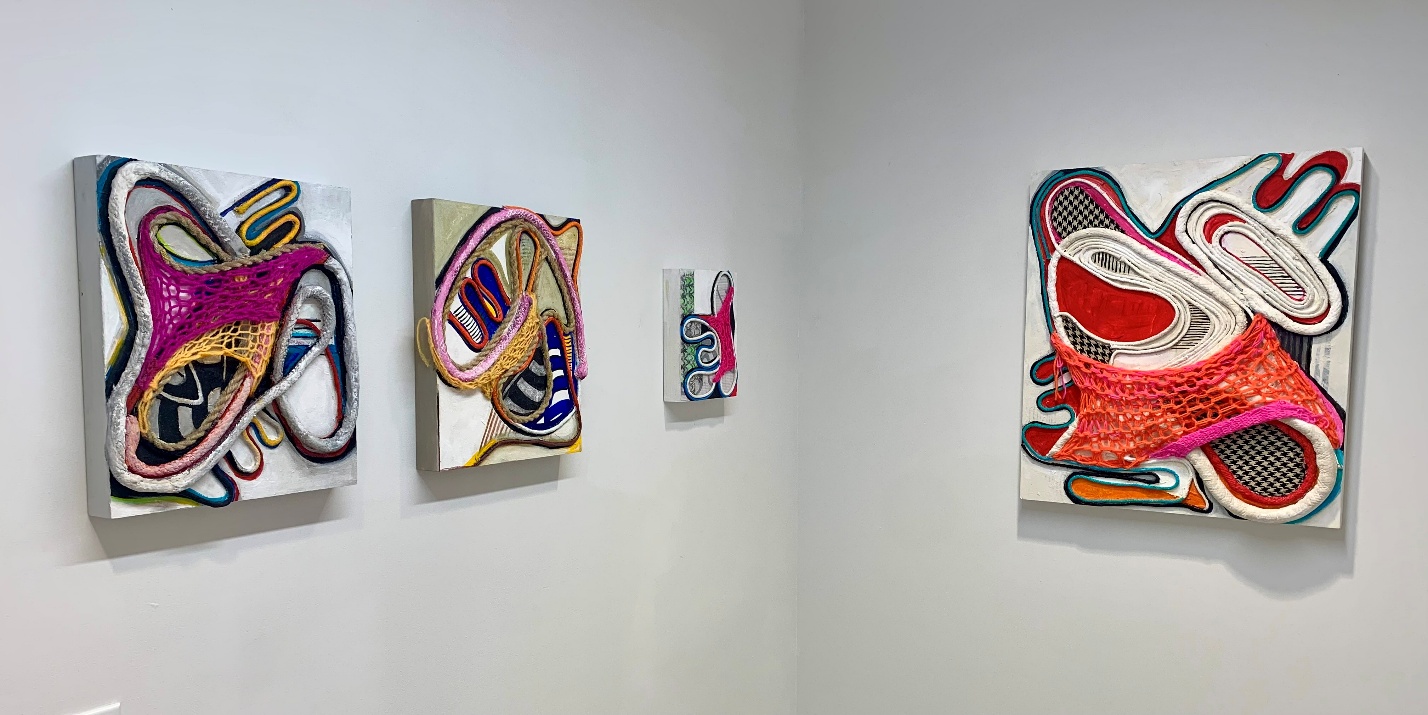
Installation view, Susan Mastrangelo: The Beat Goes On at Kathryn Markel
Susan Mastrangelo’s solo show, The Beat Goes On, at The Pocket Gallery of Katherine Markel Fine Arts features work completed from 2022 to 2025, with the majority of the pieces completed in 2025. Mastrangelo creates bold reliefs that transform a variety of materials into bold abstract and biomorphic forms.
Emily Sundblad, The Adolescent Ocean, installation view, Bortolami, New York, 2025
A person who can sit through a Survey of Art lecture set to a Leonard Cohen soundtrack while reading The Waves may be well equipped to navigate Emily Sundblad’s Adolescent Ocean. Personal history intermingles with cultural and art iconography, forming a tide of debris that floats to the surface in this show of collage-like, collective memory-dreams.
Installation image of Naomi Okubo: Resonance on a Surface, 2025. Photograph by Ken Lee
When Naomi Okubo decides to begin working on one of her enthralling paintings, there is a multistep process that far proceeds the brush gracing the canvas. The careful preparation of materials, digital and physical, allow Okubo to consolidate her thoughts and produce an organic depiction of her personal experience. The authenticity with which this is depicted is a result of the forethought and boundless introspection that she imposes upon herself. It is important to note that the artworks selected for the exhibition Naomi Okubo: Resonance on a Surface currently on view at Fou Gallery, weave a narrative fabric that chronologizes Okubo’s development as a visual artist.
Zoe Beloff, Model for Drive-In Dreamland by Albert Grass (c. 1945), 2012, Wood, paint, plexiglass, found objects, 67 × 27 ⁵⁄₁₆ × 19 ³⁄₈ inches, 170 x 70 x 48.5 cm., photo courtesy the artist and Astor Weeks
When my mother was very old, I wanted to tell her what it was like to be in the art world. I said, “It is a little like joining the carnival.” While not affording her much comfort, I tried to convey the disorderly balancing act of the ridiculous and the transcendent, the illusory and the real, the sincere and the piratical. I wanted to suggest a midway of precarious lives, thrill rides, and a dubious game of chance.
I am meeting Natalia at Kaliner gallery on a steamy day in June. The artist, who arrived here for this milestone exhibition, her first solo in New York, is uncertain when and how she will be able to return home to Israel. The war in Iran was launched just a week after the opening. Stranded away from her family, she remains determined and optimistic. This toughness in the face of chaos is also evident in her artwork. The paintings in Nightlight are vibrant, large, and striking.
Judith Simonian’s solo show at JJ Murphy Gallery, poignantly titled The Human Element, Huddled and Still, features her latest paintings from the past few years. At first glance, there is familiarity in each piece – a living room, a still life, part of a ship – but as one starts to look closer, something starts to happen. Within each painting, there is a portal into another world; there are clashing planes and changing scenes that are so seamlessly blended together the viewer’s brain needs some time to catch up. What is particularly astounding about Simonian’s work is that her subject matter is a humble amalgamation of scenes, spaces, and objects one would encounter in everyday life.
For decades, Dona Nelson has dissolved the formal boundaries of painting: refusing to apply pigment to just one side of the canvas, mounting the stretchers of her double-sided paintings on freestanding metal stands, and letting them occupy gallery floors like sculptural interlopers. In her current two-person show with Andrew Ross at Thomas Erben Gallery, however, the painter has ceded the floor space entirely, anchoring her three new works squarely to the wall.
This exhibition of Salman Toor’s paintings acts like snapshots in a story or a movie, each depicting a separate experience. Every piece draws you in and carries a true push and pull within the composition. The push and pull that drew me in was the idea of public versus private that emanates from within the work, the dream and reality, and just how much intimacy Toor decides to share with us. The feelings of intimacy and vulnerability come from witnessing the lives of the figures Toor presents, leaving us to wonder if we are allowed to bear witness to these moments, or if we’ve just “walked into” something meant to be entirely private.
Installation view: Alicja Kwade: Telos Tales, Pace Gallery, New York, 2025. Photo courtesy of the gallery
It’s a rare joy to encounter immersive installations that truly activate space and affect the viewer both intellectually and viscerally. This spring, three standout New York exhibitions— Alicja Kwade at Pace, Anastasia Komar at Management, and Pierre Huyghe at Marian Goodman—do just that. Each exhibition envelops visitors in an environment that challenges the senses and pushes the boundaries of perception, while decentering the human’s place within it: Komar contemplates the primordial origins of life and the interconnectedness of all living things; Huyghe imagines a collaborative ecology where humans, animals, machines, and artificial intelligence co-create new realities; and Kwade abstracts away the human almost entirely, leaving behind only our systems for measuring and making as the scaffolding for a parallel, perhaps post-human world.
Upon entering this exhibition, I was taken to the wall pieces immediately, especially the use of vibrantly colored embroidery string mimicking paint strokes on the canvas. Art historical references and connections are very prevalent in the works of this exhibit. It was refreshing to see this conversation of the painting canon being brought up in a contemporary light by the use of this novel medium. Amer’s love and interest in the history of painting is apparent, and her works show art historical influences intertwined with intuition and a strong painterly hand that is present despite there being no paint in the show.