Notice: Function WP_Object_Cache::add was called incorrectly. Cache key must not be an empty string. Please see Debugging in WordPress for more information. (This message was added in version 6.1.0.) in /www/artspiel_344/public/wp-includes/functions.php on line 6131

Crazy River Umwelt Series Part I

Featured Project

Map

Description automatically generated
Hovey Brock: Blackleg Tick, 2021, 24” x 36”, acrylic on panel

A central theme in my Crazy River project has been highlighting the emotional toll of the climate crisis by putting under a microscope, so to speak, my own feelings about not only the impacts of the crisis but the knowledge that humans’ actions are the cause. This series of three on-line essays, thought experiments if you like, expands that project to change the POV to non-human actors that are inextricably bound with the habitat in the Western Catskills: the black-legged or deer tick (Ixodes scapularis), the white-tail deer (Odocoileus virginianus), and Japanese knotweed (Reynoutria japonica). All three have seen their habitat change dramatically through climate change and human interventions. Using my imagination and research, I try to enter the umwelt of all three species, an impossible task, as Thomas Nagel pointed out in “What Is It LIke to Be a Bat,” for which artistic license may give us the best chance to accomplish. My intentions in doing so fall along three axes: theoretical, aesthetic, and spiritual, dimensions all essential to my own art practice. What follows is a look at the umwelt of black-legged ticks from the perspective of theory.

Continue reading “Crazy River Umwelt Series Part I”

The Lands of Kats Kill

The Lands of Kats Kill is the second in a series of three interrelated experimental pieces that combine graphics, text, and hyperlinks based on themes coming out of my Crazy River project, for which I gave an interview on this website on May 16th. Crazy River takes a wide-angle view of the climate crisis, ranging from my own climate grief to an in-depth focus on the many causes and effects of rapid environmental changes on the West Branch of the Neversink in Ulster County. In this piece I investigate the idea of the Catskills as a region, and an incongruous bundle of contradictions and coincidences. The Lands of Kats Kill weaves three timelines together: the geologic, the historical, and the personal. This structure repeats throughout my Crazy River project. The previous piece in this series, Invaders, took apart the idea of invasive species. The following will explore the concept of the Golden Spike in stratigraphy as fact and metaphor.

Continue reading “The Lands of Kats Kill”

Invaders


Feral Hog, 24” x 36”, 2021, Acrylic on Panel. © Hovey Brock

Invaders is the first in a series of three interrelated experimental pieces that combine graphics, text, and hyperlinks based on themes coming out of my Crazy River project, for which I gave an interview on this website on May 16th. Invaders plays with the idea of invasive species, which has to be the misnomer of the century. So-called invasive species do reduce biodiversity in their new ecosystems but they are all the result of human intervention. International trade has been the main agent for transport to new locations, but climate change has also forced many species to move beyond their original habitat in order to survive. Every invasive species does what all living creatures do, including our own: take advantage of opportunities. Invaders includes my Crazy River paintings, photographs, and a list of 100 species from an on-line source: The Global Invasive Species Database, produced by the Invasive Species Specialist Group, a global network of scientists dedicated to identifying and tracking invasives.

Continue reading “Invaders”

Landscape Deconstructed at the Hammond: Linda Stillman

Part 1: Linda Stillman – Interview with Jennifer McGregor

Background pattern

Description automatically generated

Linda Stillman, Daily Skies: 2020, February 15, 2020 focus, 2021, archival pigment print on paper, 19 x 13 inches

Landscape Deconstructed: Mimi Czajka Graminski and Linda Stillman is a virtual exhibition on view at the Hammond Museum and Japanese Stroll Garden website until June 2022. It is curated by Bibiana Huang Matheis. The opening on September 11, 2021, included a virtual conversation with Mimi Czajka Graminski and Linda Stillman moderated by Jennifer McGregor which has been distilled and reformatted for individual interviews with each artist.

Continue reading “Landscape Deconstructed at the Hammond: Linda Stillman”

Claire McConaughy: Nearby at 490 Atlantic Gallery

Featured Artist

A picture containing plant, colorful

Description automatically generated

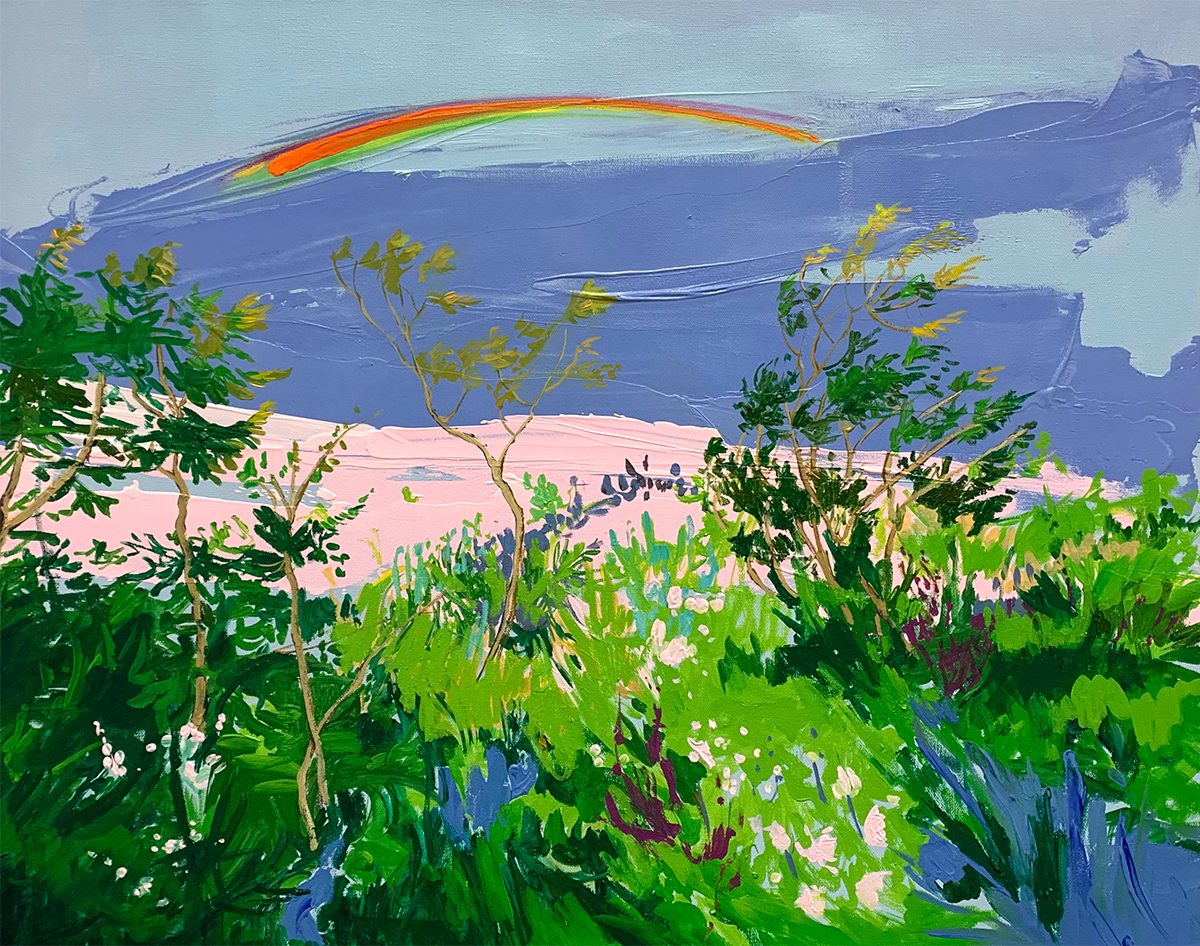
Delicate Rainbow, 2021, 24”x30”, oil on canvas, photo courtesy of the artist

In her solo show at 490 Atlantic Gallery, New York based painter Claire McConaughy features landscapes depicted in vivid colors and expressive linear marks. In Delicate Rainbow for instance, the painting plays on tension between horizontal, vertical, and diagonal orientations – an unexpected pale pink flow becomes a backdrop horizon to green vegetation spreading its limb-like branches diagonally upwards; on the top, blue-purple brush strokes depicting sky or water, lead the eye sideways, and then right above, a surprising orange linear brush stroke with the other rainbow colors hinted, stretch across the middle top.

Continue reading “Claire McConaughy: Nearby at 490 Atlantic Gallery”

Earthscapes: Emerging to a Brighter World: Pamela Casper at Wisner House

Art Spiel Photo Story


Installation view

In her solo art exhibition at Reeves-Reed Arboretum, Pamela Casper invites the garden-loving public to reconcile a personal relationship of guardianship that goes beyond admiring nature’s beauty. The artist says that the trajectory of the work in this show follows her own path of transformation—from observing beauty and imagining nature “above ground” to exploring the endless networks hidden below. The show is curated by Executive Director Jackie Kondel and runs through October 31tst, 2021.

Continue reading “Earthscapes: Emerging to a Brighter World: Pamela Casper at Wisner House”

Amy Talluto: Moments of Light in the Forest

talluto_studio_portrait.jpg

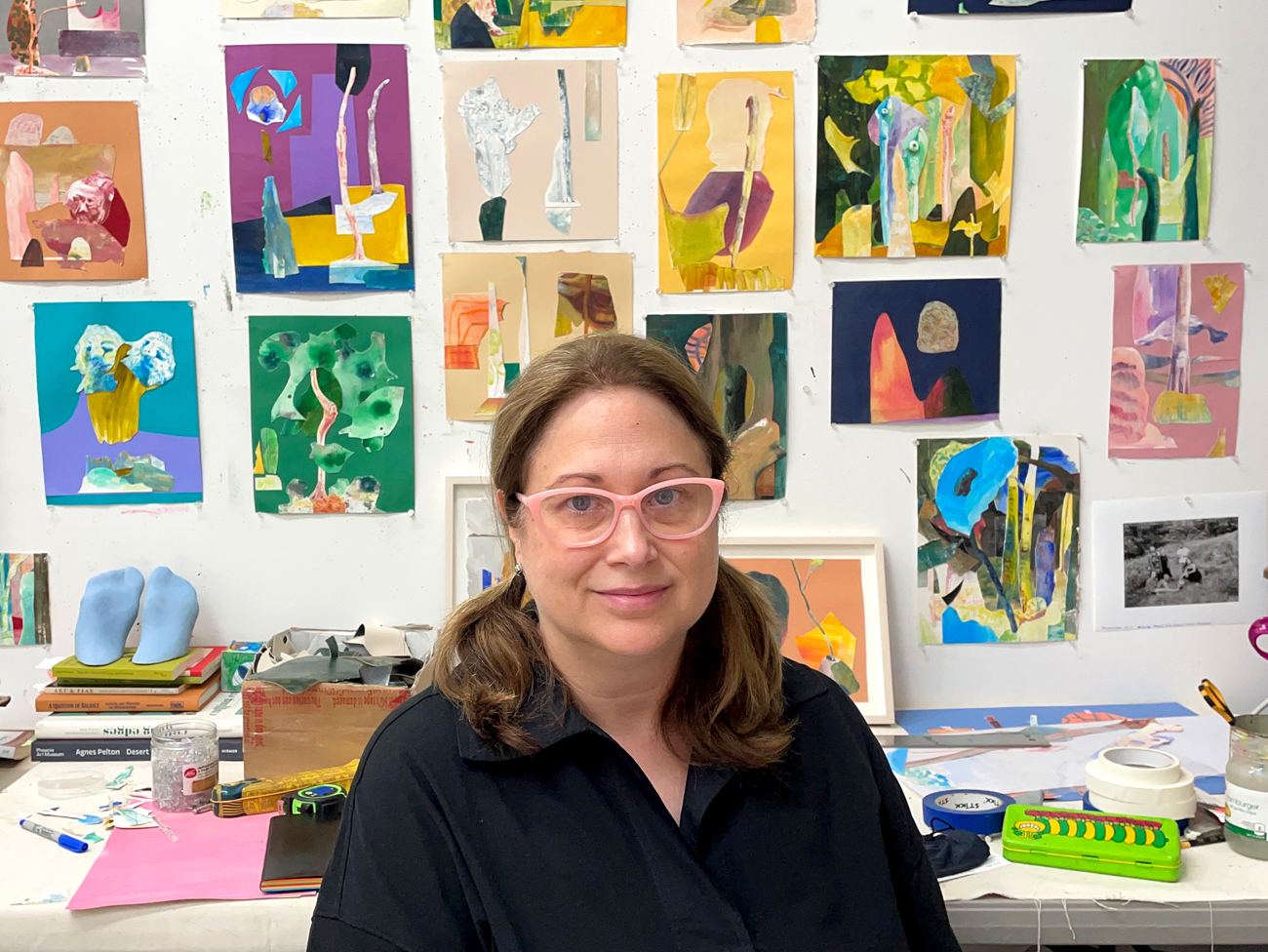
Amy Talluto in her studio in Upstate NY, 2021, Photo courtesy of the artist

Amy Talluto’s paintings and collages depict landscapes, ranging from representational wood-scapes to more abstracted forms reassembling a hybrid of landscape and still life. Darren Jones wrote in Artforum that Amy Talluto’s series of oil paintings from 2017 produce “symphonic arrangements of green, ranging from deepest phthalo to honeyed laurel. Dashes of pink, crimson, and yellow also crop up, to shimmering effect. The technical proficiency of her sumptuous compositions, based on forests around the artist’s Catskills home, parlays them into sites of ethereality.” (Darren Jones, Artforum). Recently, during the pandemic, the artist started exploring collage, resulting in bold cutouts, and consequently paintings, where the previously hinted pinks, yellows and crimsons become central alongside the blues and greens. Amy Talluto participates in The Upstate Art Weekend show at the rambling old manufacturing building in High Falls, NY. This art event was initiated by Todd Kelly, Alex Gingrow and Shanti Grumbine, who have studios in that building and have invited over 30 artists to show their work there from Aug 27-29, 11am-6pm.

Continue reading “Amy Talluto: Moments of Light in the Forest”

I Wish I had a River, The Underground Lobby Garden: Keren Anavy at ZAZ10TS

Art Spiel Photo Story

A picture containing outdoor, road, ground, person

Description automatically generated

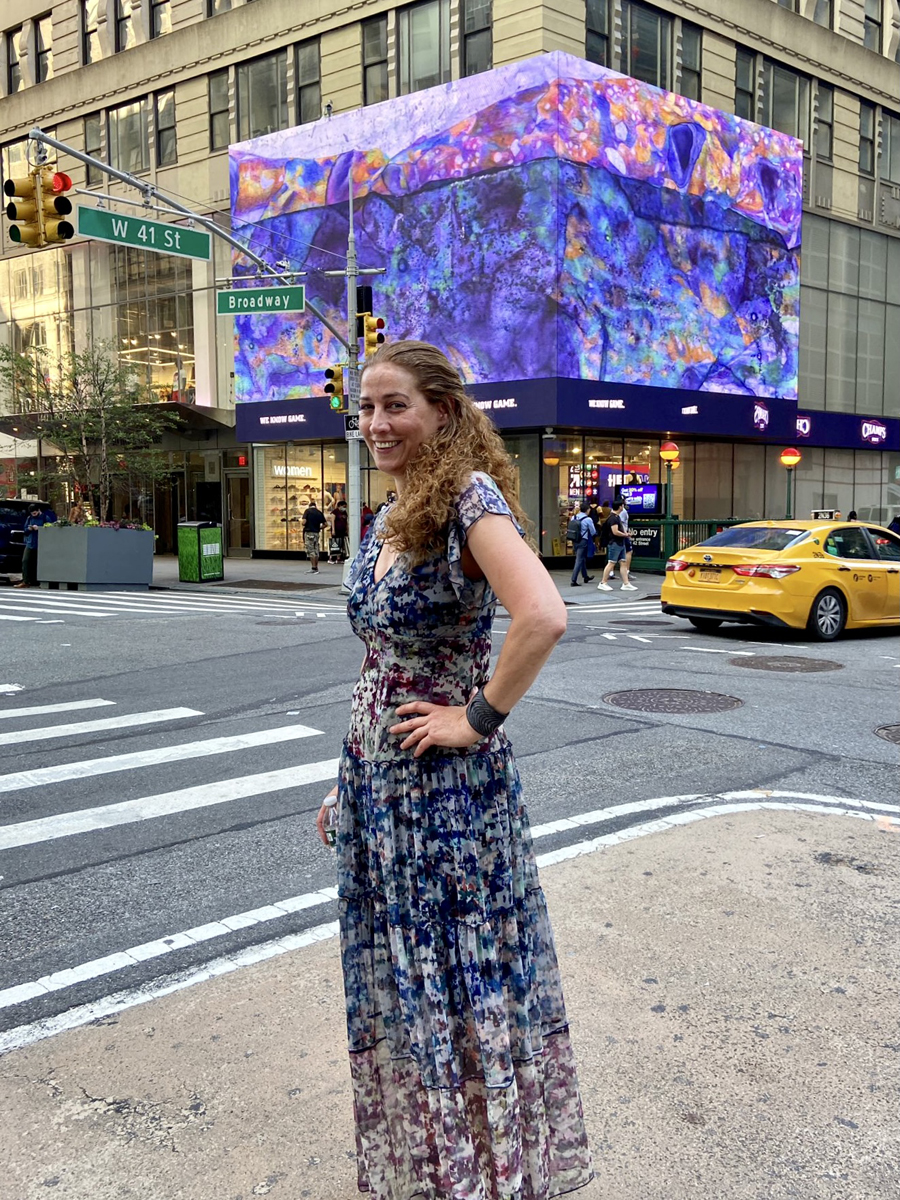
The artist in front of the billboards featuring her work, I Wish I Had a River, The Underground Lobby Garden.Photo credit:ZAZ10TS

Keren Anavy’s site-specific multi-media installation I Wish I Had a River creates a sense of a painted garden made of paintings, drawings, laser cutouts, sculptures, and video within the confines of the lobby of 10 Times Square. The artist draws on the history, architecture, and ecology associated with her installation site–the center of the bustling garment district; and Art Deco architecture of the building. Moreover, merely 40 years before its completion, New York’s biggest reservoir and supplier of all of Manhattan’s drinking water in the 19th century was decommissioned and torn down one avenue to the East. This relationship between nature, particularly water, functioning as a cultural agent and an important element of consumerism is of particular importance for Anavy, who grew up in a desert region of conflict, where the water resource was scarce. The show is curated by Lauren Powell and runs at ZAZ10TS through August 31, 2021.

Continue reading “I Wish I had a River, The Underground Lobby Garden: Keren Anavy at ZAZ10TS”

Ana Sophia Tristán: NaturalMente at Galería Matices in San José, Costa Rica

In Dialogue with Ana Sophia Tristán

A picture containing drawing, tree

Description automatically generated

CO-VIDA, Acrylic on canvas, 2020, 48 x 35 inches

Costa Rican painter Ana Sophia Tristán was set to open her solo show NaturalMente in April, but as was the case with many art events scheduled for this year, the exhibition had to be postponed until further notice as a result of the pandemic. Fortunately by the end of September, Galería Matices – located within the halls of the historic Costa Rica Country Club, felt ready to revisit the task of mounting the emerging artist’s exhibition and Tristan was able to hold a socially-distanced vernissage in late October. NaturalMente had always planned to present paintings from her ongoing series of semi-surrealistic works of figures immersed in nature, but the several month delay allowed the artist to debut a few new pieces inspired by COVID-19 as well.

Continue reading “Ana Sophia Tristán: NaturalMente at Galería Matices in San José, Costa Rica”

Joyce Yamada: Contemplating the Human Species


Joyce Yamada, Portrait, 2019, photo courtesy of Nila Onda

Painter Joyce Yamada grew up on the west coast. She spent her childhood vacations in the beautiful national parks of the US and Canada where pristine forests and the Pacific coast were imprinted in her visual memory. She recalls that although as a teenager she realized that art is her task in life, struggling to survive by minimum wage work led her to medical school which she completed and then subsequently became a diagnostic radiologist. This science background has fed her mind and artwork ever since. Yamada says she is a painter because she conceptualizes in images rather than in words — “when puzzled, my mind juxtaposes or fuses unexpected images, often leading to new work,” she says. For instance, an early series, Body, Earth, came to her in art school — while looking at the hills across the bay from San Francisco she saw the low rounded hills as the reclining body of a woman. The juxtaposed imagery meant to her that we are intimately and indivisibly part of earth and of nature, that what we do to the earth we do to ourselves. She has subsequently seen this idea expressed in indigenous cultures, and it became central in her work.

Continue reading “Joyce Yamada: Contemplating the Human Species”