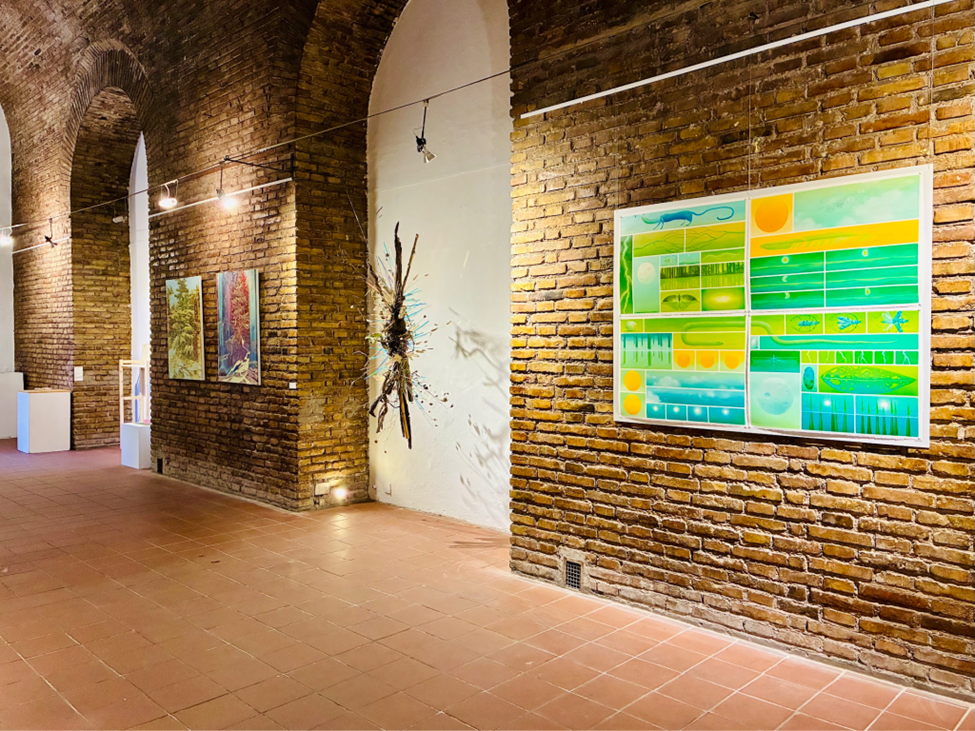
Installation view. Photo courtesy of Martina Tanga
Curator Martina Tanga had been reflecting on the ideas behind Learning With Trees – Artists for Climate and Environmental Solutions long before the exhibition took shape. In 2022, she read Ben Rawlence’s The Treeline, a book tracing how the Boreal forest is shifting under the impact of climate change. That reading sparked the idea that trees could serve as a highly accessible and disarmingly effective way to approach conversations about climate change.
Guy Nelson, The Road Not Taken, North Dakota Museum of Art
The North Dakota Museum of Art’s latest exhibition, Guy Nelson: Tales from the Understory, is a multidisciplinary solo show focused on the woodlands and prairies of the upper Midwest. Featuring sculpture, painting and video, the exhibition will be on display through July 20, 2025. This exhibition marks the tenth in the Museum’s Art Makers Series, an annual award for artists with connections to the region, which is underwritten by Dr. William F. Wosick of Fargo.
Installation shot (photo courtesy of 57w57st Gallery)
Willam Carroll’s newest painting series titled Trees has found a nice place to debut in 57w57arts. Each artist has their own room within the gallery space, the other artists include: Michael Voss, Steph Krawchuk, Seth Dembar, and Christopher Boyne. The rooms are also active office spaces where employees and clientele enjoy the work during appointments. Carroll’s series of seven new paintings on wood panels find themselves in the waiting room, stoically standing alongside a wonderful view of the New York Public library right outside of a nearby office window. Seeing the work within this space, especially it being a waiting room, allows viewers an opportunity for quiet contemplation, a foil to the hustle and bustle of what is right outside. You begin to feel as if you are journeying through the forest on a silent winter day.
Carl Cheng, Alternative TV #3, 1974-2016. Plastic chassis, acrylic water tank, air pump, LED lighting and controller, electrical cord, aquarium hardware, conglomerated rocks, and plastic plants. Courtesy of the artist and Philip Martin Gallery, Los Angeles
I often think about the first scientist who looked into a microscope and saw the dividing of cells, the jiggle of bacteria, and the movement of microorganisms. They must have marveled at the invisible worlds that were revealed. Similar to uncovering fossils of long-extinct species, we are humbled when we discover that we are only a tiny part of a much larger story. These monumental confrontations move us emotionally as much as they do intellectually, evoking within us a sense of awe and wonder. Close Encounters at Box Spring Gallery and Carl Cheng: Nature Never Loses at the Institute of Contemporary Art both ask us to consider our position within the cosmos, drawing attention to the fragility of our existence and the complicated ecosystems in which we live. Turning inward, allow yourself to be nourished by Ann Wehrwein’s Tender Ground at Pentimenti, where she renders quiet moments of everyday life with layers of color and care.
If you haven’t visited the little paradise up in the Bronx called Wave Hill recently, now is the time to go there, not only to experience the beautiful gardens but to see exhibitions that are not to be missed, one of them being Stephanie Beck’s Bough. Beck, who has always been a risk-taking sculptor, either building cities out of paper or manipulating wood into gravity-defying constructions, speaks with me about her latest body of work constructed from materials found at Wave Hill and bringing to light crucial environmental issues beautifully and elegantly. This is the last week to see the show, which runs through December 1st, 2024.
Installation by Natalie Collette Wood, Urban Oasis: Nature in Transit at Chashama 53rd St & 5th Ave Underground Subway Newsstand. Photo courtesy of the artist and Chashama
During the slow and hot month of August, Art still thrives through ChaShaMa in unexpected places around midtown. ChaShaMa – a nonprofit organization that provides studio and exhibition spaces for artists in midtown real estate and other venues throughout the five boroughs – empowers unique and surprising opportunities for installations across the City.
The artist withBig Yellow, 18″ x 11″ x 7.5”; ceramic; 2017. Photo Credit: Linda Cunningham
Ten years ago, Judy Hoffman became enthralled with clay and hand-building. The current exhibition Evolvers and Wildtypes at the Long Island City Sculpture Space is her first solo show of these ceramic sculptures. Hoffman’s ceramics’ imagery and forms tap into a previous installation work made from sculpted paper pulp, natural materials, and man-made debris. Paper clay techniques permit the bonding of wet clay to fired forms, enabling the construction of diverse configurations. These components are conjoined to initiate a dialogue between organic and mechanical elements, yielding imagery that defies expectation. The artwork evolves through a rhythm of construction and deconstruction, encapsulating cycles of creation, deterioration, and renewal. Viewers are meant to encounter an elemental rawness, surprise, and a touch of humor.
Ashley Garrett: Ambrosia, Garrett’s second solo show at SEPTEMBER in Kinderhook, NY, features a body of work she has made over three years—some evolved over years and others more quickly. Garrett has been working on large-scale 94 x 57-inch paintings on canvas since 2019. Garrett says that the weaving of brushstrokes creates a space that changes perspective between up and down, water and air. The gallery space also offers an experience of movement with sight lines through three distinct rooms. In the installation, small paintings on canvas can be seen from each corner of the rooms to the farthest corners of the gallery.
The work included in Strange Brew, Denise Sfraga’s solo show at the Garage Art Center, explores the life cycle of plants. This fascination with plants has always been at the root of the artist’s creative inspiration. Sfraga, who is based in New York City, says that working in her own garden and experiencing its constant state of flux, gives her the opportunity to witness first hand actual seed germination, leaf and flower growth, the dispersion of the next generation of seeds and the final stages of decay, “an ever evolving landscape of life forms that change color, shape and appearance daily.”
Hovey Brock: Frost Valley, 2019, 36” x 48”, acrylic on panel
A central theme in my Crazy River project has been highlighting the emotional toll of the climate crisis by putting under a microscope, so to speak, my own feelings about not only the impacts of the crisis but the knowledge that humans’ actions are the cause. This series of three on-line essays, thought experiments if you like, expands that project to change the POV to non-human actors that are inextricably bound with the habitat in the Western Catskills: the black-legged or deer tick (Ixodes scapularis), the white-tail deer (Odocoileus virginianus), and Japanese knotweed (Reynoutria japonica). All three have seen their habitat change dramatically through climate change and human interventions. Using my imagination and research, I try to enter the umwelt of all three species, an impossible task, as Thomas Nagel pointed out in “What Is It LIke to Be a Bat,” for which artistic license may give us the best chance to accomplish. My intentions in doing so fall along three axes: theoretical, aesthetic, and spiritual, dimensions all essential to my own art practice. What follows is a look at the umwelt of white-tailed deer from the perspective of aesthetics.