On April 26th and 27th, from 1 to 6 pm, artists in DUMBO will open their doors to the public as part of DUMBO Open Studios, offering a rare look inside the art studios along the Brooklyn waterfront. Since the 1970s, DUMBO has been shaped by its vibrant art community. This interview series highlights a handful of participating artists in 2025. Each response offers a glimpse of what’s waiting behind the studio door. Cheryl Wing-Zi Wong has been in DUMBO since 2015. Her studio is at 20 Jay Street #M10B (mezzanine level).
Wind Challenge III at Fleisher Art Memorial, partial installation view, Alexis Granwell (left) and Brynn Hurlstone (right)
There are many thought-provoking shows in Philadelphia this July. Beginning at Fleisher Art Memorial, three innovative Philadelphia sculptors combine materials in unexpected ways to reflect on intimacy, vulnerability, and natural phenomena. At the Fabric Workshop in center city, artist John Jarboe brings her cabaret aesthetic to create a stunning immersive experience titled Rose Garden following her life and gender journey. In Kensington, at Peep Projects Todd Stong’s delicate drawings and wall-sized multi-panel monotype reflect on the complexities of history, contemporary life, and what the artist terms queer cultural production.
Simona Prives’s latest installation at Philadelphia’s PRACTICE Gallery, towards the noise of dark waters, combines projection and collage to explore themes of renewal and decay. This site-specific installation by the Brooklyn-based multi-disciplinary artist features life-sized projections of collages built upon densely packed drawings, ink paintings, and various printmaking techniques. These collages suggest maps, geological patterns, and industrial imagery, creating abstract yet recognizable worlds.
Valérie Hallier working on the series Déflorée History in her studio during a residency with ESKFF at Mana Contemporary, NJ., 2023
Flower petals gradually became a significant element in Valérie Hallier’s artwork. Fascinated by the profound symbolism of flowers, Hallier initially struggled to incorporate them effectively into her artistic practice. Her initial approach involved photographing flowers in unique ways and settings. She also experimented with their dried components, adhering them to various surfaces. Eventually, she began to focus on pressing individual petals. Hallier discovered that working with petals was ideal for conveying complex themes such as femininity, resilience, sexuality, vibrancy, and decay. Born in Paris, France, and raised in Normandy, Hallier had a shy nature as a child. She was consumed with the ambition to draw everything in existence, a desire for comprehensiveness that continues to influence her work. Art, for her, has always been an essential means of engaging with both her internal and external worlds. Reflecting on her early art education, Hallier fondly remembers her excitement upon meeting others who shared her artistic ‘language.’
Susan Hoffman Fishman, The Earth is Breaking, Beautifully VII: Dead Sea Sinkholes, acrylic, oil pigment stick, cyanotype and mixed media on paper, 51” x 51,” 2023
Susan Hoffman Fishman is an artist who has addressed climate change for many years both in context of her own work as an artist and in her writing on other artists’ work in that arena. Hoffman was first interviewed with Burning Worlds about four years ago and has recently been interviewed there again on her latest series of paintings depicting coastline sink holes and other landscapes impacted by climate change,
Moby Dick Illustration by Augustus Burnham Shute, Public domain, via Wikimedia Commons
Gather round, me hearties, and let me tell you a tale: a tale about a much-dreaded comment received by many an artist on Instagram and during a studio visit. This comment can sound like a terrifying roar made by a fearsome beast. And it’s called—the “Leave-It-Like-That.
It’s the kind of comment we might receive on our works-in-progress (a struggling fawn just starting its wobbly walk). And we may have blithely thought to ourselves, “Hey, why don’t I post this WIP on the ‘Gram and give people a window into my process!” But…Beware ye who enter here. This generous sneak peek could attract a Leave-It-Like-That (or even its frightening brethren: the “Stop-Don’t-Touch-It” or the “Looks-Finished-To-Me”).
Rec Lobe TV, University of Wyoming Art Museum, 2022, Police Scanner, monitor, projections, sound, laptop, printer, printouts, speakers
NonCoreProjector is a collective of visual artists, technologists, scientists, and musicians experimenting with physical, biological, conceptual, and political data systems, along with human/AI symbiosis. In their projects they explore consequential relationships between spoken and written language and multisensory, visceral experience. Their project Rec Lobe TV is currently exhibiting at The University of Wyoming Art Museum through December 23, 2022. The NCP collective members—Jack Colton, Elias Jarzombek, John O’Connor, Rollo Carpenter and Nat Clark—are in conversation with Art Spiel about their projects and collaborative work.
In Steven Pestana’s imaginative mixed media installation at Peep Space, light, shadow, projection and reflection integrate through poetic transitions and passages. The show runs from May 20th through June 19th, 2022.
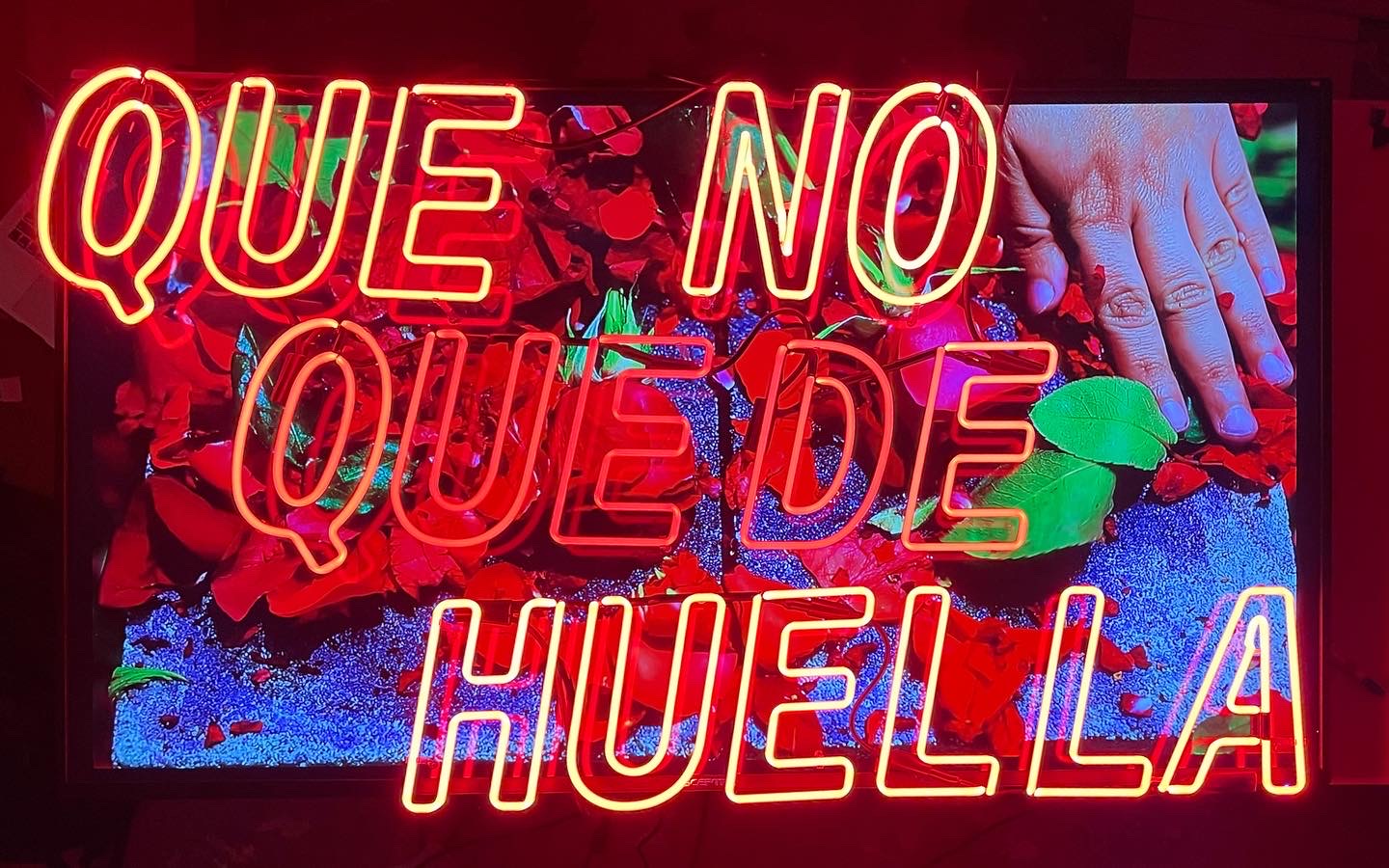
Jesus Benavente, Quede Huella (Let There Be No Trace), 2022, Neon video, 49.5 x 29 x 8 inches. Photo courtesy the artist.
At 291 Grand Street, a bright red glow radiates from Home Gallery, a storefront window exhibition space in the Lower East Side. The light comes from large, fluorescent neon letters that spell out “Que no Quede Huella,” which are layered over a flat screen TV playing a rotating series of videos. The installation is the latest iteration of multimedia artist Jesus Benavente’s neon video sculptures, displayed in the exhibition Que no Quede Huella (Let There Be No Trace), curated by Elisa Gutiérrez Eriksen.
Kris Grey (NYC) and Barbara Maria Neu (Austria), Miss(ing), 2021. Video (runtime: 4 minutes, 8 seconds), performance (15 minutes) and sculptures. Photos: un/mute team
How can artists unmute themselves and make work in creative dialogue with each other while they experience forced solitude at faraway places? How can collaborative practices be reinvented in social isolation? And how can virtual and chance encounters between strangers can lead to the making of jointly authored images and objects? The un/mute project, initiated by EUNIC New York and Undercurrent, the independent exhibition space in DUMBO, was an attempt to probe these questions by inviting 32 artists to work across borders, languages, and media, while sharing the global experience of the Covid-19 pandemic at distant locations, under varied social circumstances, and in cultural contexts.