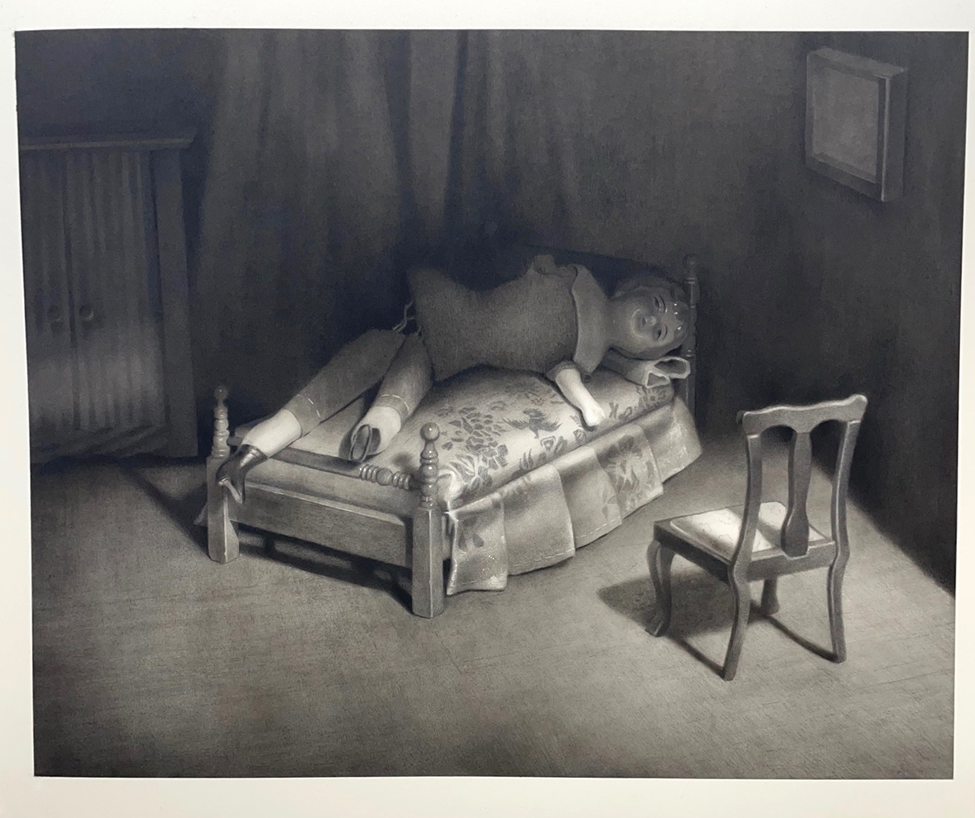
Athena Parella, Bedtime Story, Charcoal on paper, 17.5 x 22, 2025
“Childhood” has always been a fertile source for artists in all disciplines. We all had a childhood and, for better or worse, we all carry memories that often haunt us throughout our lifetimes. Ruby/Dakota, a scrappy young gallery in the East Village is presenting a two- person show entitled What The House Dreams Of that brings together two young artists with memories to share.
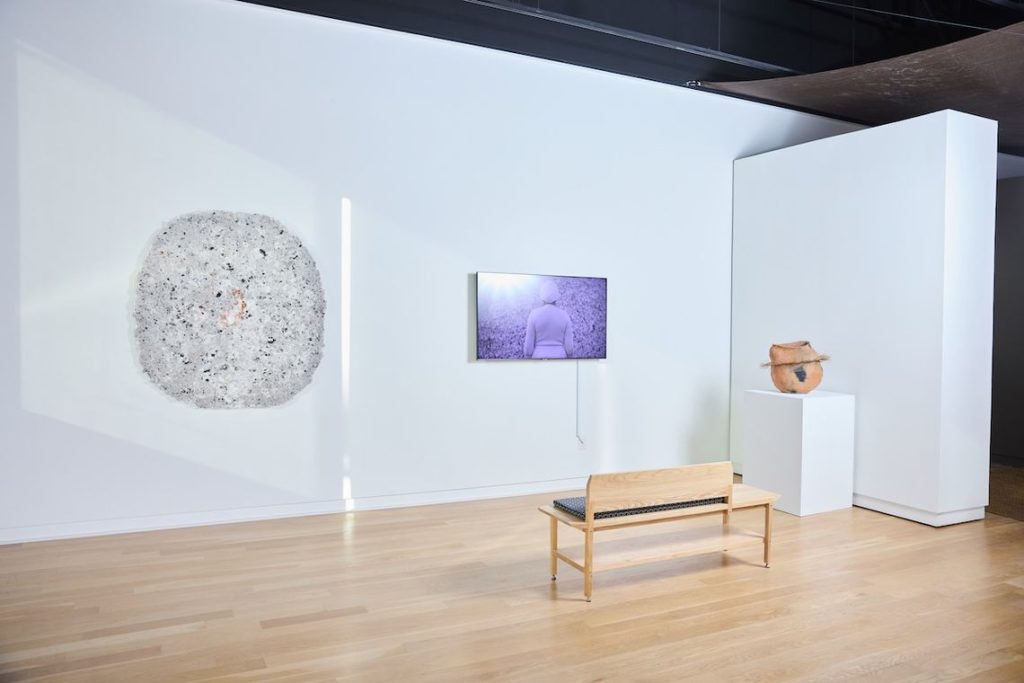
Clay as Care Installation view. Photo by The Clay Studio
Just as a solitary action can cause a ripple effect, the sharing of unique ideas can inspire and transform existing systems to include and support different communities. The exhibitions this month demonstrate genuine curiosity and meaningful activation, leading to a trend of revisionist histories in art, institutional displays, or familial archives. Curators Jennifer Zwilling and Nicole Pollard reinvent how gallery exhibitions should be interacted with and ask the question of how clay can assist in caring for mental health at The Clay Studio. Artists Mahsa Attaran, Monica Hamilton, Hanieh Kashani, and Anna Schwartz create a language to describe the power of memory as they mine through personal photographs and materials at Automat Collective. Calero Rodríguez establishes her own History of Art, incorporating Latino, Afro, and Carribean imagery in masterly assembled collages at Taller Puertoriqueño.
The Essence of a Moment, a group exhibition presenting a collection of artists’ contemplations on the makings of a moment. A moment is by its nature fleeting, and it’s by our nature as people that we seek to extend or preserve them; despite their intangibility. This group show engages with the questions – How can one define something as nebulous as a moment? Is it done retrospectively after it has passed? Is it a confluence of occurrences? Or perhaps it exists with the body’s perception of the present moment? These works offer a variety of insights and perspectives into understanding a moment.
Emily Sundblad, The Adolescent Ocean, installation view, Bortolami, New York, 2025
A person who can sit through a Survey of Art lecture set to a Leonard Cohen soundtrack while reading The Waves may be well equipped to navigate Emily Sundblad’s Adolescent Ocean. Personal history intermingles with cultural and art iconography, forming a tide of debris that floats to the surface in this show of collage-like, collective memory-dreams.
Vojislav Radovanović at the studio. Photo by Jason Jenn
Vojislav Radovanović’s multidisciplinary practice spans painting, drawing, installation, video, and performance. His work touches upon themes of queerness, memory, the immigrant experience, spirituality, and the complex relationship between humans and the natural world. Influenced by his upbringing in Serbia during a time of war and social upheaval, Radovanović approaches art as a therapeutic space for healing and transformation. His process-driven works often combine recycled materials, vibrant color, and symbolic imagery to create poetic, emotionally resonant narratives. Through layered compositions and dreamlike logic, he invites viewers into a shared space of reflection, imagination, and emotional release.
The group show Duae Lingua at The Brâncuși Gallery in the Romanian Cultural Institute began as a personal reflection on curator Daniela Holaban’s migration journey from Romania to the United States and gradually evolved into a broader curatorial inquiry into dual identity and cultural translation through the lens of Eastern European women artists. “Initially, I was interested in the dissonance between linguistic and cultural fluency—how even after mastering a language, true belonging can remain elusive,” says Holban. In this interview with Art Spiel, Daniela Holban elaborates on how that concept became the foundation for the exhibition, using language as both metaphor and framework to explore themes of identity, memory, and assimilation.
In the group show Mindscape: Patterns of Identity at L’Space, people, animals, and places shift and juxtapose, coming together like pieces of a map—one that charts the shared inner terrain of memory, trauma, and identity. Curated by Noa Rabinovich Lalo and Carolina Werebe, with L’Space founder Lily Almog, the show, as Almog puts it, draws on “a shared Israeli heritage and a deep connection to the contemporary art scene in Israel, a country with a rich cultural history and traditions amidst ongoing uncertainty.” And it’s that sense of uncertainty that pulls everything together—voids and absences linger in the air. Even when the work seems rooted in specific places, the setting remains layered and elusive, offering more questions than answers. This is evident in Netta Lieber Sheffer’s sweeping charcoal drawing installation of Sigmund Freud’s Vienna clinic, where he lived and worked for 47 years before fleeing the Nazis in 1938.
In Running Line, on view at FORMah gallery, objects stripped of function take on new roles: charged, amorphous, and poetic. Israeli artist Noga Yudkovik-Etzioni creates a space where memory, material, and form converge through elongated installations on the floor and a series of small wall-mounted paper-based reliefs
Chaos, Video projection mapping and AI animation splash around large and small white cardboard boxes; these display facets of the memories and experiences that are hard to relinquish.
Artist Beverly Peterson has been squirreling away the components of Self-Storage in her studio over several years—collecting, modifying, situating, upending, and repositioning things, paintings, photographs, video, and film. She describes this work as a “deeply personal, emotional, and immersive experience that invites visitors to reflect on their own memories as they explore a dreamlike environment.” It is that, but that’s like describing a particular person as an “ambulating biped with hair.” There’s more.
Art as Political Vehicle? Pritika Chowdhry, Marcelo Brodsky, and Rafael Yaluff
Marcelo Brodsky. 1968, Fire of Ideas. Kingston, 1968. 60 x 90 in. Overwritten photograph. Courtesy of the artist and Henrique Faria Fine Art.
Exhibiting in Conflictual Distance at EFA Project Space within the framework of The Immigrant Artist Biennial: 2023 Contact Zone Pritika Chowdhry, Marcelo Brodsky, and Rafael Yaluff explores, in Oraib Toukan’s formulation, ‘cruel images.’ Images that contain evidence of political and bodily violence but are confronted at an extreme political or geographic distance from their events’ site of occurrence. Together with the artists, co-curator Anna Mikaela Ekstrand discusses the politics of art and how the artists approach personal histories and historical and political events before the exhibit.