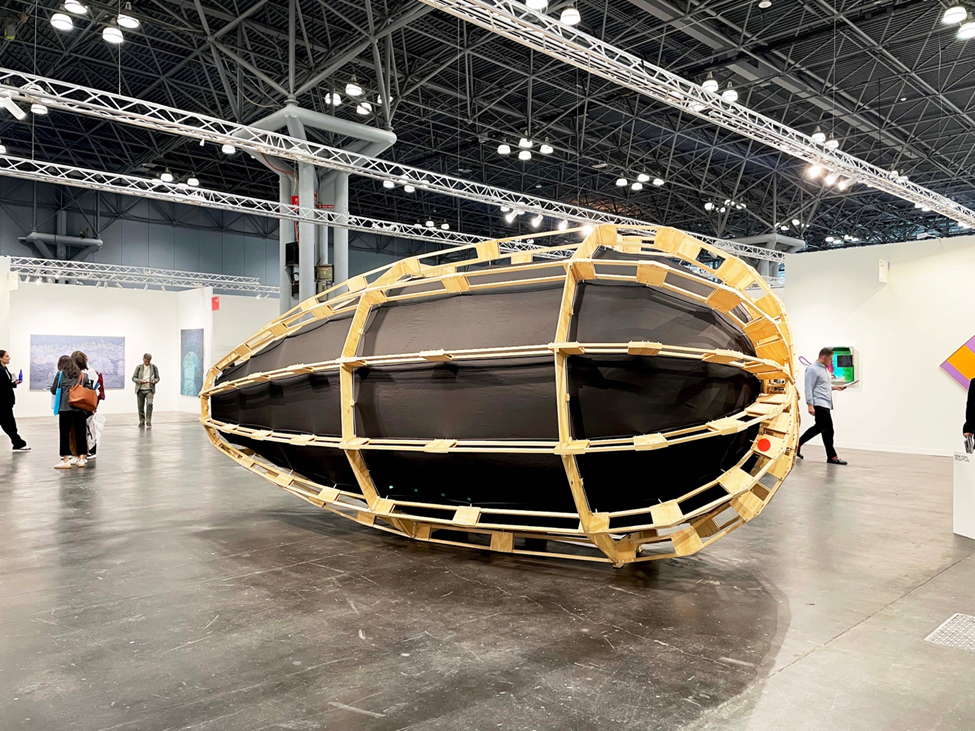
The Armory Show 2025 – Daniel Zeller “Inference,” 2015, Mixed media, Approx. 95 x. , Pierogi Gallery. Photo by Eva Zanardi
September in New York is a sensory crescendo—fashion, tennis, and art converge in a city that thrives on spectacle. At the center of it all, The Armory Show 2025 returned to the Javits Center from September 4–7, hosting over 230 exhibitors from 35 countries and drawing more than 50,000 visitors. This year’s edition, the second since its acquisition by Frieze, was slightly smaller than last year’s—but no less ambitious. Dealers reported strong momentum from VIP day onward, especially for works at lower price points, while higher-priced pieces moved at a measured pace. Many noted a noticeably younger crowd—engaged, curious, and eager to discover.
This is part of a series of articles for the upcoming exhibition, The Greatest Emergency at the Circulo de Bellas Artes of Madrid. The exhibition is based on Santiago Zabala’s book, Why Only Art Can Save Us: Aesthetics and the Absence of Emergency. In this exhibition, ten contemporary artists rescue us into our greatest emergencies, that is, those we do not confront as we should. Each article in the series will contextualize these artists’ practices and explore how they are linked to Zabala’s aesthetic theory and the exhibition’s themes. The fourth article in this series highlights the work of kennardphillipps.
Diane Burko, Amazon 7, Diptych A, 2022, mixed media on canvas, 20×20 inches, In the collection of Joseph and Pamela Yohlin
This is part of a series of articles for the upcoming exhibition, The Greatest Emergency at the Circulo de Bellas Artes of Madrid. The exhibition is based on Santiago Zabala’s book, Why Only Art Can Save Us: Aesthetics and the Absence of Emergency. In this exhibition, ten contemporary artists rescue us into our greatest emergencies, that is, those we do not confront as we should. Each article in the series will contextualize these artists’ practices and explore how they are linked to Zabala’s aesthetic theory and the exhibition’s themes. The third article in this series highlights the work of American artist Diane Burko.
This is part of a series of articles for the upcoming exhibition, The Greatest Emergency at the Circulo de Bellas Artes of Madrid. The exhibition is based on Santiago Zabala’s book, Why Only Art Can Save Us: Aesthetics and the Absence of Emergency. In this exhibition, ten contemporary artists rescue us into our greatest emergencies, that is, those we do not confront as we should. Each article in the series will contextualize these artists’ practices and explore how they are linked to Zabala’s aesthetic theory and the exhibition’s themes. The second article in this series highlights the work of American artist Josh Kline.
Beverly Fishman, I dream of Sleep, 2020. Installation. Courtesy of the artist and Miles McEnery Gallery
This is part of a series of articles for the upcoming exhibition, The Greatest Emergency at the Circulo de Bellas Artes of Madrid. The exhibition is based on Santiago Zabala’s book, Why Only Art Can Save Us: Aesthetics and the Absence of Emergency. In this exhibition, ten contemporary artists rescue us into our greatest emergencies, that is, those we do not confront as we should. Each article in the series will contextualize these artists’ practices and explore how they are linked to Zabala’s aesthetic theory and the exhibition’s themes. The first article in this series highlights the work of American artist Beverly Fishman.
Unlike many art historians and art critics, philosophers do not look for works of art that are necessarily beautiful or interesting. Most of us—at least those educated in the continental tradition of Hegel, Nietzsche, and Arendt—instead look for works that disclose a theoretical stance. Martin Heidegger’s writing on Van Gogh’s shoes paintings, Arthur Danto on Andy Warhol’s Pop Art, and Jacques Rancière on Alfredo Jaar’s photographs are paradigmatic examples. This does not mean we do not care about the artist’s effort in creating such work; rather, we focus more on whether the work discloses an aesthetic notion, political idea, or anthropological concept that has meaning for society at large. Artists, for us, have the same ontological purpose as scientists or politicians. A great work of art, new scientific discovery, or progressive policy can change people’s relationship with reality. If these works, discoveries, and policies change this relationship, it is not necessarily because they are “better” than others but because they touch our existence to a greater degree.
The Spanish born, New York based artist Pablo Garcia Lopez makes mixed media reliefs and sculptures which evoke hybrid forms resonating with Baroque imagery, biological forms, and at times Victorian delicate ornaments. His Spanish heritage, coupled with his background in biochemistry and Neuroscience largely inform his visual vocabulary and themes.
Rosa Valado, Time, detail, mixed media on paper, 8′ x 16′, 2017 , photo courtesy of Rosa Valado
The Spanish born NYC based artist Rosa Valado has prompted in her immersive installations multi-layered sensory experiences, utilizing diverse approaches, from the smell of burning wax and music to architectural elements and engineering problem solving. Throughout her body of work which includes besides installation, drawings and paintings, she has been exploring notions of space and time by engaging with ideas on architecture and light. Rosa Valado shares with Art Spiel some of her formative art experiences, her process, ideas, and projects.