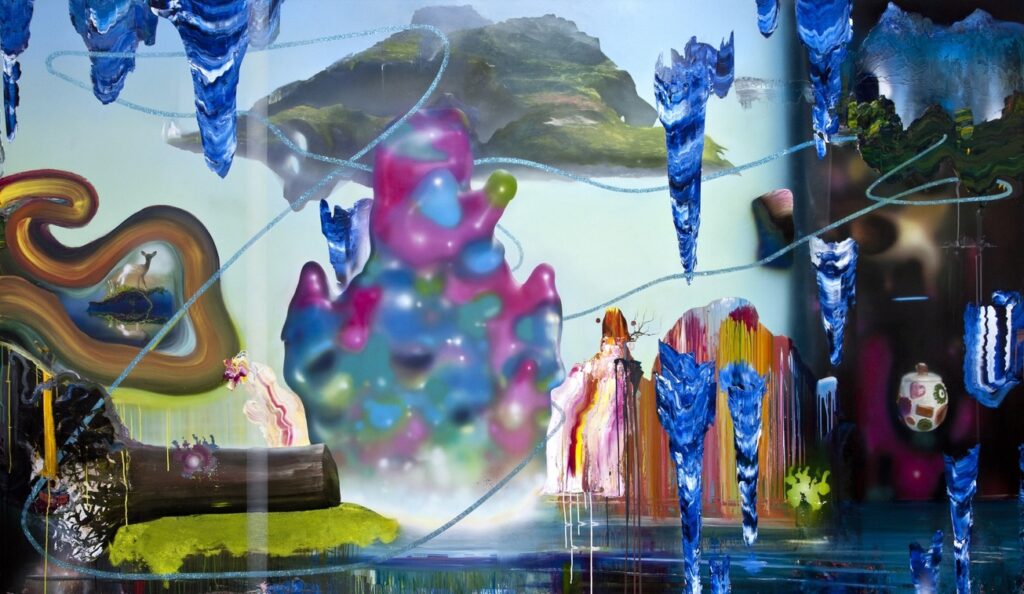
Tom LaDuke, Chain, 2015, Acrylic and canvas over panel, 87” x 153”
Across trippy, iridescent seas, massive, eerie interiors, and uncanny, translucent forms, Tom LaDuke composes intimate “letters” to the cultural ghosts that shaped him—poetic reflections on perception, memory, and the subtle currents of emotional drift.
Love letters straight from your heart Keep us so near while apart I'm not alone in the night When I can have all the love you write
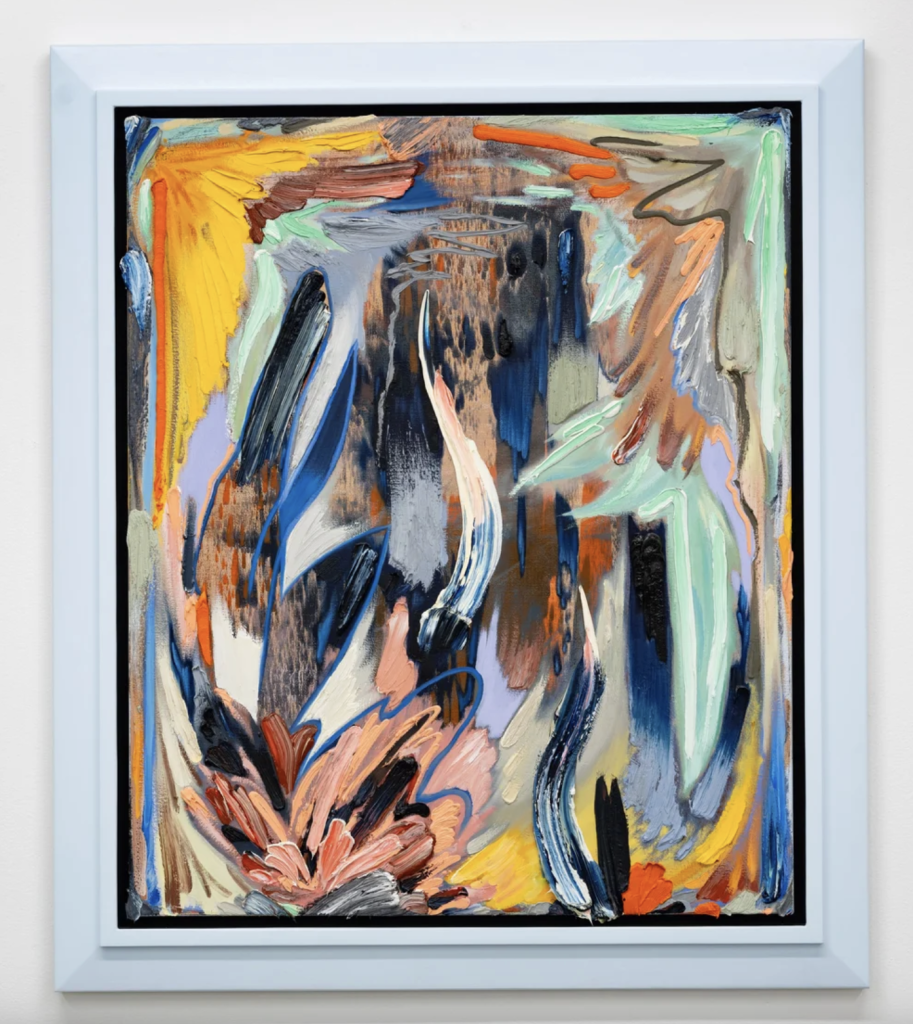
Jonathan Syme, Receding, Shy Daylight, 2024, oil on canvas in artist frame, 43” x 37”. Courtesy of Royale Projects
Jonathan Syme paints like someone coaxing spirit from matter—a phrase that sounds mystical until you’re standing in front of the work, where it becomes simply descriptive. As restless as they seem, his canvases don’t argue or perform; they resonate, like a vibration passed through the soles of your feet. Thick skeins of paint are unearthed, revealing strata in a geologic dig of intuition. There’s a kind of archaeology to the gesture: gouges, stains, and eruptions of impasto build a type of sedimentary record, chronicling attention. The eye slows down, and with it, thought.
Sculptural Garden, Installation Shot, photo courtesy of Hollis Taggart
Seeing John Knuth’s exhibition, The Hot Garden, at Hollis Taggart’s new downtown outpost was wonderful, surreal, energetic, and unexpected. This is Knuth’s first major body of work following the devastating Eaton Fire in January 2025, which destroyed the artist’s home and archive. This exhibition gives us an opportunity to see fragments of the past and the birth or rebirth of something entirely new out of the ashes, embodying the quote in the press release from Octavia Butler’s Parable of the Sower, writer and once Altadena resident, “All that you touch, you change. All that you change, changes you.”
Vojislav Radovanović at the studio. Photo by Jason Jenn
Vojislav Radovanović’s multidisciplinary practice spans painting, drawing, installation, video, and performance. His work touches upon themes of queerness, memory, the immigrant experience, spirituality, and the complex relationship between humans and the natural world. Influenced by his upbringing in Serbia during a time of war and social upheaval, Radovanović approaches art as a therapeutic space for healing and transformation. His process-driven works often combine recycled materials, vibrant color, and symbolic imagery to create poetic, emotionally resonant narratives. Through layered compositions and dreamlike logic, he invites viewers into a shared space of reflection, imagination, and emotional release.
Rose Briccetti’s interdisciplinary and intermedia practice combines deep historical, artistic, and scientific research with artmaking to re-present natural and cultural histories to question systems of power. Her work surrealistically weaves together strange truths, biology, museology, cultural myths, internet culture, and personal experience using humor and vivid visuals.
L.W.D. sees himself as an observer of modern society—a world that has, in many ways, passed him by over the last three decades. L.W.D.’s work is rooted in the assertion of his personal identity within the fractured American society. His art reflects the painful shift from childhood to adulthood, a transformation that feels almost brutal, marked by the loss of innocence in the face of America’s historical realities. His perspective of the American way of life, capturing both the disappointments and fleeting joys, recalls the social commentary of Philip Guston—particularly in the simplicity of his cityscapes, yet with a distinctive handwriting, palette, and choice of subjects. L.W.D.’s visual language fuses the emotional character originating from blues lyrics and the iconic symbolism of Roy Lichtenstein’s pop art. Working within the tradition of the naive picturesque narrative, L.W.D. incorporates the humor of a comic book while maintaining his focus on the historical and the social.
First thing that pulled me into Shiva Ahmadi’s Tangle exhibition were the pressure cookers. It took me a moment to recognize them: from a distance, they appeared as intricate decorative objects and archaeological relics simultaneously. While the vintage pressure cookers evoked associations of domestic warmth and memories of my grandma’s kitchen, their surfaces etched with Arabic calligraphy and floral ornamentation recall artifacts from a Persian or Arabic cultural heritage museum. The patience and meticulous craft of such engraving parallels the labor of generations of women who spent countless hours in the kitchen crafting their family’s meals.
All persons to whom license certificates have been issued shall not lend or allow any other person to have, hold or display such certificate; and any person so parting with a license certificate or displaying the same without authority shall be guilty of a misdemeanor Image courtesy the Artist and Moskowitz Bayse
Julia Weist’s new exhibition Private Eye, currently on view at Moskowitz Bayse in LA, blends artistic practice with journalistic research to investigate how big data operates in America. In 2021, companies in the United States spent over $110 billion on big data. Weist’s work taps directly into this massive industry, which buys and sells our personal information without consent.
I Go to Seek a Big Perhaps, installation view, courtesy of the gallery
August in LA may be the hottest month of the year, but definitely not so hot for the art scene. Still, while many choose to spend the month traveling, some of the most unconventional and interesting spaces in town are putting up excellent summer shows that gather a lively crowd for their openings. Some standouts are Make Room, La Loma Projects, and Track16.
Ernesto Renda and Katie Hector in their studios. Images courtesy of the artists.
Ernesto Renda and I first met on the internet, as more and more artists do. A follow turned into likes, which developed into mutual curiosity and respect for each other’s practice. Renda, who lives in New York, and I in Los Angeles, kept in touch for months, viewing miniature backlit versions of the other’s work while each suspecting there was more than met the eye. As fate would have it, Renda’s solo exhibition, The Moment of Truth, opened at Moskowitz Bayse in Los Angeles; subsequently, my solo exhibition, EGO RIP, opened at Management in New York City two weeks later. Viewing the work in person was enlightening and generated conversations around material play, intuition, and the verisimilitude of our subjects. These brief yet poignant chats inspired us to pose the questions below from the perspective of one visual practitioner to another.