Jenny Holzer’s Hypocrisy

Opinion
Walls of the Guggenheim Museum bathed in a purple glow. A scrolling LED text installation winds up the ramps of the Guggenheim Museum, displaying texts written and curated by the artist, leading to a blue sky beyond the oculus.
Installation view, Jenny Holzer: L: right Line, May 17-September 29, 2024. Solomon R. Guggenheim Museum, New York. @2024 Jenny Holzer, Artists Rights Society (ARS), New York, Photo: Filip Wolak

“I want people to concentrate on the content of the writing and not ‘who done it.’ I want the work to be of utility to as many people as possible. And I think if it were attributed to me, it would be easier to toss.”

Quote by Jenny Holzer from Art21

Recently, I wrote an opinion piece on the suspect politics of Maurizio Cattelan’s show at Gagosian Gallery — it questioned why successful artists who make political claims for their work do not use their privilege to engage in direct political commentary and action rather than critique by analogy. I’m not suggesting they need to engage in social practices like Mel Chin or Tania Bruguera; I think artists like Cattelan can be more direct in their criticism or more like Theaster Gates, who acknowledges the contradictions and privilege that comes with his success to the degree that he openly differentiates between museums and institutional exhibits that permit him to experimentation and his gallery exhibits that afford him market engagement. Meanwhile, while those works have an implied politic, he is an activist who focuses on community development, which is realized through his Chicago-based Rebuild Foundation, which is a platform for cultural development and neighborhood transformation. This multifaceted approach enables Gates to navigate and influence both the art world and broader societal issues without collapsing one into the other.

Continue reading “Jenny Holzer’s Hypocrisy”
Maurizio Cattelan’s Hypocrisies

Opinion
View of Maurizio Cattelan’s 2024 exhibition “Sunday” at Gagosian, New York. Photo Maris Hutchinson

The conjunction of art and politics is a confusing and often compromised enterprise. The commentator Ben Davis argues that as our society regresses under the politics of neoliberalism, such art serves a “compensatory role.” Much explicitly political art is either pedantic or satirical. There’s a long history dating back to the Incoherents and Decadents, the late 19th-century artists who embraced absurdity, irrationality, and the grotesque to protest against emerging bourgeois values and the academic practice of art. They used parody, satire, the carnivalesque, as well as didactic and pedantic jokes to expose cultural ideocracies and societal flaws. This was followed by the Dadaists in the early 20th century, who expressly mixed real-world politics and provocative, anti-art gestures with the intention of undermining social and artistic conventions and setting the groundwork for a social and cultural revolution. Since then, and as an avant-garde compliment to social realism, there has grown up a tradition of the trickster artist—pranksters using absurdity, parody, and gestures to scandalize and provoke their audiences.

Continue reading “Maurizio Cattelan’s Hypocrisies”

Peter Eudenbach: From Cricket Songs to Solar Panels

In Dialogue

A framed picture of a person sitting in a chair

Description automatically generated

Virginia-based artist Peter Eudenbach says that while he has always been interested in making things, his pathway to studio art was through the humanities. The history of art and ideas became part of his language even before he found his voice as an artist. His belief that studio practice has the most potential to make sense of human experience was a significant driver in his choice to pursue an art career.

Continue reading “Peter Eudenbach: From Cricket Songs to Solar Panels”

Impossible Failures at Zwirner

Opinion
A photo of Pope.L in his studio, dated 2022
Pope.L, studio, 2022, photo courtesy of David Zwirner Gallery 52 Walker

When I heard about Impossible Failures it promised to be an exciting exhibition, in that it was to bring together Gordon Matta-Clark (1943–1978), a White post-Minimalist artist best known for his site-specific works of cutting through buildings and homes, and Pope.L (b.1955), a Black artist who used to describe himself as the friendliest Black man in America, and is known for his public performances and installations, which address Black racial stereotyping and other such hypocrisies. In a not un-interesting way, the resulting exhibition is a curatorial mash-up in which the works in it are overwhelmed. As such, this is not an exhibition where the works of each artist supply a context for the other, nor does it explore Matta-Clark’s legacy by focusing on Pope.L’s overlapping strategies. Instead it might be thought of as a collaborative installation authored by the curator Ebony L. Haynes.

Continue reading “Impossible Failures at Zwirner”

The Immigrant Artist Biennial: Jorge Rojas

tether_2.jpg

Jorge Rojas performing tether, Performance Art Festival (PAF), Salt Lake City Public Library, 2018. Photo credit: Adelaide Ryder. Courtesy of the artist

The Immigrant Artist Biennial (TIAB) is a volunteer, female-led, artist-run project. TIAB 2020 launched in March in New York City at Brooklyn Museum, and continued in September through December at EFA Project Space, Greenwood Cemetery, and virtually, presenting 60+ artists. This interview series features 10 participating artists.

Jorge Rojas is an artist from Cuautla, Morelos, México. He is interested in cultural, social, spiritual and mediated forms of communication. Rojas uses performance to bring people together through participation, interaction, and active engagement. His interests include spiritual histories, interpretations of ancient rites and customs, institutional critique, and responding to abuses of power.

Continue reading “The Immigrant Artist Biennial: Jorge Rojas”

A Studio 54 Reject Is At It Again 40 Years Later

Lisa Levy in dialogue with Art Spiel

A person standing in front of a building

Description automatically generated

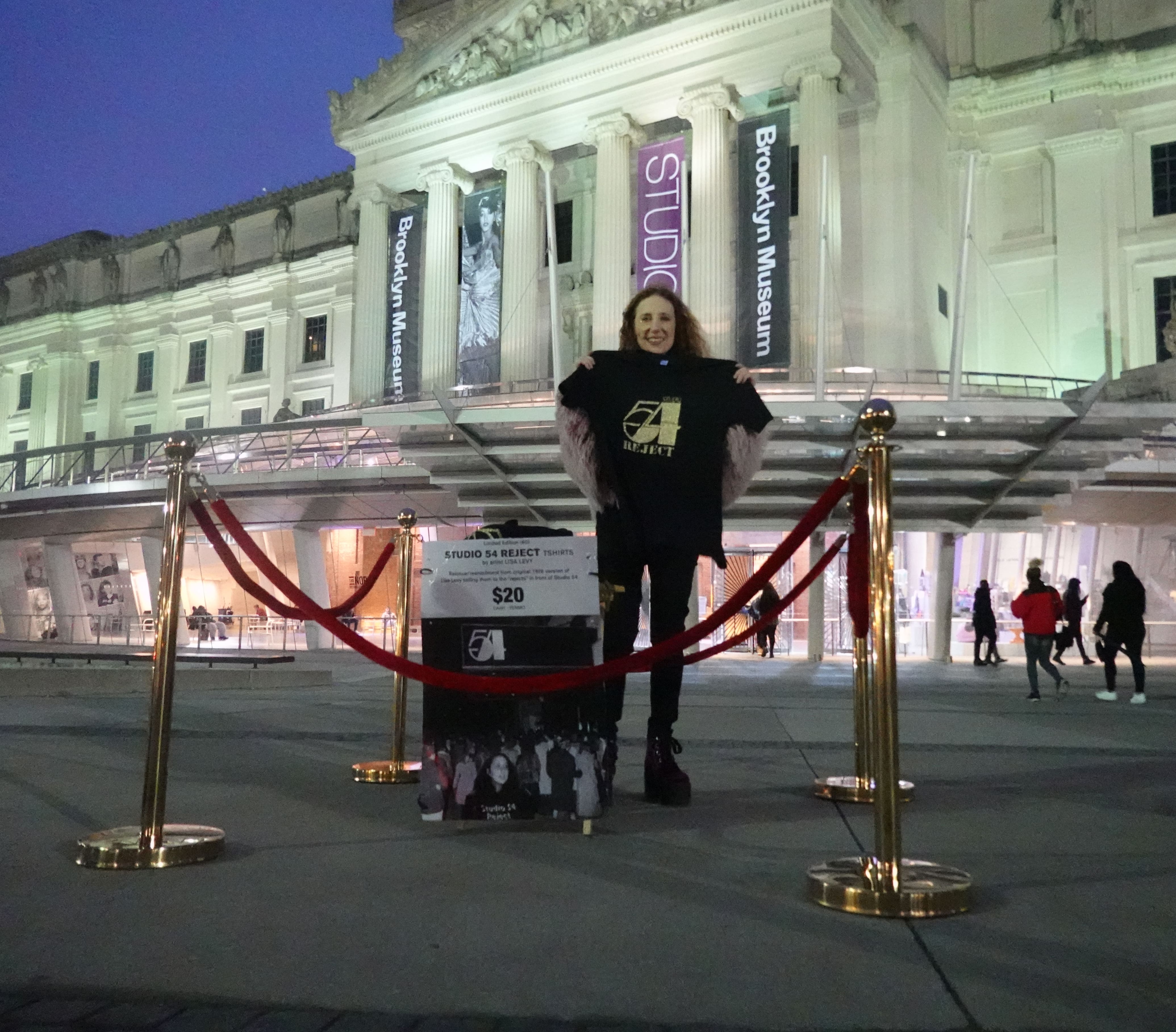
Studio 54 Reject Re-Performance by Lisa Levy, Photo Credit: Phil Buehler.

Right before the Coronavirus outbreak prompted a mass-shutdown of New York City’s galleries and museums, multidisciplinary artist, radio show host and (self-proclaimed) psychotherapist Lisa Levy recreated her classic guerrilla art project ‘Studio 54 Reject’. On the opening night of the “Studio 54: Night Magic” exhibition at the Brooklyn Museum, Levy stationed herself outside the institution’s main entrance. Standing behind a small table encircled by red velvet ropes and four stanchion posts, she gestured toward a sign reading “Studio 54 Reject T-Shirt, $20” while imploring passersby to take pride in “reject status” with the purchase of a shirt, newly re-designed in gold glitter and the official logo.

Continue reading “A Studio 54 Reject Is At It Again 40 Years Later”

Catchat, following an Interview With a Cat

Kristen Clevenson in conversation with Noa Ginzburg, February 2020

Catchat, a screenshot of a skype conversation, 2019.
Photo by Hannah Bruckmueller

“This is an interview recorded at the Museum of Modern Art, Department of Eagles, 12 Burgplatz Düsseldorf,” announces the interviewer. “MIAOW! MIAOW!” replies the interviewee.” In 1970, the Belgian artist Marcel Broodthaers (1924-1976) conducted and recorded an Interview With a Cat. In Catchat, a trans-Atlantic collaboration between Hannah Bruckmüller, Michal Ron, and Noa Ginzburg which was recently published on PROTOCOLS, the three listen carefully to the protagonist cat and transcribe French and Cat tongues into Hebrew and Latin letters. Kristen Clevenson and Noa Ginzburg share with Art Spiel their conversation about cats, collaborating while in different time zones, transcribing illegible languages, and using deep listening to assert agency.

Continue reading “Catchat, following an Interview With a Cat”