Featured Project: with founder and curator Magdalena Wisniowska
Johanna Strobel, Low Affinity, 2021, installation view
Johanna Strobel’s mind-bending multi-media sculptural installations at GiG Munich resonate with an urgent longing for an orderly system while a sense of entropy surfaces simultaneously. Plug going into socket, red and blue lights turning on and off—hint at an unstable world where information is lost through failing USB cables and unreliable mnemonic devices.
Featured Project: with curators Leonora Loeb and Keisha Prioleau-Martin
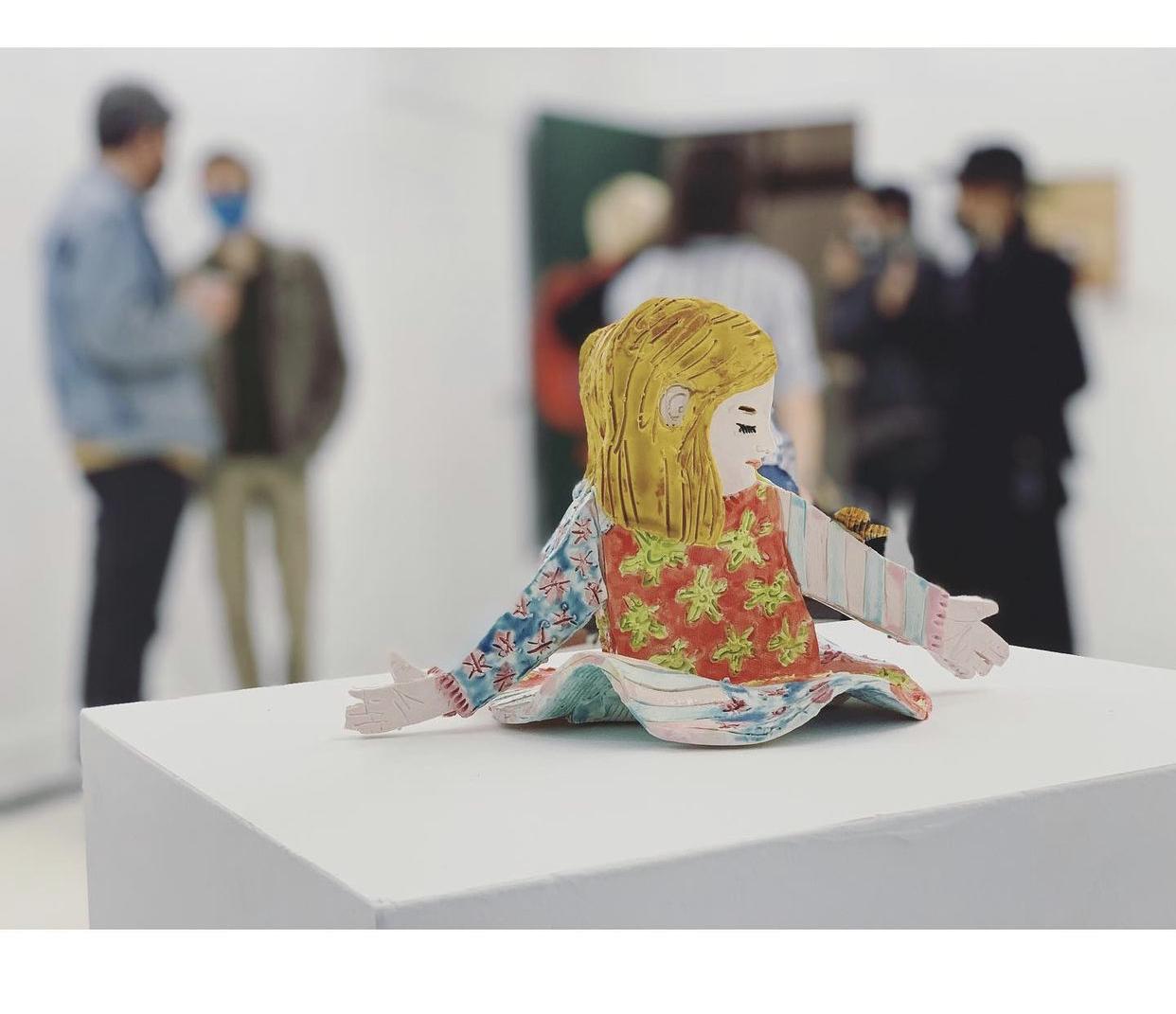
Opening night of Nice to See you Again, In the foreground: Madeline Donahue, Butterflies, 2021, glazed ceramic, 8” x 7” x 6”
The group show Nice to See you Again at Underdonk features work by ten artists whose paintings, sculptures, and photographs address the loaded meaning of the outdoors during the pandemic—a shared sense of longing for the openness of the outdoors while simultaneously also craving for the warmth of the indoors. The show is organized by Leonora Loeb and Keisha P:rioleau-Martin and runs from October 30 th through November 20 th , 2021.
Amanda Thackray with A Tangle; A Swarm; A Precondition of the Plastisphere, 2021
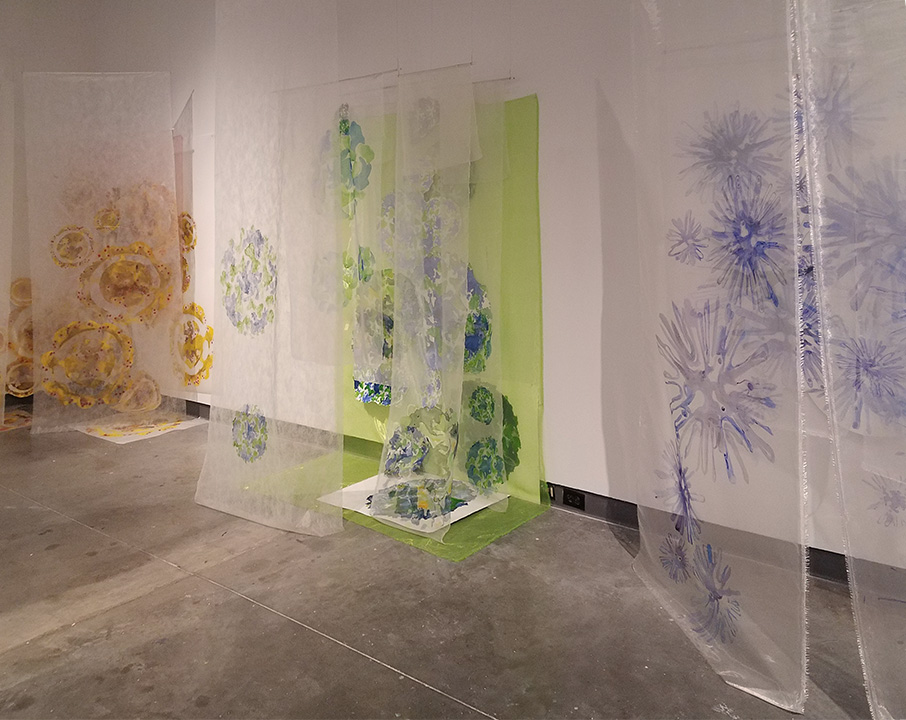
In her solo exhibition at the Lemmerman Gallery in NJCU curated by Doris Cacoilo, Amanda Thackray presents her handmade paper installations, prints and sculpture which altogether comment on plastic pollution and the fragility of marine environment. The artist creates an allegorical environment which both reflects and distorts an aquatic world.
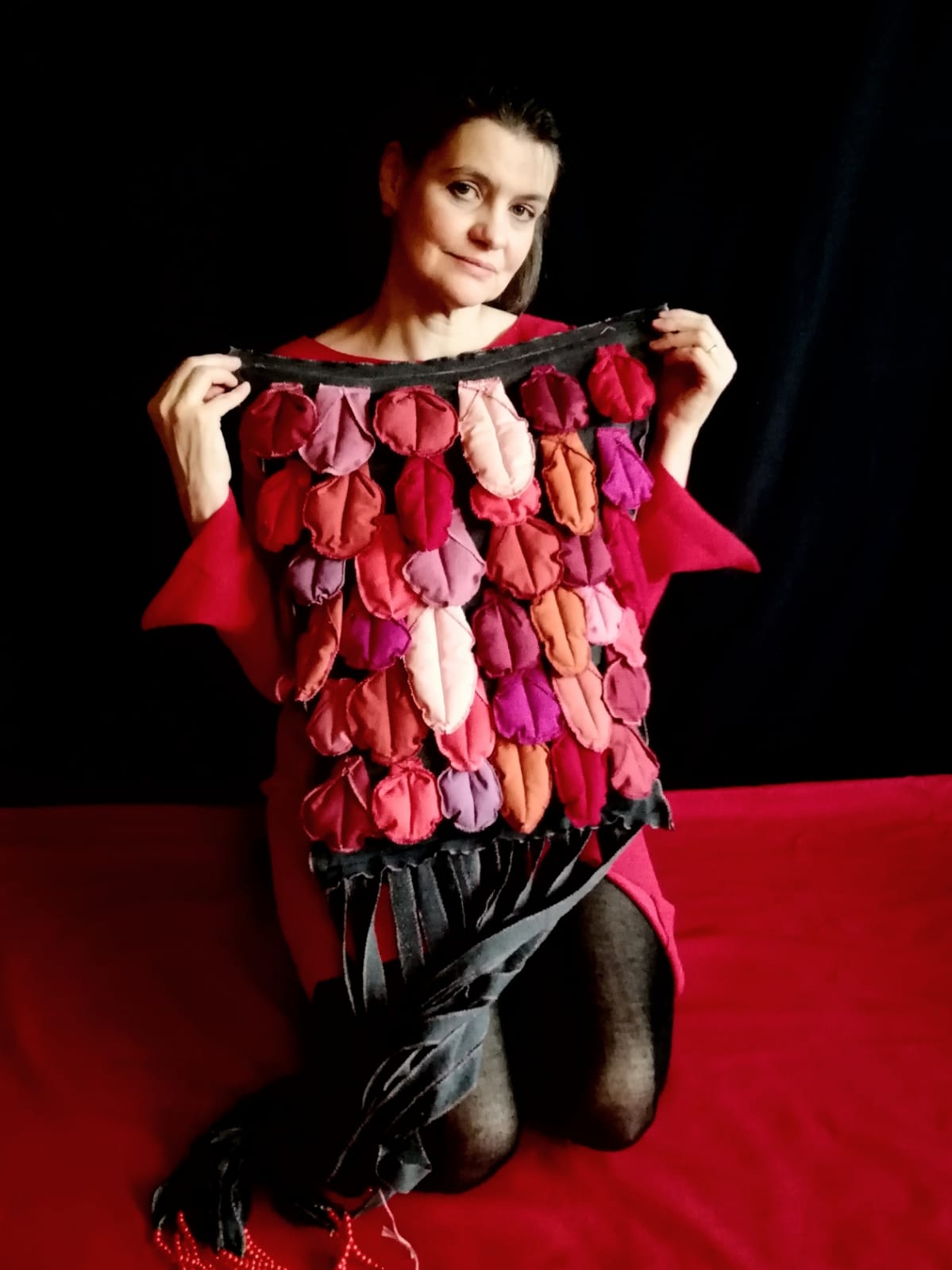
Franziska Warzog, Creature covered by tongues, textile sculpture, 2008, 134 x 27 x 12 cm, (52.8 x 10.6 x 4.7 in), photo taken by the artist’s husband
The Hanover based artist Franziska Warzog makes textile sculptures characterized by bold shapes and vivid colors reminiscent of patterns in nature. As a daughter of two visual artists, she was introduced to design principles since early on.
Installation view, Garrison Art Center Gillette Gallery
Punto in Aria, Patricia Miranda’s solo exhibition at Garrison Art Center, features monumental textile- based sculpture and installations in the gallery space, as well as a site-specific lace installation on the venerable tree outside. In addition to Miranda’s artworks, the show includes items from the artist’s collection, such as panels and glass gilded with vintage and inherited gold leaf depicting lace patterns. Miranda’s work involves a rigorous research into historic material practices in context of women’s labor, ritual, and the environment. The show runs through November 7th, 2021.
On May 13, 2020, in the middle of the global pandemic, the NYU Abu Dhabi Arts Center in the United Arab Emirates hosted a streaming event consisting of a four-and-a-half-hour filmed version of HOLOSCENES, a durational performance installation that was originally presented there live in November of 2016. The event also included a conversation with Lars Jan, artist, writer and project director, as well as members of his team. HOLOSCENES is comprised of performers going about common, every-day tasks while the aquarium in which they are confined fills and empties with water. Although conceived as a commentary on “states of drowning” – rising seas, melting glaciers, intensifying storms, floods, and their impact on daily life – the project takes on additional meaning as we struggle with our own physical and psychological confinements during the great global quarantine.
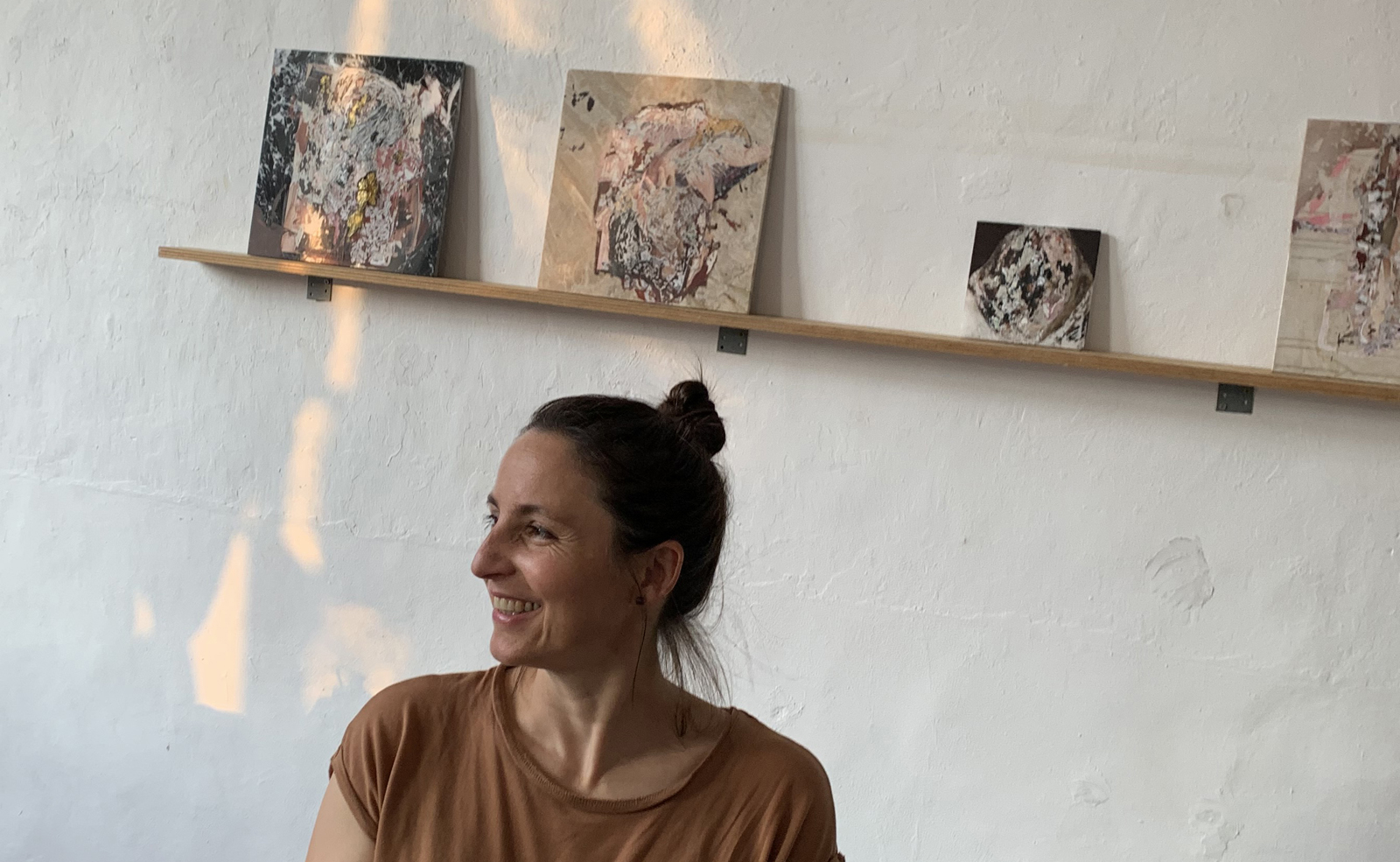
Hedwig Brouckaert in her Studio in the Beginage in Ghent Belgium, August 2021
New York city based artist Hedwig Brouckaert is currently working on a body of work for two solo shows, one at the Emory & Henry College in Virginia, where she is invited as visiting artist in January 2022, and one for Galerie El in September in Belgium. She has been developing Peel (America), a collage series of magazine images of skin on marble tiles, which she started during the lockdown. She says the tiled walls in public spaces have become like skin surfaces that were feared during the pandemic, as touch has become complicated. She is fascinated by the contrast between the depth and time visible in a marble tile, created by age-old geographical processes, and the temporality of magazine paper. “Even though magazines – and mass media images in general – arrive as pristine, glowing objects in the mail or on the newsstand they are meant to disappear quickly and to become trash, to be replaced by the most recent up-to-date information,” she says.
Featured Project: with John Morton and Rahul Saggar
Installation in-process, Hand Work and wear we are. Photo by Yumiko Yamazaki
Composer John Morton and Artist/Engineer Rahul Saggar created an audience-activated environment at the boiler space in the ELM Foundation in Williamsburg, inviting visitors to experience a new appreciation of their sonic and spatial surroundings. Visitor’s movements activate a sensor that produces sounds, while their steps simultaneously wear away a walking path on a painted floor surface. The two inter-related installations explore both physical and sonic pathways, uncovering and revealing multiple layers of sound and color, mirroring our everyday meanderings and encounters.
Rita Grendze installing “Susurrations” , 2013, Krasl Art Center, St. Joseph, MI
Chicago based artist Rita Grendze draws, sculpts and makes large scale installations that bring the two and three dimensional forms together in imaginative ways. She creates visceral environments utilizing mostly found materials, ranging from music sheets to textiles.
The artist and her work, photo courtesy of Camille Thomas
Canboulay, Simonette Quamina’s solo exhibition at Smack Mellon, features a series of immersive wall-sized visual horizons which borrow the methodological framework of a caesura, a break in a poem. The notion of “break” exists within each work through cuts and rips as well as overall, separating elements of her continuous visual story into vignettes of individual works. Through her use of sophisticated variety of collage and printmaking techniques, Quamina integrates narratives referencing histories such as socioeconomic ramifications of sugarcane and familial subjugation, into complex, dark surfaces.