A Grain of Salt | Un Grano de Sal, the new exhibition at the Boiler in ELM Foundation features Fernando Ruíz Lorenzo’s new body of work—a series of paintings and installations with solar salt, styrofoam, acrylic, and aerosol paint. Ruíz Lorenzo’s work merges the history and political narratives of Puerto Rico’s colonial relationships to Spain and the United States.
Pope.L, studio, 2022, photo courtesy of David Zwirner Gallery 52 Walker
When I heard about Impossible Failures it promised to be an exciting exhibition, in that it was to bring together Gordon Matta-Clark (1943–1978), a White post-Minimalist artist best known for his site-specific works of cutting through buildings and homes, and Pope.L (b.1955), a Black artist who used to describe himself as the friendliest Black man in America, and is known for his public performances and installations, which address Black racial stereotyping and other such hypocrisies. In a not un-interesting way, the resulting exhibition is a curatorial mash-up in which the works in it are overwhelmed. As such, this is not an exhibition where the works of each artist supply a context for the other, nor does it explore Matta-Clark’s legacy by focusing on Pope.L’s overlapping strategies. Instead it might be thought of as a collaborative installation authored by the curator Ebony L. Haynes.
Left: Wildriana Paulino, Right: Linda Cunningham. Photo courtesy of Michele Brody
Scaling Nature at the Bronx River Art Center features large-scale mixed-media installation works by three artists: Michele Brody, Linda Cunningham and Wildriana Paulino. Curated by Gail Nathan, the premise of this show is to represent nature as a force of nurture and destruction through the use of materials from the ephemeral to the concrete. Paulino and Brody both work with cast handmade paper that hangs from the gallery ceiling to command the space. Their massive artworks invite the viewer to be engulfed by a feeling of being one with nature and simultaneously wary of the effects of climate change.
Jac Lahav, Immersive blue vine installation on the hardship and beauty of being a foster parent
Jac Lahav: The Saffron Thief at Sugarlift is an immersive installation about the artist’s experience as a foster parent. At the center, a large sculpture titled 29, references 29 points of contact that the artist has had with different foster children. The lines of saffron and gold leaf across abstracted canvases, and a site-specific wall drawing allure visitors to enter Lahav’s world.
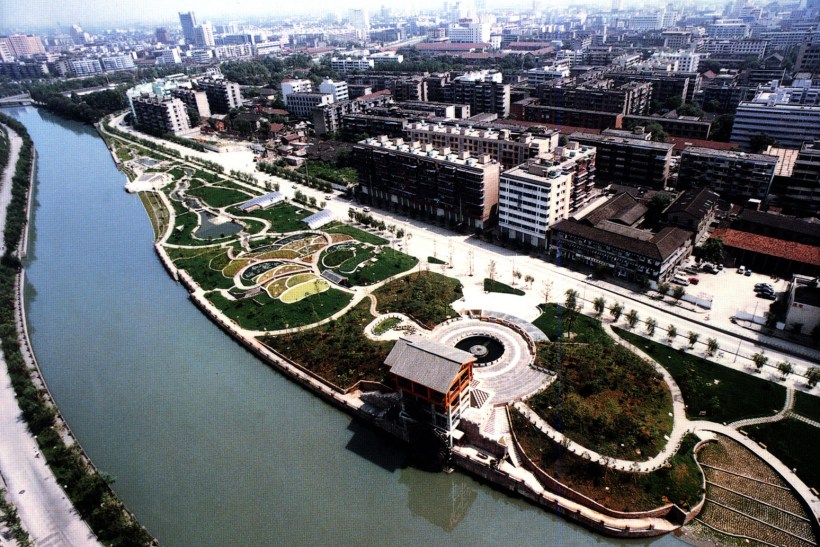
For the last 50+ years, eco-artist and environmental activist Betsy Damon has devoted herself to community building – the coming together of individuals to achieve a common purpose. Since the 1980s, after a decade of engaging the public through public performances in New York City, she has worked at the intersection of art and science, focusing on the topic of water and on creating models for communities in the United States and China to know and become stewards of their own water sources. The brief descriptions below, highlighting four of Damon’s many exhibitions, ecological and sustainable design projects, publications, and organizations are only a brief glimpse into her prolific and important body of work.
Jody MacDonald, Everywhere All Over. All Over. Everywhere. (detail), mixed media, 168″ x 180″ x 96″, 2022.
Jody MacDonald dissects in detail the concept of “identity” through a cast of small-scale 2-D and textile-based 3-D surrogates. She uses repurposed materials to create figures and detailed, miniature accessories (wigs, clothing, shoes furniture) set inside elaborate, mixed media environments with clues which shed light on the complex, often conflicting narratives.
In October 2021, at the periphery of the parking lot outside of the Time and Space Limited Center in Hudson, artwork by Linda Mussman appeared—about 20 large dictionaries and encyclopedias opened out on a crude wooden table. For several months, round the clock, these dictionaries were exposed to rain, sunlight, and snow, and rifled through by winds. Peach-colored streetlight bathed the texts some nights, and bright sunlight bleached the pages some days. The grass around the table receded and then returned with – mirabile dictu – a green shoot briefly fighting its way between 2 volumes.
In conversation with Adèle Eisenstein and Saba Farhoudnia
No Signal, 2022, acrylic on acrylic mirror sheet, 7 panels, 48×16” ea., 48×112”. Photo: Farzan Ghasemi
Reflection, the solo show of Saba Farhoudnia in Jamaica Center for Art & Learning, highlights the cruel and tragic practice of so-called “honor” killing, by way of individual stories which give the victims their voice back, and shed a light on this reality for far too many women, girls and LGBTQ+ (taking at least 5000 lives annually per the United Nations Population Fund). The ensemble of individual panels and stories welcomes the visitor into a colorful and intriguing landscapes. Adèle Eisenstein, the curator of the show, says that the layers of paint reveal a reflective surface, which delivers a direct message to the observer—this might have been you. While dishonor killing is the most extreme end of the spectrum, the subject addressed also touches upon and exposes stratified layers of gender-based violence.
Curator Jennifer McGregor in conversation with the artists
Kate Collyer, Bundle: Alaska, 2022, mixed media and video, dimensions variable. Courtesy of the artist.
Artists Kate Colyer, Lorrie Fredette, and Megan Porpeglia talk with curator Jennifer McGregor about their framework to create whispered conversations, on view at Stand4 Gallery and Community Space in Bay Ridge, Brooklyn. The collective was active during COVID via Zoom reading about the natural world. They created bundles in response to their individual trips in 2021. These were shared through the mail to instigate a series of new artworks. Jennifer McGregor was brought in as curator to help shape the exhibition.
Power. Power, not bravado, not ego, but the power of intelligence, skill, fortitude, and vision is what Mary Ann Unger possessed and that is what is on exhibition at Williams College Museum of Art (referred to as WCMA). Throughout her life she defied limitations frequently imposed overtly and subconsciously on women. Attending Mt Holyoke College in the mid-60s, she studied biochemistry when few women were found in science departments, then transferred to studio art taking up welding, casting and carving. This was not the typical route for women during the mid-to late 60s. She traveled on her own to North Africa and this journey greatly influenced her work. Returning to New York she completed an MFA at Columbia and launched her career as a post minimalist sculptor, finding herself in the minority amongst a sea of men.