Dario Mohr’s Don’t Forget to Check. Image by Yasmeen Abdallah
Themes of searching and connection to ancestors through practice, ritual, and persistence are intertwined through work that depicts aspects of migration, objecthood, and the complexities of humanity itself. The winds moving across the island dictate the mood as we bow and sway through graceful installations in deeply resonant forms at LMCC Art Center and Artcrawl Harlem.
Elizabeth Insogna and Jesse Bransford, photos courtesy of Tappeto Volante, ended on July 21st.
Many wonderful artists wielded their prowess in and around New York this month, in a myriad of ways and media. Moving around the city in the height of summer can be a daunting task, but these shows draw you into other realms that make you forget all about humidity and glad you made the trip. From Brooklyn to Governors Island to Storm King, here are some standouts that were definitely worth the journey.
Untitled (12 tubs), 2023, Socrates Sculpture Park, New York, NY.
Bat Ami Rivlin, who has lived in New York City for over a decade, finds her artistic practice profoundly shaped by the city’s relentless cycle of object turnover. The daily expulsion of waste from restaurants, buildings, and homes onto the streets, followed by the inevitable clear-out, is a stark reflection of urban existence. This phenomenon sparks contemplation on how these transient objects organize our spatial interactions, both during their use and after their disposal.
Valérie Hallier working on the series Déflorée History in her studio during a residency with ESKFF at Mana Contemporary, NJ., 2023
Flower petals gradually became a significant element in Valérie Hallier’s artwork. Fascinated by the profound symbolism of flowers, Hallier initially struggled to incorporate them effectively into her artistic practice. Her initial approach involved photographing flowers in unique ways and settings. She also experimented with their dried components, adhering them to various surfaces. Eventually, she began to focus on pressing individual petals. Hallier discovered that working with petals was ideal for conveying complex themes such as femininity, resilience, sexuality, vibrancy, and decay. Born in Paris, France, and raised in Normandy, Hallier had a shy nature as a child. She was consumed with the ambition to draw everything in existence, a desire for comprehensiveness that continues to influence her work. Art, for her, has always been an essential means of engaging with both her internal and external worlds. Reflecting on her early art education, Hallier fondly remembers her excitement upon meeting others who shared her artistic ‘language.’
In Dialogue with Linnéa Gad, Magdalena Dukiewicz, and Anna Ting Möller
Linnéa Gad. Detail from Shoal II. Photographed by David Schulze. Courtesy of The Immigrant Artist Biennial.
Instead of transcribing a previously established set of ideologies through scholastic mediums, Linnéa Gad, Magdalena Dukiewicz, and Anna Ting Möller engage with materials that “breathe”—materials whose lives and afterlives warrant separate biographies.
Presented within the context of The Immigrant Artist Biennial 2023: Contact Zone, Swedish artist Gad creates sculptures with limestone, oysters, lapis lazuli, and other materials profoundly connected to the Earth’s carbon cycle. On Governors Island, her sculptures, Shoals I-II, evoke humanity’s resonance with and reliance upon nature. Polish-born artist Dukiewicz juxtaposes industrial components with provocative, organic materials such as hair and blood. In the group show, Enmeshed, Dreams of Water, at NARS Foundation, Dukiewicz’s Object #6 (2023) contains decay, regeneration, and fluidity elements into beautifully translucent and sculptural artwork. Chinese-born Swedish artist Möller, whose work will be presented in Parasites and Vessels at Accent Sisters, unpacks the convoluted social history of kinship via kombucha cultures. The oysters, hair, and kombucha are not subjected to manipulating the artists’ hands; instead, the materials are collaborators in these projects, bringing their subjectivities, histories, and sociological implications into the creative process.
Together with TIAB’s co-curator, Anna Mikaela Ekstrand, the artists speak about their work about technology, materiality, and ecosystems.
Installation view Desire Lines, photo Argenis, courtesy of KODA
Sa’dia Rehman:Desire Lines is a solo exhibition as part of artist’s residency with KODA on Governors Island, New York. Rehman’s exhibition focuses on the building of the Tarbela dam in Pakistan in 1968-1976 – a hydroelectric dam responsible for the displacement and forced migration of 184 villages and the climate devastation following the completion of this project.
Garden for Drowning Descendant/Garden Sequence from “Flying and Drowning Dream,“ interactive mixed reality installation, 2022, with performer Danielle McPhatter.
Eva Davidova makes new media works that focus on ecological disaster, our interdependence as a species, and the political implications of technology which she unpacks with performative works rooted in the absurd. She imagines the paradox that one day our descendants–human or cyborg–will be constructing our reality as a simulation, and asks: “If we are the games our children will program one day, can we influence the code they are writing?”
Jody MacDonald, Everywhere All Over. All Over. Everywhere. (detail), mixed media, 168″ x 180″ x 96″, 2022.
Jody MacDonald dissects in detail the concept of “identity” through a cast of small-scale 2-D and textile-based 3-D surrogates. She uses repurposed materials to create figures and detailed, miniature accessories (wigs, clothing, shoes furniture) set inside elaborate, mixed media environments with clues which shed light on the complex, often conflicting narratives.
Filling the gap, 2020. 24″x30″. Acrylic, painted canvas fabric on masonite board.
Tomo Mori is a Japanese-born and New York City-based fiber artist who has been focusing on two main bodies of work: wall based collage series and sculptural installations . In both she is working with used materials like old clothes and linens, fabrics she keeps reusing and transforming into new forms. During this 2021 Asian American and Pacific Islander Heritage Month, Tomo Mori shares what brought her to art making, what role her cultural background plays in her work, and what are some of her recurrent themes and processes.
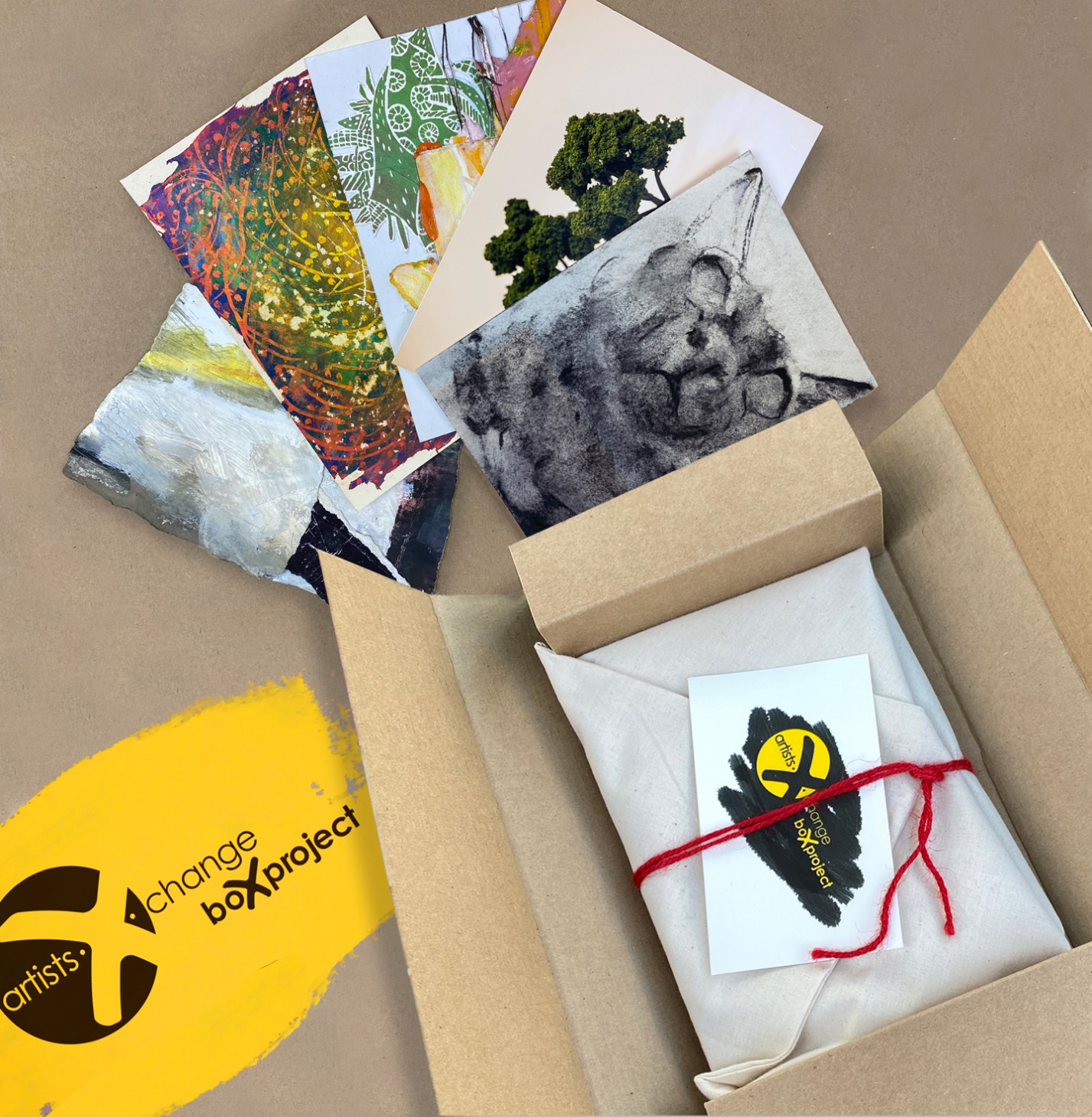
Soon after the Corona pandemic hit NYC, a resourceful and talented group of NY based artists came together to create an informal collective called artists-X-change (aXc) with the aim to alleviate the growing distress that both artists and art organizations have been facing. They were united by a sense of urgency — the severity of the situation coupled with the need to help others in their community.