Process on-site and view of Palais Equitable in Vienna. (right image): from the Wien Museum’s Online Collection taken around 1899.
In March 2020, Nicola Ginzel arrived at the Q21 Art Residency at the Museumsquartier in Vienna, Austria. This residency, which hosts international artists and selects one American artist every two months with the support of a Fulbright Scholar Grant, is designed to foster creative exchange through collaboration, networking, and studio visits.
Artists in residence in a training session at the Golden Lab
In 2012, the Sam & Adele Golden Foundation for the Arts introduced a one-of-a-kind residency program dedicated to the art of paint. Situated in the heart of central New York, mere steps from the Golden Artist Colors manufacturing facility, a 19th-century barn was transformed into a space that seamlessly blends history and modernity. It offers spacious studios and private apartments, providing a haven for artists to engage with materials and technologies that define contemporary artistic practice. The Golden Foundation Residency Program is a deliberate endeavor to aid professional artists in their quest to explore and master innovative materials and techniques. Each year, the Foundation hosts six Exploratory Residency Sessions, each lasting four weeks and accommodating three artists at a time.
Mapping the Invisible, the final show of the ’23-’24 season at the Flinn Gallery in Greenwich, Connecticut, showcases the work of Laura Battle, Jaq Belcher, and Amy Myers, each of whom contemplate and explore the mysteries of our existence through the lenses of science, math, and geometry. Co-curated by Francene Langford and Caren Winnall, the show runs till June 19, 2024. Langford elaborates on the curatorial process and highlights the work in this show.
When Elisabeth Condon noticed an Open Call for a show at Westbeth, she immediately thought of artists Alyse Rosner and Susan Luss, whose process-oriented approach perfectly matched her vision for a collaborative project. They all agreed to come together, planning to let the installation unfold over four days, allowing their work to merge and shape the exhibition dynamics. Their setup process—discussing, reshaping, and improvising in the gallery—revealed more profound interconnections. The trio’s improvisational method produced an exciting viewing experience analogous to a live jazz ensemble with distinct leitmotifs.
Woman in a Window (detail) 1957 Richard Diebenkorn, Collection Buffalo AKG Art Museum / Gift of Seymour H. Knox, Jr., 1958
Have you heard about a mysterious note found among Richard Diebenkorn’s papers that he made for himself in his later years? It’s a motivational studio credo titled Notes to Myself on Beginning a Painting and is comprised of ten tips. All ten are fascinating to think about, but number eight is the most enigmatic:
Sok Song,- SoNoBe: Legermain Barbed and Coiled. Clay, paper, plastic, 16”x16”x16”.2023, Me, Mom, and the War on Identity. Acrylic, screen print, collage on paper, 36”x28” 2023 ( on wall)
The Long Island City Artists, an art non-profit known as LIC-A, is currently presenting a bold exhibition that brings together artists who work simultaneously in two media not always thought of as compatible. Curator Matt Nolen has gathered a fascinating group of artists from the NYC metropolitan area who work in both clay and drawing–one influencing and bouncing off the other. The synthesis is a fascinating and genre-bending exhibition.
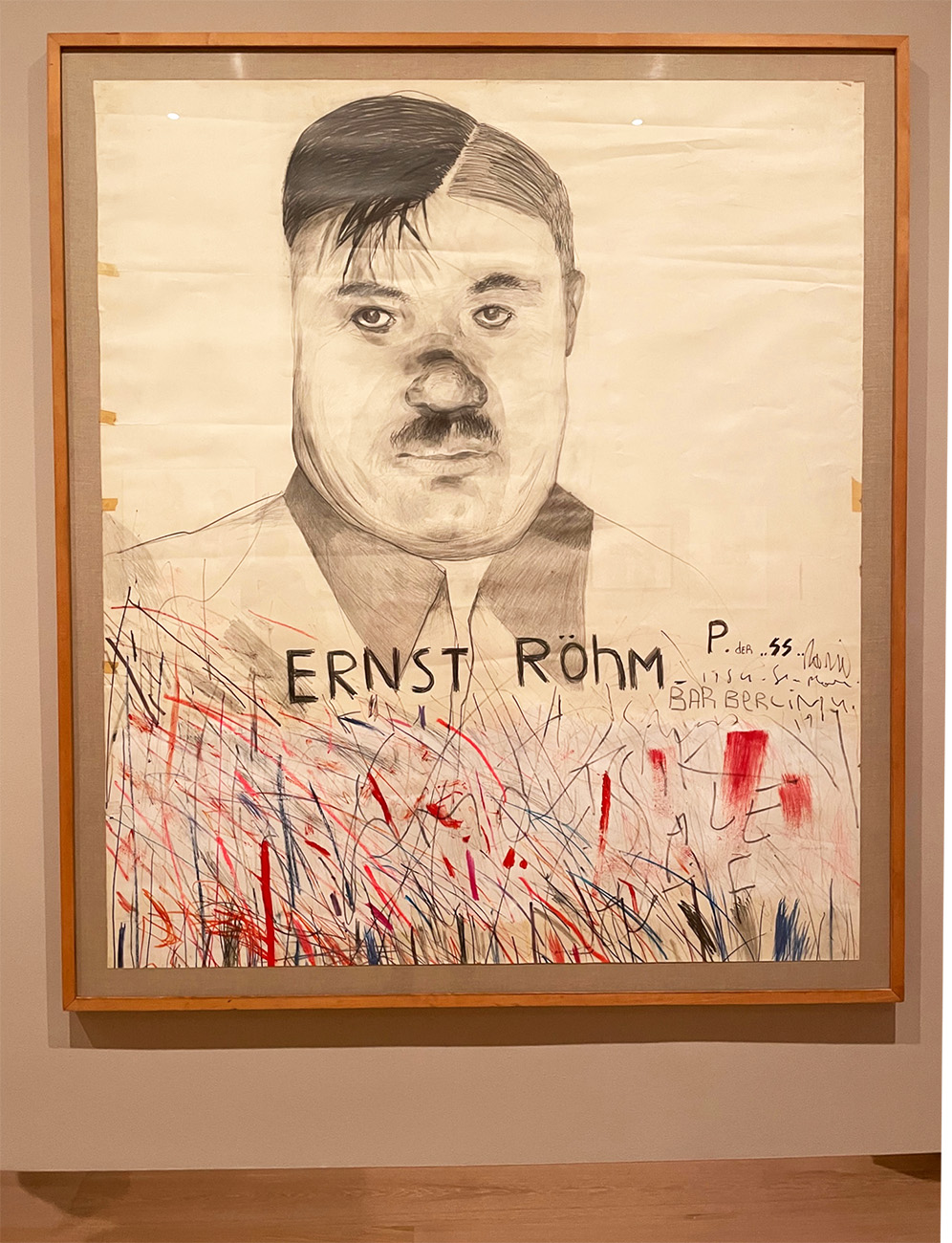
Ernst Röhm, 1981, Graphite, gouache, marker, and color pencil on paper. 54 3/4 x 47 1/4 inches
Who was Stephane Mandelbaum? A closeted gay man? The child of Holocaust survivors? A liar? A thief? A brilliant artist you’ve never heard of? All of the above and perhaps more.
The Drawing Center is presenting the first-ever show of Mandelbaum’s work in the US, and it is a show that left me gob-smacked. The combination of Mandelbaum’s brilliant drawing, deeply personal vision, and the complexity of his backstory is a tale made for cinema. Born in 1961 to a family of paternal Polish Holocaust survivors and maternal Belgian Armenians, Mandelbaum grew up in the town of Namur, about an hour and a half from Brussels. His Father, Ari, was a well-known painter, and his mother, Pili, was an illustrator. There is no record of siblings. A gifted draftsman from a young age but dyslexic and eccentric, Mandelbaum moved from Namur to Brussels, where he seemed to devote his time to making drawings and engaging in what is termed “petty crime.” He married a woman from Zaire (now called The Democratic Republic of Congo) and lived between the worlds of Belgian Africans, the Belgian crime underworld, and his own artistic imagination.
Finally! What a joy to meander through a show that is not just a formulaic scaffolding rendered to execute a marketing plan rather than make art. Walking into the building that houses September Gallery’s new space in Kinderhook, NY, The first thing you see is not a wall or architectural ornamentation but a monumental scroll that immediately hints you might be here for a while. This colossal collage introduces Myth Maker, the second exhibition at September Gallery by Laleh Khorramian.
Nancy Bowen with “Third Eye” and “Throat” from Chakra Series, 2009, mixed media on paper, photo by Lindsay Walt
What links Nancy Bowen’s work at Westchester Community College Art Gallery—from abstract to narrative work—is the presence of the female body in some form. “I will always be compelled to create work from a feminist point of view, work that needles or asks questions, and given our current political and social climate, that seems even more necessary than ever,” Bowen says. The show runs through April 12th, 2023.
Manju Shandler, Wonder Whale 1, 2018, mixed media, 23×19 inch
Luckily, or to many art-mavens’ chagrin, our 21st century art world—in line with the global techno-culture and socio-political processes—seems to have abandoned crusades of “right” or “wrong” related to artistic form (though sometimes that does not apply to content). We are experiencing a dizzying array of aesthetic expressions, where often fast-pace visual trends replace ideologies of form. Unlike some passing trends, visual narratives based on mythological iconography have been central in all art forms since archaic ages, except for the early-mid half of the 20th century when narrative impetus was largely downplayed in most of what was called the “Avant Garde” art of the time.