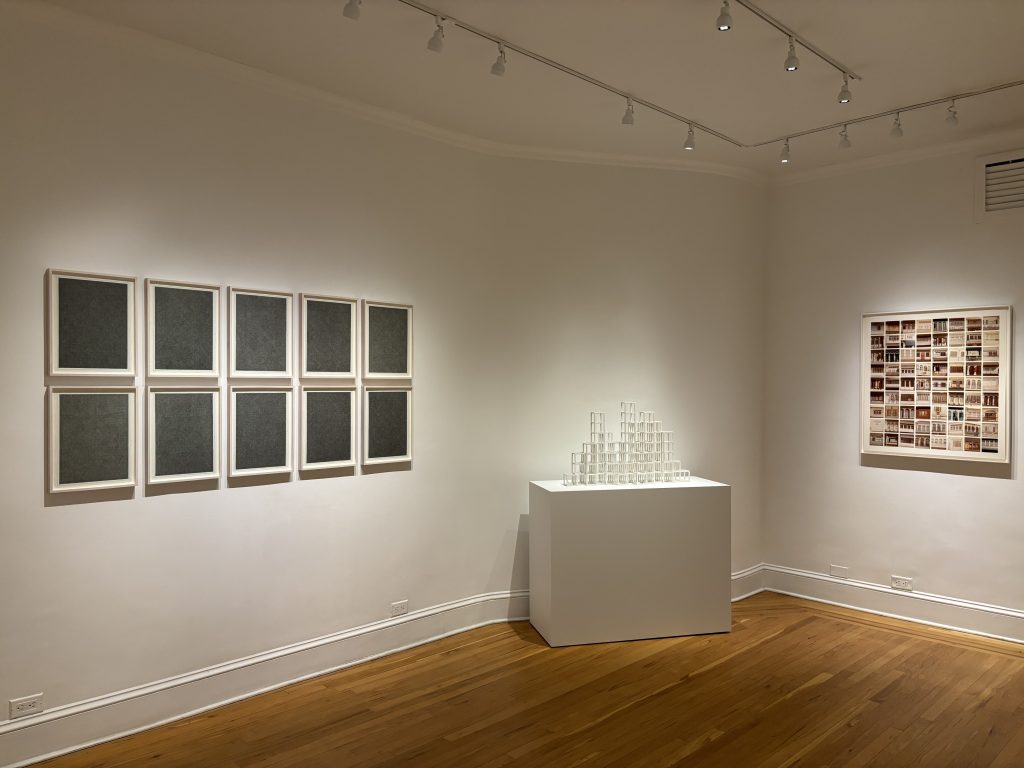
Installation View. Phong H. Bui and Sol LeWitt. Craig Starr Gallery (1)
For both Phong Bui and Sol LeWitt, the line is a democratizing gesture. The line as a line: a mark; steering focus towards the method of an image’s creation rather than convincing the viewer of the realism of its ultimate subject. And, at least for both of these artists, this means we begin to deal with units. With LeWitt, the unit is the geometric shape — a square, cube, or even a diagram-a nugget of information, often placed within another diagram, offering multiple levels in the narrative of the work’s process and arrangement.
Almond Zigmund, figure ground yellow, 2023, acrylic on paper, 36 x 53”, photo credit: Jenny Gorman
Almond Zigmund’s work occupies the charged space between structure and disruption. Moving fluidly across sculpture, painting, and installation, her practice explores the intersection of geometry, architecture, and lived experience—often in subtle yet powerful ways. I have the pleasure of discussing her work at the end of her recent exhibition at East Hampton’s Guild Hall. In this interview exchange, Zigmund speaks about the formative influences that shaped her, from growing up in a creative household to navigating the distinct geographies of Brooklyn, Las Vegas, and the East End of Long Island. The conversation delves into the improvisational roots of her approach, her ongoing engagement with spatial systems, and how tension—between control and spontaneity, place and perception, the built and the organic—continues to animate her work. With references to theorists, artists, Zigmund offers a thoughtful and richly textured account of how art can be both experiential and critical, formal and deeply human.
Prayer / Pattern / Prayer at Morgan Lehman offers a mesmerizing view of patterns as a deeply seated human instinct. Fittingly, a radial symmetry unfolds from the vertex of the L-shaped room. Yet curator Jan Dickey balances this evenness with a syncopated rhythm of paired artworks and bold standalone pieces. In creating a pattern of patterns, this show offers a metonymic view of artists running with different strands from the fabric of a species-wide impulse toward order and adornment.
Garden of Music (after Bob Thompson), 2024, acrylic and oil on canvas, 54” x 94”
For artists working within the realm of geometric abstraction, understanding the weight of art history is vital. The hard-edge lines, a keen understanding of color theory, and structured patterns—all form part of a visual language that has evolved over a century. Artists today, when approaching geometric abstraction, face a unique tension. On the one hand, they inherit the legacy of giants such as Piet Mondrian, Wassily Kandinsky, Josef Albers, and Kazimir Malevich, whose works laid the foundation for what we understand as “geometric art.” On the other hand, the question looms large: How does one continue to make geometric abstraction in 2024?
Mapping the Invisible, the final show of the ’23-’24 season at the Flinn Gallery in Greenwich, Connecticut, showcases the work of Laura Battle, Jaq Belcher, and Amy Myers, each of whom contemplate and explore the mysteries of our existence through the lenses of science, math, and geometry. Co-curated by Francene Langford and Caren Winnall, the show runs till June 19, 2024. Langford elaborates on the curatorial process and highlights the work in this show.
Beverly Fishman, I dream of Sleep, 2020. Installation. Courtesy of the artist and Miles McEnery Gallery
This is part of a series of articles for the upcoming exhibition, The Greatest Emergency at the Circulo de Bellas Artes of Madrid. The exhibition is based on Santiago Zabala’s book, Why Only Art Can Save Us: Aesthetics and the Absence of Emergency. In this exhibition, ten contemporary artists rescue us into our greatest emergencies, that is, those we do not confront as we should. Each article in the series will contextualize these artists’ practices and explore how they are linked to Zabala’s aesthetic theory and the exhibition’s themes. The first article in this series highlights the work of American artist Beverly Fishman.
Unlike many art historians and art critics, philosophers do not look for works of art that are necessarily beautiful or interesting. Most of us—at least those educated in the continental tradition of Hegel, Nietzsche, and Arendt—instead look for works that disclose a theoretical stance. Martin Heidegger’s writing on Van Gogh’s shoes paintings, Arthur Danto on Andy Warhol’s Pop Art, and Jacques Rancière on Alfredo Jaar’s photographs are paradigmatic examples. This does not mean we do not care about the artist’s effort in creating such work; rather, we focus more on whether the work discloses an aesthetic notion, political idea, or anthropological concept that has meaning for society at large. Artists, for us, have the same ontological purpose as scientists or politicians. A great work of art, new scientific discovery, or progressive policy can change people’s relationship with reality. If these works, discoveries, and policies change this relationship, it is not necessarily because they are “better” than others but because they touch our existence to a greater degree.
Harriett Finck in front of Gears, 2021, 52” x 52”,acrylic on paper
Manufacturers Village Artist Studios, located in an 1880’s historic industrial complex at 356 Glenwood Avenue in East Orange, NJ, will feature the work of over 60 different artists at its annual open studios weekend, Friday 10/15 (VIP Preview) and Saturday thru Sunday from 11-5, 10/16 and 10/17.
Carol Salmanson, Lightshift 1 with the artist, LEDs, reflective sheeting, plexi, beads, 50.5″ H x 69″W x 5.5″D, 2018
Carol Salmanson began as a painter and then gradually started embracing the use of LED lights in her work. In “Two Sides to a Coin,” Salmanson’s recent solo show at SL Gallery, she shows her paintings and light work side by side. This results in a dynamic conversation between the two forms. Salmanson shared with Art Spiel the genesis of her work, thought process, and projects. Continue reading “Carol Salmanson: Two Sides to a Coin”
Jamie Martinez, who has just launched THE BORDER at the 56 Bogart building in Bushwick, is a prolific artist, curator, blogger, and now – gallerist. In his interview with Art Spiel, Martinez shares a bit about himself, the genesis of his multiple activities and his exciting plans for the near future. Continue reading “Jamie Martinez, a Triangle on Its Own”
In her solo show “No Regrets” at ODETTA, Nancy Baker created intricate constructions which reflect her need for reliable reality through a rigorous process of interweaving mathematical data and text from the US Constitution into interlocking elegant forms. Continue reading “Nancy Baker: No Regrets at ODETTA”