Notice: Function WP_Object_Cache::add was called incorrectly. Cache key must not be an empty string. Please see Debugging in WordPress for more information. (This message was added in version 6.1.0.) in /www/artspiel_344/public/wp-includes/functions.php on line 6131
At the crossroads of architecture, painting, and sculpture, one encounters the awe-inspiring steel monoliths of Tony Smith (1912–1980). Tony Smith: Wall, New Piece, One-Two-Three showcases the evolution of the artist’s sculptural practice throughout the 1960s and 1970s.
Ellsworth Kelly (1923-2015) is one of those artists whose status I’ve never understood. While he is held in high esteem by many, I’ve always questioned his significance. Don’t get me wrong, I like his work, but liking it doesn’t necessarily make it significant. His work is elegant, refined, and smart, and yet even in the 1950s-70s, it seemed conservative against the backdrop of Abstract Expressionism, Pop, and Minimalism. What made Kelly different from his peers was that when he was living and studying in Paris after World War2 on the GI Bill, while many of his fellow artists from the States were exploring lyric abstraction and L’informale, Kelly was looking at Art Concrete and had begun to make multi-canvas paintings.
Zachary Keeting coffee and cigarettes 2016 acrylic on canvas (triptych) 48” x 124” photo courtesy the artist
In Zachary Keeting’s restless and complex paintings swirls of vivid purples, yellows, and reds float by or contained within geometric shapes of subdued browns and pinkish off-whites. Together they orchestrate distinct rhythms and create a sense of luminosity. Keeting’s alluring colors often generate dynamic pictorial spaces filled with an imaginative array of fragmented forms which remind me of mirror shards prisms against a shifting light, particles in a quantum physics lab, or visual transcriptions of sounds. Although each of these parts, whether biomorphic or geometric, appears to assume a distinct characteristic, the overall sense we get is—what we see now is on the verge of changing within the next second.
To kick off the Dumbo Open Studios Weekend in late April, Platform Project Space opened MOD, a five person show commanding strong appeal, curated by Sharon Butler. As the title and press release indicate, modularity, modernism and mods, or modifications in contemporary gaming, are all potentially at play both in the individual works and together as an installation. Each artist’s contribution holds a single wall or area in a small room that’s comfortable, easy, and open. The formal language of color and shape is nuanced to suggest personal and organic qualities and intimate spaces. No mystery here. Instead, curiosity openly hovers in close examinations of the human touch, in the detail and care given to small moments.
The curatorial team held a fascination with exploring and activating the ceiling, corners, and floors of Equity Gallery via the works that comprise Making Sense Without Consensus. Here are 2 examples of this; on the left, Linda King Ferguson’s work stretching downward to the floor; and on the right, Diogo Pimentão’s work installed to live and extend around the corner of a gallery wall.
Now on view at Equity Gallery in the Lower East Side is a notable group exhibition, cogently titled Making Sense Without Consensus, with works by 14 remarkable artists and 3 astute curators at the helm. The exhibition statement says that these artists explore reality through fragmented connections and geometric materiality, “investigating whether the linearity of time is real or if past and future overlap.” In further absorbing what this exhibition might represent, I also want to offer an illuminating quote from The Radicant (2009), an essay by celebrated curator and critic Nicolas Bourriaud. This thought piece provides context for the development of Making Sense Without Consensus:
“In ordinary language, ‘modernizing’ has come to mean reducing cultural and social reality to Western formats. And today, modernism amounts to a form of complicity with colonialism and Eurocentrism. Let us bet on a modernity which, far from absurdly duplicating that of the last century, would be specific to our epoch and would echo its own problematics: an alter modernity …”
Portrait of Paul Behnke in the studio with Gloria’s Guardian, 2020, acrylic on canvas, 62 x 60 inches, photo courtesy of Robin Stout.
Paul Behnke is a champion of painting – and he does it with evident gusto. His paintings come from idiosyncrasies, life experience, and a process that begins as intuitive, mixed with periods of sharp critical gaze. His paintings have evolved from early contained and minimalistic bold-color geometries, to more recent chaotic forms and layered complexity, at times almost explosive.
The PA based painter Theresa Hackett has been reflecting on landscape and environmental issues throughout her extensive body of work, Her paintings combine elements of drawing as well as different materials such as earth material and plastic. Altogether the process of coalescing all these elements is readily visible on the surface —the marks, bold shapes, vivid colors, texture— create landscapes resonating with vitality but also with an urgent sense of loss.
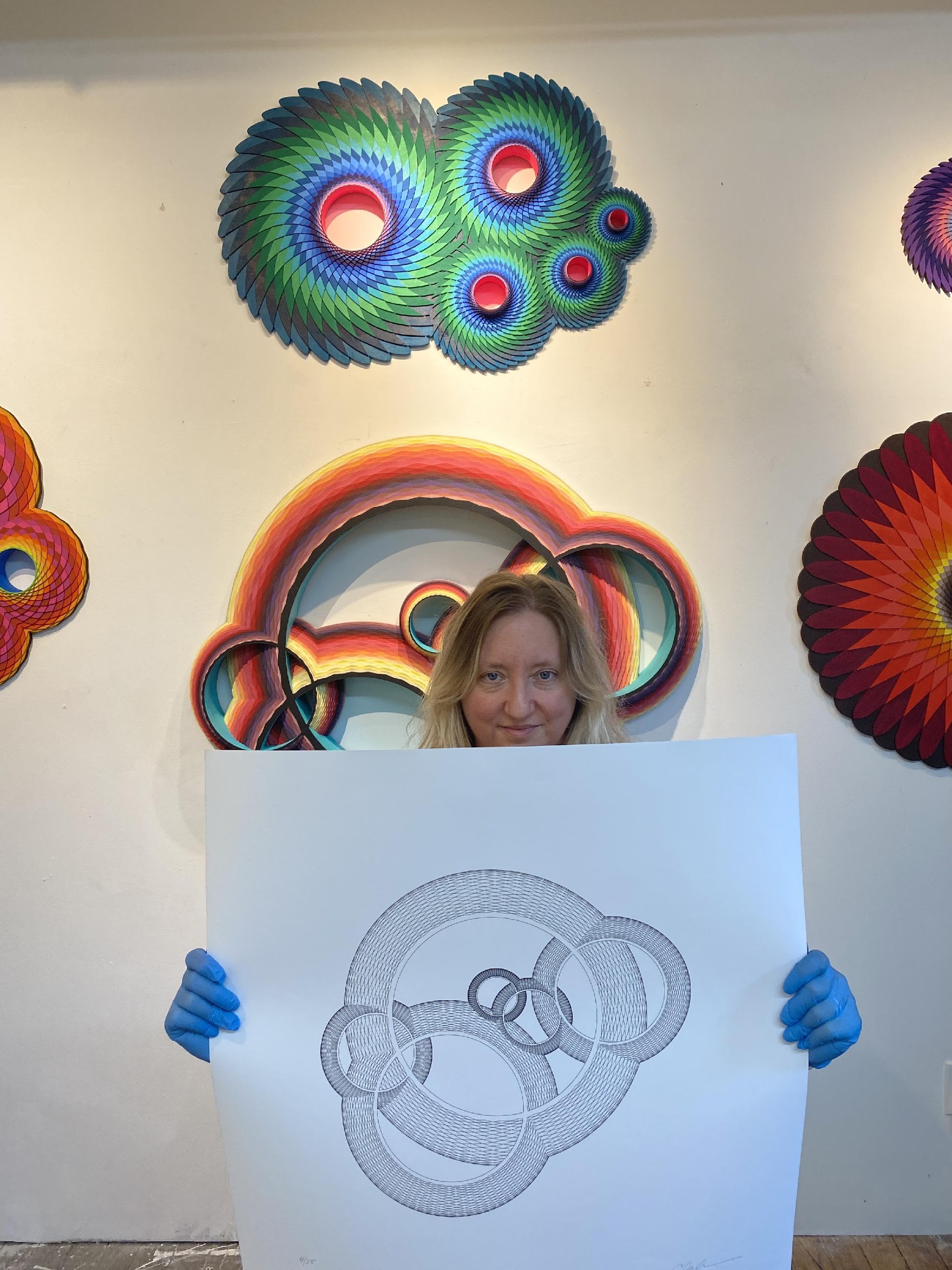
Christine showing one of her prints in front of a wall in her studio. The drawing in this print was used for the laser cutting of the wall sculpture
Manufacturers Village Artist Studios, located in an 1880’s historic industrial complex at 356 Glenwood Avenue in East Orange, NJ, will feature the work of over 60 different artists at its annual open studios weekend, Friday 10/15 (VIP Preview) and Saturday thru Sunday from 11-5, 10/16 and 10/17.
The artist at the Islip Museum. “Cornered”, watercolor on graph paper, 40 x 40 inches, 1975-76
Dee Shapiro’s paintings have evolved over decades of a rigorous thematic and formal search—how colors and shapes can express the intricate relationship between pattern, geometry, and nature through a two- dimensional form? With what appears to be a strong impetus to constantly re-invent her painterly vocabulary, Dee Shapiro’s work keeps us on our toes with each of her series of work, which she sees overall as evoking an alternate reality with absurd connection. From her early Fibonacci progression color coded on graph paper, to her later representational Bathers series–Shapiro’s paintings assert themselves with a life of their own, without a need for any explanation.
Sunset, mixed media on board, 36 x 44 inches, 1990s
My first encounter with the work of the artist Alexander Rutsch was through his daughter, the artist Alexandra Rutsch Brock (Alexi), a friend and one of my fellow co-founders of the London Calling Collective. I visited the Rutsch family home in Pelham where she grew up and where her mother still lives. The home, an eccentric, polymathic cacophony of hand-hewn art and embodied life, reflects my experience of Alexi as a passionate and energetic artist, teacher, and friend. A labyrinthine artist’s house- the type that real estate brokers abhor, is brim-full of paintings, sculptures, built-in furniture, object d’art, hand-tiled stone walls, curved nooks, hallways to a warren of rooms, and Alexander Rutsch’s overflowing attic studio, where the work from this exhibition came. I marvel at the fecundity of imagination a childhood in that house must have fostered. This history makes it a special honor to step back and review the exhibition, Alexander Rutsch, a Pop-Up, at Kenise Barnes Fine Art in Larchmont, NY, on view March 4-7 and March 11-14. 2021. The exhibition includes paintings on panel, works on paper, sketchbook pages, and whimsical bronze sculptures cast from industrial materials and found objects.