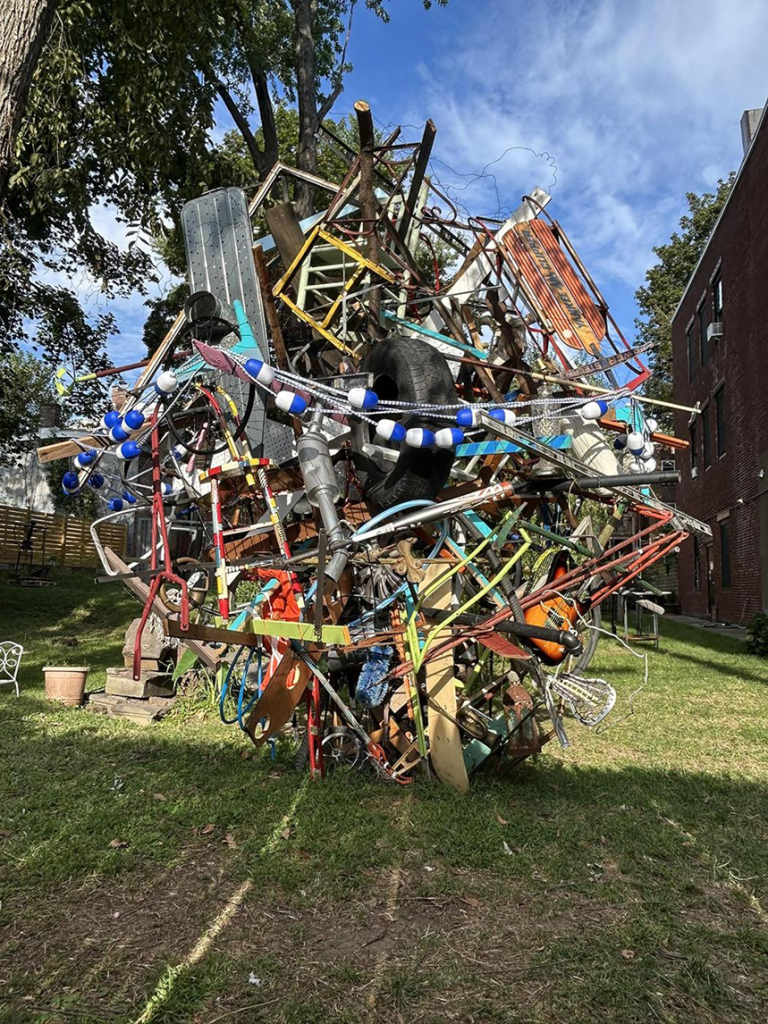
Holland Tunnel Newburgh opens its sculpture garden. Julie Lindell, Everything, 2025, 144x144x144 in. Mixed media, found objects. Photo courtesy of Julie Lindell
When artist Alexandra Limpert invited Janet Rutkowski to co-curate Reclamation in honor of her longtime friend and Holland Tunnel founder Paulien Lethen, Rutkowski accepted without hesitation. Although she had just finished curating and exhibiting in several projects, she embraced the challenge with what she describes as her “devil-may-care” approach. The exhibition’s title emerged quickly, reflecting her interest in the idea of recovery and renewal.
The group show Duae Lingua at The Brâncuși Gallery in the Romanian Cultural Institute began as a personal reflection on curator Daniela Holaban’s migration journey from Romania to the United States and gradually evolved into a broader curatorial inquiry into dual identity and cultural translation through the lens of Eastern European women artists. “Initially, I was interested in the dissonance between linguistic and cultural fluency—how even after mastering a language, true belonging can remain elusive,” says Holban. In this interview with Art Spiel, Daniela Holban elaborates on how that concept became the foundation for the exhibition, using language as both metaphor and framework to explore themes of identity, memory, and assimilation.
FELLOW IMAGINARIES installation (three pieces), Carole d’Inverno and Susan Rostow, (left) Telling Bones, 21 x 19 x 15, paper, metal, bone, plastic, wood, pigments. Rostow, (middle) North-South, 42 x 71, vinyl emulsions, ink pens, inks on canvas, rod, d’Inverno, (right) Under Cover, 24 x 12 x 12, wood, sisal rope, wire. d’Inverno
Carole d’Inverno and Susan Rostow live a block apart. Over the past year, they passed sculptures between studios, texted images and material references, built paper maquettes, and revised their work without fixed goals. Fellow Imaginaries, now on view at Atlantic Gallery, result from this sustained exchange. The exhibition includes fully collaborative hybrid sculptures made jointly by d’Inverno and Rostow, alongside individual works by each artist: sculptures by Rostow and both sculptures and paintings by d’Inverno. Though distinct in authorship, all the works were developed in close dialogue. They respond to one another in form and material and in how they occupy space. Walking into the show feels like entering a toy store—joyous, playful, a place of invention. The visitor becomes a child again, wondering how things were made and how they might move.
Katie Hudnall: The Longest Distance between Two Points at the Museum for Art in Wood, installation shot, image courtesy of the gallery
I always love that Earth Day is situated right when the city is exploding with new flowers and life. These spring exhibitions show appreciation for our planet by working with found and repurposed materials, honoring their origins while building something new. At the Museum for Art in Wood, Katie Hudnall constructs delightful and “mechanically improbable” animals and curiosity cabinets of found objects in her show, The Longest Distance between Two Points. Drexel University’s Pearlstein Gallery showcases CONTEMPORARY RUIN future visions, a collection of work that meditates on the realities of decay in our cities, offering both a poetic reflection on our everyday lives and practical approaches toward building a more resilient future. South of the city, Lavett Ballard’s solo show at Rowan University, The People Who Could Fly, features striking mixed-media collages that recast stories of African-American folklore and history using layers of imagery.
Kariann Fuqua, Emergent Strategies: In Defense of Weeds, 2025. installation shot: front gallery. Image credit, Brad Farwell
In her latest exhibition, Emergent Strategies: In Defense of Weeds, Kariann Fuqua invites viewers to reconsider their relationship with the natural world—specifically the wild plants we so often dismiss as nuisances. Through a collection of drawings, photographs and found objects gathered from her acre of land in Mississippi, Fuqua examines the ecological and cultural narratives tied to “weeds,” challenging the capitalist obsession with control that underpins the American lawn.
Jim Condron’s exhibition at the New York Studio School, curated by Karen Wilkin, continues his consistently thoughtful Collected Things series, inviting viewers to see everyday objects as vessels of personal and cultural memory. The sculptures, varying in size from around 20 to 96 inches, playfully transform seemingly ordinary items into layered narratives that bring unexpected elements together.
Dad’s Journey. 2003. Pen, ink, colored pencil, fabric, thread, buttons, on paper. 15 x 11
“She was weird,” said the Columbus Museum of Art curator affectionately of artist Aminah Brenda Lynn Robinson at the press preview celebrating the late artist’s work. She went on to explain that Robinson made her own art supplies, lived an unconventional and rich life, making art in many mediums and acted as an informal archivist and raconteur of her community. “Weird,” in this context is a high compliment. Fort Gansevoort, an eccentric gallery in New York’s Meatpacking District announced its representation of Robinson’s estate (1940-2015) in collaboration with the Columbus Museum, to which Robinson bequeathed her work and archives. It’s a perfect match between artist and gallery.
Pat, 2020. Pigment print, oil, acrylic, red oak, and found objects on wood. 31 3/8 x 25 3/8 x 1 7/8 inches
Llyn Foulkes is a 90-year-old painter, jazz musician, troublemaker and visionary. After making a splash entrée on the American art scene in 1961, he hopscotched around the artworld, changing genres and styles as his restless mind embraced new ideas. He has been “consistently inconsistent” (from his website), wonderful for an artist, but not always strategic for a career. The commercial art world can be somewhat conservative, preferring that an artist find a groove and stick to it. As a result, though brilliant, Foulkes has not yet achieved the wide recognition that he deserves.
Encyclopedia of Light (Today in Two Parts) at Elijah Wheat Showroom, installation view
On March 31, 1884, the Village of Newburgh became New York’s second municipality to receive electricity, just two years after New York City. On September 14, 2024, Matthew Lusk achieved a similarly electrifying milestone by launching his solo show, Encyclopedia of Light (Today in Two Parts), an outstanding exhibition running through December 1 at Elijah Wheat Showroom in Newburgh, NY.
The Object Library, photo courtesy of Yasmeen Abdallah
Mementos abound all around us in our day-to-day activities. Often, they hold dear memories: some we wish to keep, and some we wish to release so that we can move on to new experiences. Be it a trinket that houses memories of better days, a gift from someone we cherish, or a serendipitous discovery that found its way into our orbit, we become fused in inexplicable ways. What happens then, when we are asked or forced to part with such gifts? It can be freeing to release ourselves from materialism, but it can also be devastating, depending on the circumstances.