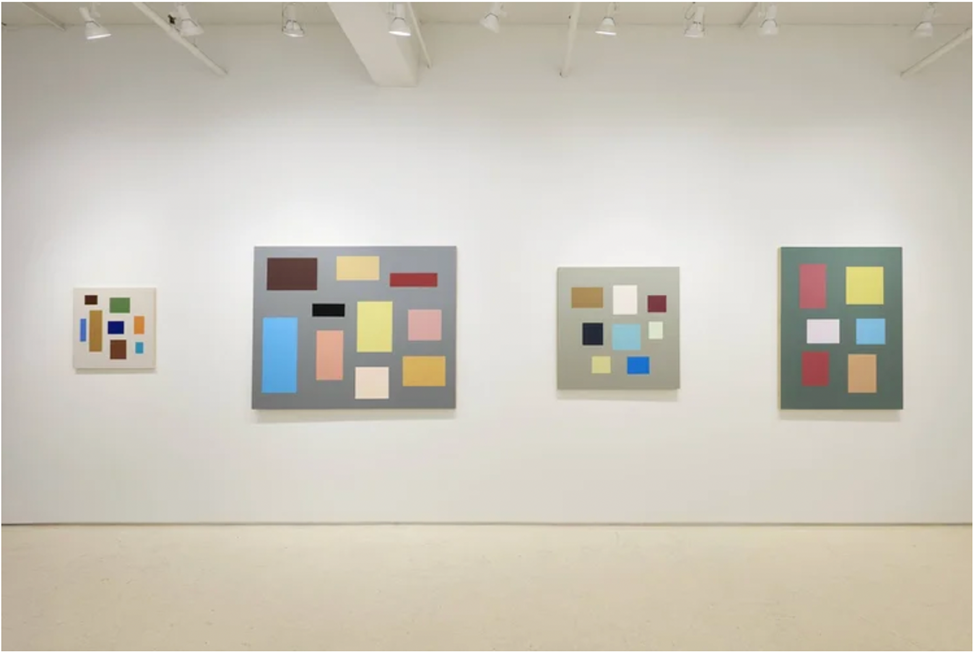
Tom McGlynn, This Here, installation view, Rick Wester Fine Art, New York
Tom McGlynn continues to grow a decade-long train of thought with a new selection of paintings in This Here at Rick Wester Fine Art. Consistent with his oeuvre, he arrays a selection of color rectangles suspended within various fields of color. An acquaintanceship with the origin of this direction, accompanied by a fresh pair of eyes, will enable a viewer to put aside the parallels with Mondrian, Albers, or even Hans Hoffmann, and see these works anew.
Installation view. Photo courtesy of The Milton Resnick and Pat Passlof Foundation
The exhibition Accommodating the Object of paintings by Elizabeth Yamin and Bosiljka Raditsa is presented by The Milton Resnick and Pat Passlof Foundation in New York and was curated by William Corwin, who describes this exhibition as an intimate survey that offers the viewer an opportunity to compare the works of these two artists, who were active during the latter part of the twentieth century without attaining prominent careers.
In Harriet Korman’s exhibition titled Portraits of Squares, the squares in question are either nested within the framework of a grid or stand alone as discreet entities surrounded by blocks of color. Her palette, in the main, is made of secondary and tertiary colors, which for the most part, are applied in an opaque and unmodulated manner — her surfaces tend to be flat and dry. Korman uses color both as a formal element to reinforce her composition’s structure as well as spatially. As one moves around the gallery, there seems to be no logical progression or sense to the paintings’ variations. The canvases, all of the same dimensions, are rectangular and are hung on the horizontal at eye level; their sequencing refuses to surrender an associative, conceptual, or anecdotal narrative. What one is left with is the fact they all, in part, reference squares and that they are all relatively different in approach. Subsequently, it is hard to determine if the “portraits” represent systemic deviations on a singular theme or if each painting was individually intuited. Behind the reception desk hangs a painting from 1979 whose forms are organic, their edges blurred, and whose surface is mottled. This painting stands as a reminder that Korman works thematically, and the present paintings are an aspect of her broader investigation of abstract painting’s various idioms.
Adam Henry, Installation view, photo credit: Charles Benton. Courtesy of Candice Madey gallery
Amongst a burgeoning market of retrograde art practices there runs an undercurrent of artists seeking to establish for art and its practices a new sustainable identity as a means of inquiry. What made his work different was that he was using painting as a platform primarily to explore the subjectivity and semiotics of perception—the polarity between painting as an optical event and a conceptual one. Taking his vocabulary from color theory, systemic and color-field painting, and cognitive science, his work focused on the difference between what a thing (materially) is and what it may descriptively represent. As with those works, Henry in his present exhibition at Candice Madey Gallery rejects at every turn the cult of individual expression, the magical thinking of transcendence, the pervasive appeal of accessibility, and spectacle. Instead with his present body of works, he reasserts his ambition is to use art as a means to engage his audience in speculative thought and self-reflection.