I had the pleasure of reading quite a few remarkable books this year. I had the additional pleasure of reviewing a number of them for ArtSpiel.
I reviewed Rapper’sDeluxe: How Hip Hop Made the World, Dr. Todd Boyd’s sweeping and lushly illustrated account of hip hop history, published by Phaidon, back around its release date in February. You can read my full review here: “Even Greater Days: Rapper’sDeluxe: HowHipHopMadetheWorld”.
Diagram from the United States Geological Survey, Harvard.edu
What’s Your Golden Spike is the third in a series of three interrelated experimental pieces that combine graphics, text, and hyperlinks based on themes coming out of my Crazy River project, for which I gave an interview on this website on May 16th. Crazy River takes a wide-angle view of the climate crisis, ranging from my own climate grief to an in-depth focus on the many causes and effects of rapid environmental changes on the West Branch of the Neversink in Ulster County. In this piece I investigate the idea of the Catskills as a region, and an incongruous bundle of contradictions and coincidences. The Lands of Kats Kill weaves three timelines together: the geologic, the historical, and the personal. This structure repeats throughout my Crazy River project. The previous piece in this series, Invaders, took apart the idea of invasive species. The following will explore the concept of the Golden Spike in stratigraphy as fact and metaphor.
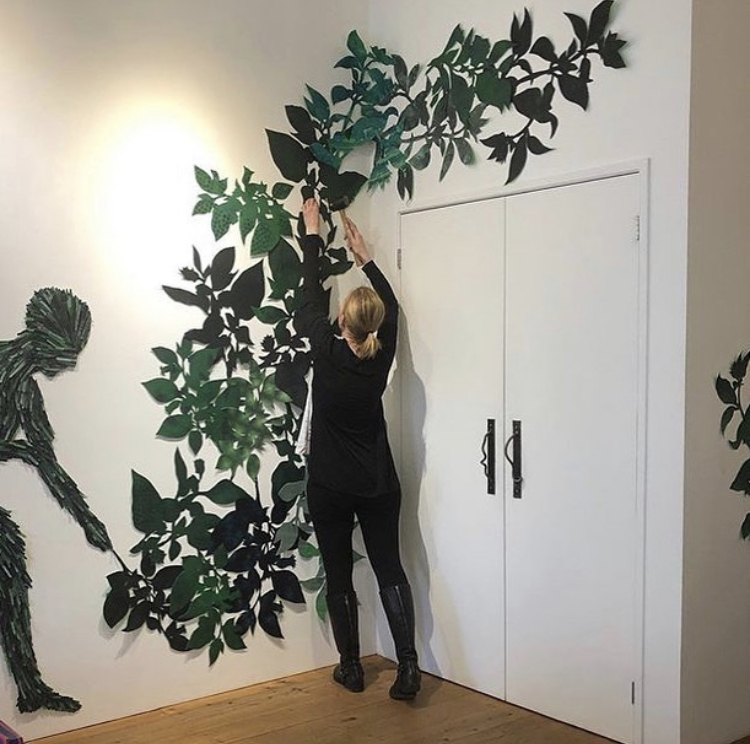
Installing “Belladonna” piece at Village West Gallery in Jersey City, March 2020. Photo courtesy of Michael Endy
Artist Anonda Bell reflects in her mixed media installations on a range of complex notions—from exploring different ways women have been perceived throughout history to environmental concerns. The entry point to her projects include homages to historical figures like the American feminist Charlotte Perkins Gilman who protested in her book Yellow Wallpaper the oppression of women at the end of the 19th century, and the Australian Lindy Chamberlain who was falsely charged with murdering her baby; references to cultural trends in psychology related to women’s anxiety and Hysteria; or environmental concerns referencing Biophobia and extinction.