Noa Charuvi: Gal’Ed at York College Arts Gallery

Photo Story
A painting of a landscape

Description automatically generated
Noa Charuvi, Cairn, 2023, oil on canvas, 36×72 inches

45 Jacob took a stone and erected it as a pillar. 46 He instructed his kin, “Collect some stones.” They gathered stones, formed a heap, and shared a meal beside it. 47 Laban named it Jegar Sahadutha, while Jacob named it Galeed. 48 Laban declared, “This heap stands as a witness between us today.” Hence, it became known as Galeed.

Genesis, Chapter 31, Verse 45

A Gal’Ed symbolizes a location marked by significant events—deathly moments or sacrifices. As it appears in the Old Testament, it signifies a covenant. In Hebrew, ‘Gal’ is a heap of stones, and it is the same word for ‘wave.’ ‘Ed’ means a witness. This heap of stones becomes an emblem of the pact between Jacob and his father-in-law: their agreement not to harm each other’s possessions or families. Serving as a symbol of shared promises, Jacob sanctifies it, offering to God on this stone.

Continue reading “Noa Charuvi: Gal’Ed at York College Arts Gallery”

Finding My Folk at Old Stone House

Featured Project
A picture containing floor, indoor, wood

Description automatically generated
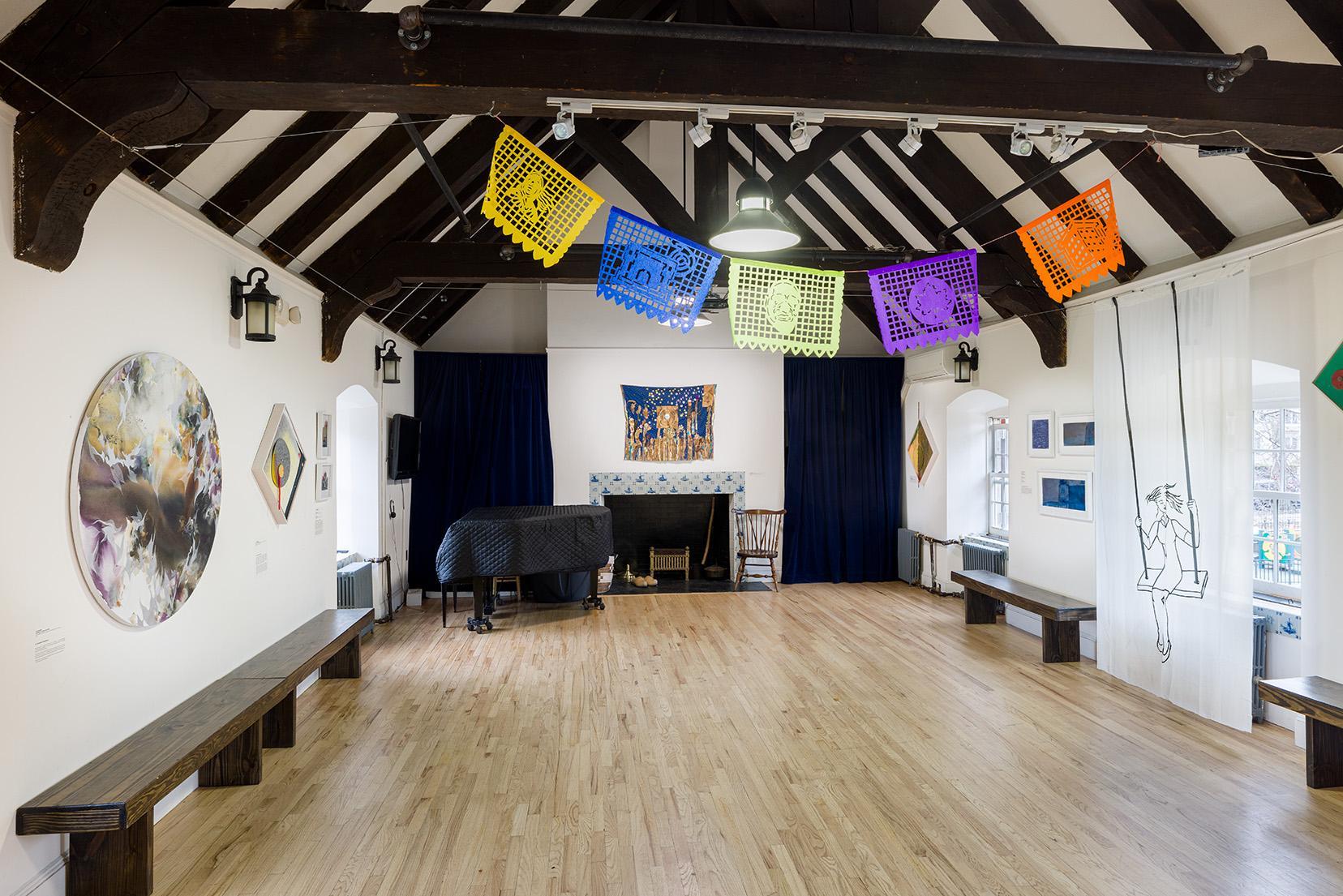
L to R: Ai Campbell, Carl Hazlewood, Angelica Bergamini, Damali Abrams, Carl Hazlewood, Angelica Bergamini, Jodie Lyn-Kee-Chow and Blanka Amezkua (center).

Finding My Folk, curated by independent curator Krista Scenna at the Old Stone House in Brooklyn, features work by seven contemporary immigrant artists whose practices embrace the folkloric in their own traditions, rituals, and customs by blending elements of their past, memories of “home,” their present, and future. The notion of Folklore underscores the show, how it is often so seamlessly embedded in daily lives that people may tend to overlook it—myths, dances, rhymes, toasts, jokes, holidays, and festivals are all essential characteristics of a community—ranging from the family unit, to a nation, to the global population. The show is on view through April 9, 2023 with a closing event on Monday, April 10th from 6:30pm – 8:00pm.

Continue reading “Finding My Folk at Old Stone House”

Emily Mae Smith: Heretic Lace at Petzel

Emily Mae Smith, Heretic Lace, 2019, Oil on linen, 48×37 inches

Walt Disney has taught us that cartoons can be used to distract us while conveying the most serious of subjects. Understanding this Emily Mae Smith in 2014, introduced into her developing iconography an anthropomorphized, androgynist broom consisting of a featureless phallic shaft attached to a twig brush. This broom, a descendant of the demonic mops portrayed in sorcerer’s apprentice section of Disney’s Fantasia (1940), has become a signature image in her work. Joined with icons associated with desire and fear, Smith has used this figure as both a male and female trope, as well as an alter-ego. To greater and lesser degrees Smith uses her glossary of icons in some cases to engage in heady meditations on such topics as death, vanity, desire, history, etc. and at other times to enigmatically introduce such subjects with little or no commentary.

Continue reading “Emily Mae Smith: Heretic Lace at Petzel”

Natalie Westbrook: Faces at Zynka

Previewing

A picture containing text, indoor, floor, painting

Description automatically generated

Natalie Westbrook’s exhibition at ZYNKA Gallery in Pittsburgh features new paintings on canvas and drawings on paper. Westbrook depicts faces as thick lines immersed in saturated hot pinks, greens or monochrome gradations—altogether fluctuating between the monstrous and the angelic, the scary and the pathetic. Sometimes they are solitary and sometimes they indicate twins or perhaps a fragmented self. In her catalogue essay on Natalie Westbrook’s work, Larissa Pham observes that Faces “come for you, leering, grinning, mouths a garish lipsticked rictus of joy, embedded flat against the canvas, their features seeming to emerge from the psychological fabric of the painting itself.”

Continue reading “Natalie Westbrook: Faces at Zynka”

Instituting The Re Institute in Millerton

In Dialogue with Henry Klimowicz, founder and director


The Re Institute empty, 2021, photo courtesy of Henry Klimowicz

The Re Institute is an extension of Henry Klimowicz’s studio, a very large 1960s dairy barn outside of Millerton, New York. About 11 years ago sculptor Henry Klimowicz started the gallery as a response to living in the “center of nowhere”, as he puts it. The artist says that the gallery allows him to have extended working relationships with other artists and their work. “I try not to know what a show will be about before it opens and I get to spend the length of the exhibition becoming aware of all of each show’s nuances,” he says about his curatorial process. A normal season at Re Institute includes 4 to 5 shows, which mostly feature 2 to 3 artists showing in the large space upstairs and another person downstairs. “I try to get each artist to have a specific reason for showing in the gallery outside of the possibility of selling work,” he says. This fits his vision of Re Institute as a non-profit institution. It’s important for him that the featured artists will find reasons to use the space uniquely. “There has to be something in the process of showing an artist that brings depth to the artist’s understanding of their own work or the process of exhibiting their work,” he says. These different ways of interacting with each artist have become the most important aspect of the space for him.

Continue reading “Instituting The Re Institute in Millerton”

Greg Drasler: Crowded Places / Open Spaces at Betty Cuningham Gallery

In Dialogue with Greg Drasler


Crowded Places / Open Spaces installation Betty Cuningham Gallery

Greg Drasler came to be a metaphorical figurative painter when he lost everything he owned in a fire in 1978, except for two paintings. At that moment he decided to focus exclusively on painting — he was a painter and painting would be everything he needed. He began to rebuild his pictorial world with scenes from the self-help DIY magazines and for over 40 years has continued to explore and expand his visual vocabulary through several bodies of work. Greg Drasler says he identifies with the subjects of his paintings “as personal questions, metaphors, and allegories often responding to social and cultural topics.” His current solo exhibition at Betty Cuningham Gallery includes both works from his lengthiest series, the Hats Paintings, and some from his most recent series, the Road House paintings. Sparked by the effects of social distancing due to the pandemic, the paintings overall assume another layer of meaning.

Continue reading “Greg Drasler: Crowded Places / Open Spaces at Betty Cuningham Gallery”

Ashley Norwood Cooper in Domestic Brutes at Pelham Art Center

In Dialogue with Ashley Norwood Cooper

A picture containing table, sitting, small, little

Description automatically generated

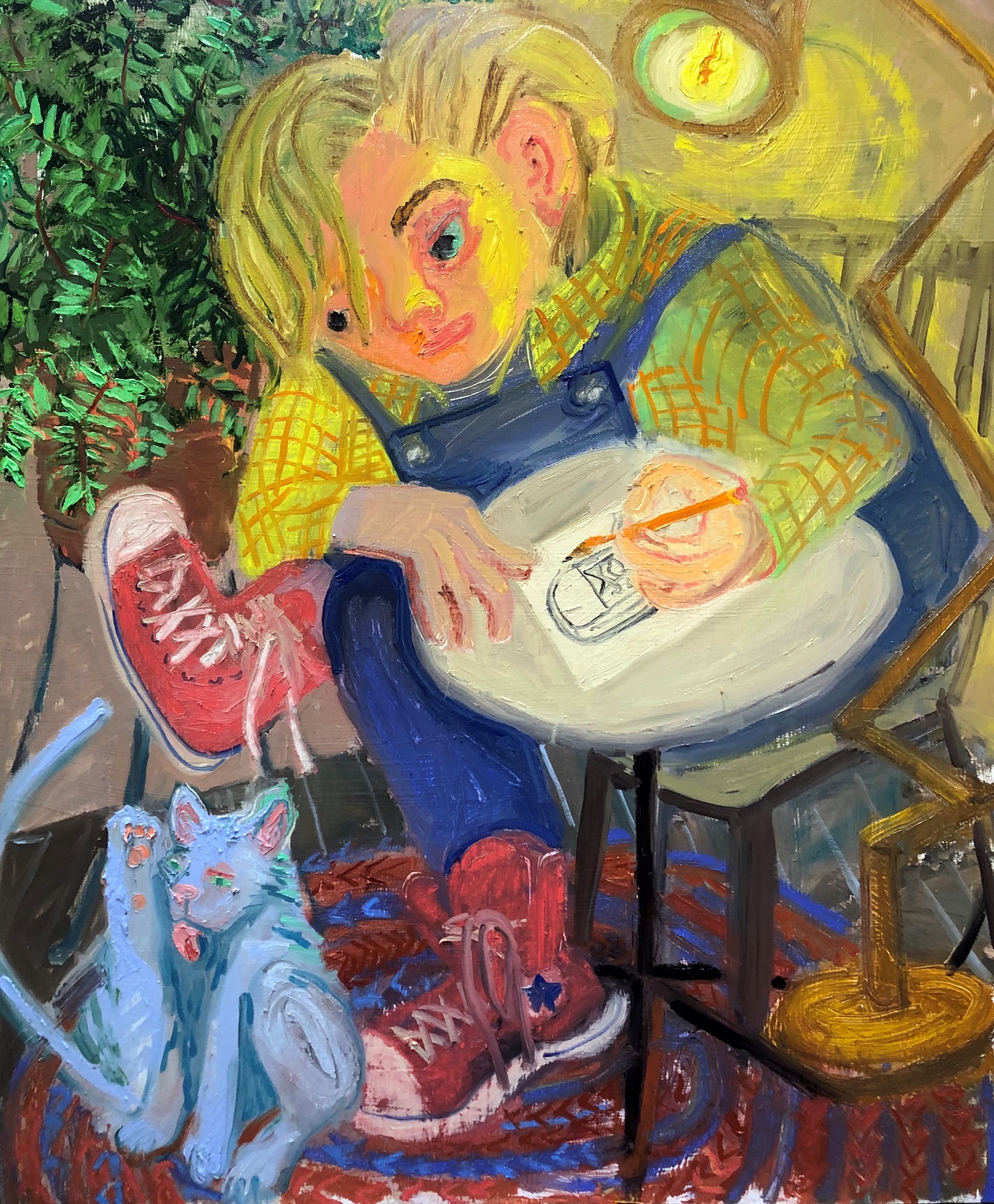
”How to Draw Your Shoe”, oil on panel, 36” x 30”, 2020.

Ashley Norwood Cooper is an artist and a mother, raising three teenagers in a small town in upstate NY. Her paintings have always dealt with family and home and how the personal connects us to the global and political. She is interested in the schizophrenic role of the artist-mother-wife-teacher and in how to redefine the heroic from a woman’s perspective. Ashley Norwood Cooper is participating in Domestic Brutes and she will present her work in a virtual studio visit hosted by Pelham Art Center on Thursday, October 15th, 5-6pm.

Continue reading “Ashley Norwood Cooper in Domestic Brutes at Pelham Art Center”

Artists on Coping: Gail Winbury

During the coronavirus pandemic, Art Spiel is reaching out to artists to learn how they are coping.


Gail Winbury in her studio, photo by Nancy Ori

Gail Winbury brings a psychological lens to her art. She shows in museums, universities and galleries in the States, Europe and Mexico. Her work was in OTAContemporary in Santa Fe, Aferro Gallery in Newark, St Peters University in Jersey City, NJ, The Jersey City Museum, the Monmouth Museum of Art and the Henrich Heine Haus in Germany and other venues. She was a resident at the School of Visual Arts, Manhattan, and at Edgewood Farms, Truro, Ma., a Fellow with the Bau Foundation in Puglia, Italy, and received a grant for an artist exchange in Israel.

Continue reading “Artists on Coping: Gail Winbury”

‘Openings’ at Studio 10

Art Spiel in Dialogue with Larry Greenberg and Kate Teale

A picture containing wall, indoor, bathroom, room

Description automatically generated
Installation view

Kate Teale and Larry Greenberg have been exchanging art ideas for many years. Recently, their conversations have transformed into a fascinating collaboration, resulting in a two person painting show at Studio 10 in Bushwick. Larry Greenberg, the founder of Studio 10, and Kate Teale, a painter who has showed her work there regularly, share with Art Spiel how ‘Openings’ came about.

Continue reading “‘Openings’ at Studio 10”

Brian Wood Drawings: Visions of Hyperawareness

Brian Wood, Plank, 2017, Graphite on paper, 11 x 14 in., photo courtesy of the artist

Brian Wood’s drawings are literally visionary. They derive from what the artist describes as a “trance-like” state, where the ego is consumed by the image, as the inner mind and hand become vital conduits for arising images. This inner process results in drawings that invoke nuanced mental states, fragmented memories, and perhaps most important, a glimpse at the unknown. Holland Cotter wrote in his NY Times review of Brian Wood’s 2014 solo show Enceinte that the artist creates “a kind of Symbolist world in which emerging into life and being devoured by it are part of the same inexorable process.” In a cynical age with ubiquitously ironic art, this unabashed approach to the spiritual elements in the process of art making is quite refreshing.

Continue reading “Brian Wood Drawings: Visions of Hyperawareness”