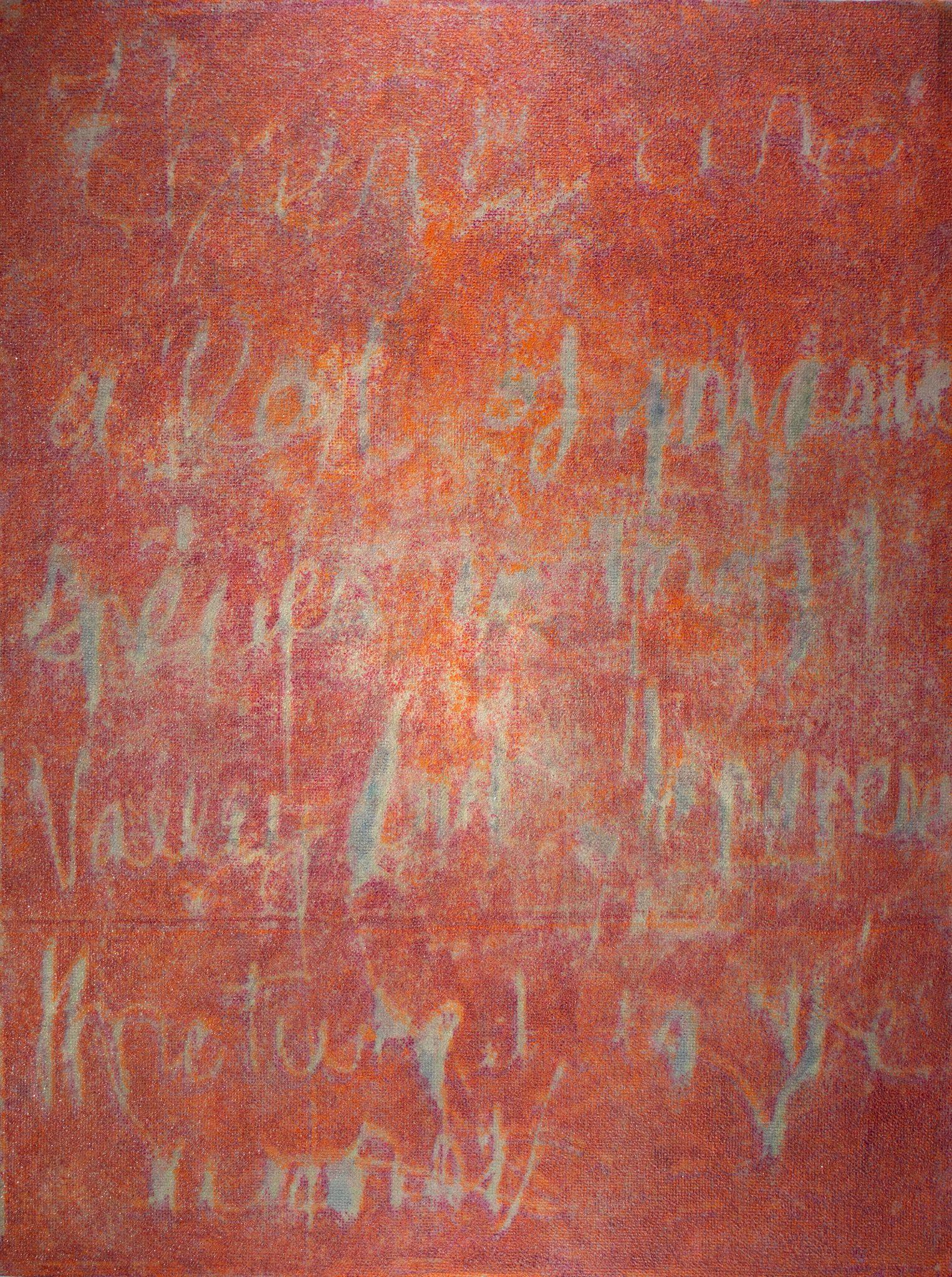
Susan Hoffman Fishman, The Earth is Breaking, Beautifully VII: Dead Sea Sinkholes, acrylic, oil pigment stick, cyanotype and mixed media on paper, 51” x 51,” 2023
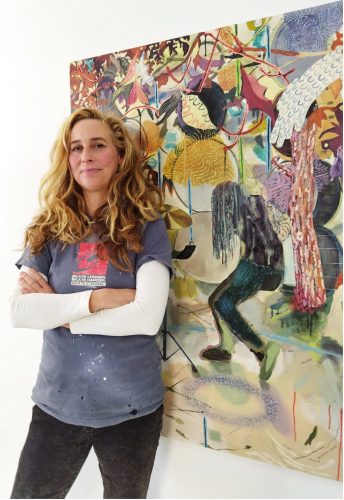
Susan Hoffman Fishman is an artist who has addressed climate change for many years both in context of her own work as an artist and in her writing on other artists’ work in that arena. Hoffman was first interviewed with Burning Worlds about four years ago and has recently been interviewed there again on her latest series of paintings depicting coastline sink holes and other landscapes impacted by climate change,
Garden for Drowning Descendant/Garden Sequence from “Flying and Drowning Dream,“ interactive mixed reality installation, 2022, with performer Danielle McPhatter.
Eva Davidova makes new media works that focus on ecological disaster, our interdependence as a species, and the political implications of technology which she unpacks with performative works rooted in the absurd. She imagines the paradox that one day our descendants–human or cyborg–will be constructing our reality as a simulation, and asks: “If we are the games our children will program one day, can we influence the code they are writing?”
Nancy Cohen, Segment of handmade paper loop that circles the gallery. Wire, thread and handmade paper, 80” x 140” x 46,” 2022. Photo credit: Maddie Orton
In the fall of 2019, Meagan Woods, an interdisciplinary artist working in dance, theatre and costume design, attended an arts/science event at Simon Fraser University in Vancouver, Canada where she was an MFA student. She was both alarmed and inspired by what she learned about the critical condition of coral reefs around the world caused by climate change. In response, she assembled a team consisting of four colleagues in the MFA Interdisciplinary Arts program and a New-Jersey based visual artist to create what eventually became an innovative, experimental opera/installation called Once She Dries. Besides Woods, the collaborative includes pianist and composer, Casper Leerink; filmmaker, photographer and installation artist, Xinyue Liu; violinist and composer, Kourosh Ghamsari-Esfahani; musician and actress, Amanda Sum; and sculptor and installation artist, Nancy Cohen.
A central theme in my Crazy River project has been highlighting the emotional toll of the climate crisis by putting under a microscope, so to speak, my own feelings about not only the impacts of the crisis but the knowledge that humans’ actions are the cause. This series of three on-line essays, thought experiments if you like, expands that project to change the POV to non-human actors that are inextricably bound with the habitat in the Western Catskills: the black-legged or deer tick (Ixodes scapularis), the white-tail deer (Odocoileus virginianus), and Japanese knotweed (Reynoutria japonica). All three have seen their habitat change dramatically through climate change and human interventions. Using my imagination and research, I try to enter the umwelt of all three species, an impossible task, as Thomas Nagel pointed out in “What Is It LIke to Be a Bat,” for which artistic license may give us the best chance to accomplish. My intentions in doing so fall along three axes: theoretical, aesthetic, and spiritual, dimensions all essential to my own art practice. Part III looks at the umwelt–a term normally applied only to animals whose use in this instance I will explain later–of Japanese knotweed from the perspective of the Vajrayana, or Tantric Buddhism.
The oil paintings featured in Shadow Weaving, Melanie Daniel’s second solo show at Mindy Solomon, depict magical landscapes of forests, ponds, and their inhabitants—a moth, a pair of coyotes, a beetle, an occasional mystical spirits. The paintings begin for her as meditations and transform into fleeting environments—both hallucinatory and recognizable. The show runs through March 18th. 2023.
Hovey Brock: Frost Valley, 2019, 36” x 48”, acrylic on panel
A central theme in my Crazy River project has been highlighting the emotional toll of the climate crisis by putting under a microscope, so to speak, my own feelings about not only the impacts of the crisis but the knowledge that humans’ actions are the cause. This series of three on-line essays, thought experiments if you like, expands that project to change the POV to non-human actors that are inextricably bound with the habitat in the Western Catskills: the black-legged or deer tick (Ixodes scapularis), the white-tail deer (Odocoileus virginianus), and Japanese knotweed (Reynoutria japonica). All three have seen their habitat change dramatically through climate change and human interventions. Using my imagination and research, I try to enter the umwelt of all three species, an impossible task, as Thomas Nagel pointed out in “What Is It LIke to Be a Bat,” for which artistic license may give us the best chance to accomplish. My intentions in doing so fall along three axes: theoretical, aesthetic, and spiritual, dimensions all essential to my own art practice. What follows is a look at the umwelt of white-tailed deer from the perspective of aesthetics.
Left: Wildriana Paulino, Right: Linda Cunningham. Photo courtesy of Michele Brody
Scaling Nature at the Bronx River Art Center features large-scale mixed-media installation works by three artists: Michele Brody, Linda Cunningham and Wildriana Paulino. Curated by Gail Nathan, the premise of this show is to represent nature as a force of nurture and destruction through the use of materials from the ephemeral to the concrete. Paulino and Brody both work with cast handmade paper that hangs from the gallery ceiling to command the space. Their massive artworks invite the viewer to be engulfed by a feeling of being one with nature and simultaneously wary of the effects of climate change.
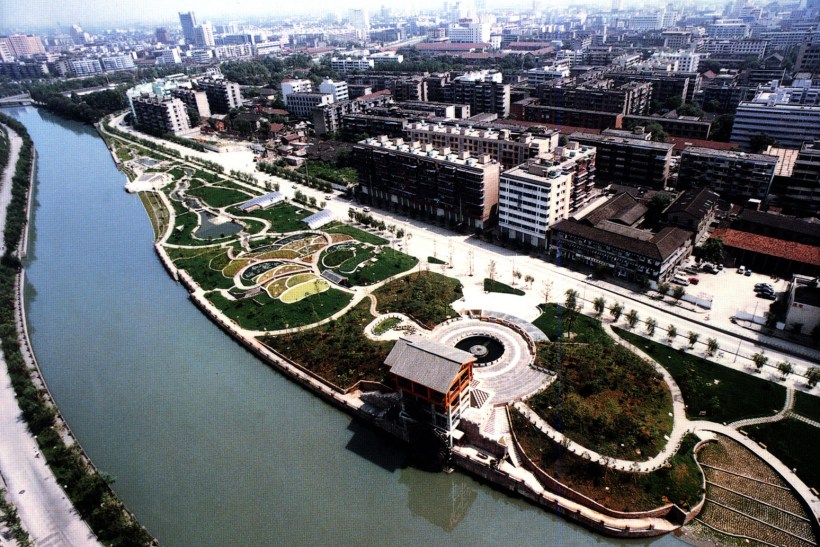
For the last 50+ years, eco-artist and environmental activist Betsy Damon has devoted herself to community building – the coming together of individuals to achieve a common purpose. Since the 1980s, after a decade of engaging the public through public performances in New York City, she has worked at the intersection of art and science, focusing on the topic of water and on creating models for communities in the United States and China to know and become stewards of their own water sources. The brief descriptions below, highlighting four of Damon’s many exhibitions, ecological and sustainable design projects, publications, and organizations are only a brief glimpse into her prolific and important body of work.
Hovey Brock: Blackleg Tick, 2021, 24” x 36”, acrylic on panel
A central theme in my Crazy River project has been highlighting the emotional toll of the climate crisis by putting under a microscope, so to speak, my own feelings about not only the impacts of the crisis but the knowledge that humans’ actions are the cause. This series of three on-line essays, thought experiments if you like, expands that project to change the POV to non-human actors that are inextricably bound with the habitat in the Western Catskills: the black-legged or deer tick (Ixodes scapularis), the white-tail deer (Odocoileus virginianus), and Japanese knotweed (Reynoutria japonica). All three have seen their habitat change dramatically through climate change and human interventions. Using my imagination and research, I try to enter the umwelt of all three species, an impossible task, as Thomas Nagel pointed out in “What Is It LIke to Be a Bat,” for which artistic license may give us the best chance to accomplish. My intentions in doing so fall along three axes: theoretical, aesthetic, and spiritual, dimensions all essential to my own art practice. What follows is a look at the umwelt of black-legged ticks from the perspective of theory.
Scherezade Garcia, Paradise According to the Tropics/Sunburnt Jesus, Acrylic, Charcoal on Linen, 72 x 48 inches
Metaphor Projects is an artists-run space for contemporary art and culture founded in 2001 by two working artists. Directors/ Curators: Julian Jackson and Rene Lynch have mounted more than 100 solo and group exhibitions presenting the work of hundreds of artists and spent two decades developing what they call “the social sculpture that is Metaphor.”