Still from Jessica Segall’s film Say When, produced by Little Sun (2021)
Speaking on behalf of all the amazing artists I’ve interviewed over the past four years for this monthly Renewable Energy series, I think that one of the greatest compliments any of us could ever hope to receive would be to be described as a “superhero” by Olafur Eliasson.
Águas do Futuro, detail, mokuhanga on washi scroll(handmade Japanese paper), installed in Bahia, Brazil, 2018
For Brooklyn-based printmaker Florence Neal, water has always been a dominant presence in her life. She grew up in Columbus, Georgia, near the Chattahoochee River, which straddles the southern half of the Alabama and Georgia borders. There she developed an appreciation for the Native American stories about the river as well as first-hand knowledge of the negative impact that the cotton and iron mills of the past and the pervasive industrial pollution had had on its health.
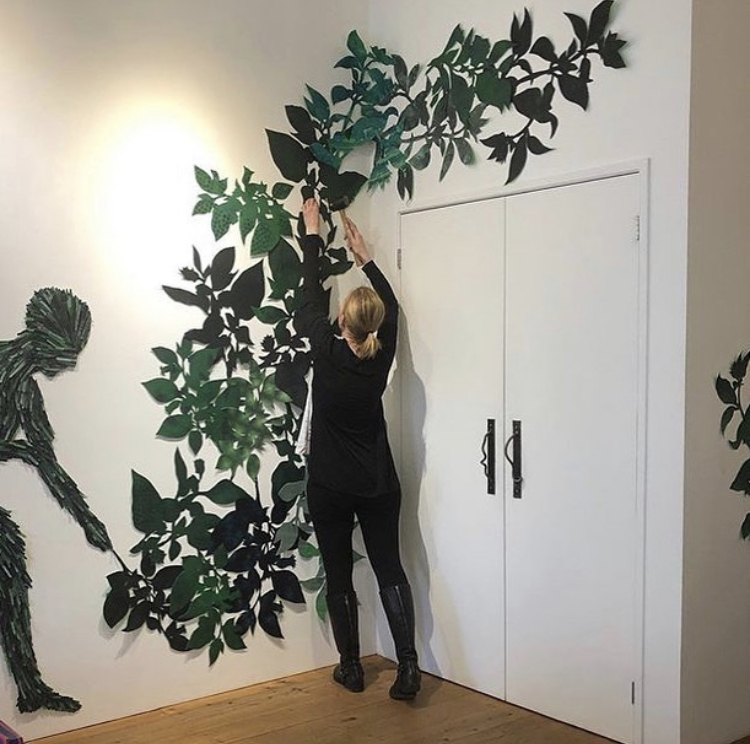
Installing “Belladonna” piece at Village West Gallery in Jersey City, March 2020. Photo courtesy of Michael Endy
Artist Anonda Bell reflects in her mixed media installations on a range of complex notions—from exploring different ways women have been perceived throughout history to environmental concerns. The entry point to her projects include homages to historical figures like the American feminist Charlotte Perkins Gilman who protested in her book Yellow Wallpaper the oppression of women at the end of the 19th century, and the Australian Lindy Chamberlain who was falsely charged with murdering her baby; references to cultural trends in psychology related to women’s anxiety and Hysteria; or environmental concerns referencing Biophobia and extinction.
Tip of the Iceberg by Amanda Maciuba, Jen Morris, Jessica Tam, dimensions variable, vinyl on glass and wall, 2021
This month, I have a wonderful interview with three artists for you. Amanda Maciuba, Jen Morris, and Jessica Tam are all visual artists working in different mediums. However, they share a fascination with how ecological language (surge, spike, wave, etc.) has worked its way into news reports’ descriptions of large phenomena such as crowds, pandemics, and political movements. They recently closed a show at the A.P.E., Ltd. Gallery in Northampton, Massachusetts titled WAVE/SURGE/SPIKE.
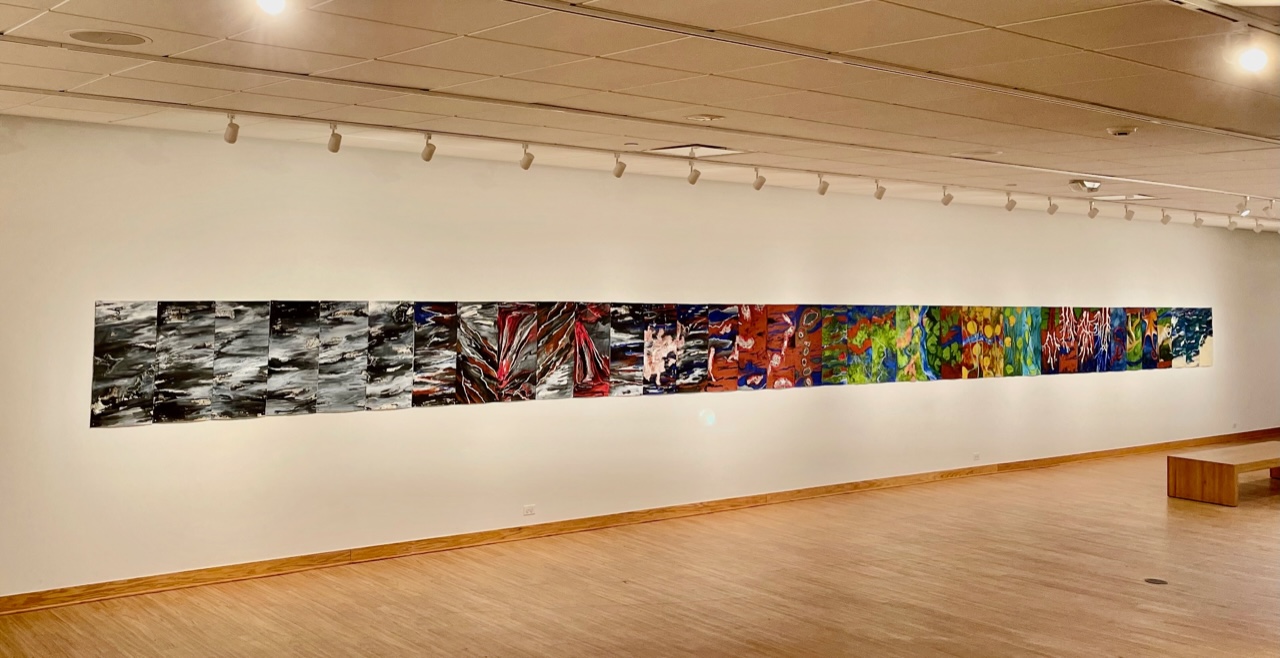
Susan Hoffman Fishman, In the Beginning There Was Only Water, 30 in. x 50 ft., acrylic, oil pigment stick and mixed media on paper, 2021, Installation view at Janice Charach Gallery, West Bloomfield, Michigan
During the height of the COVID-19 pandemic, from 2020 through 2021, eight women artists from the Midwest and the East Coast of the United States came together via Zoom to read and discuss All We Can Save: Truth, Courage and Solutions for the Climate Crisis, edited by Ayana Elizabeth Johnson, Ph.D. and Katharine K. Wilkinson, Ph.D. The book contains essays and poetry by a cadre of diverse women policy wonks, scientists, writers, journalists, lawyers, activists, and others who address the most critical existential issue of our time with the intention of offering different ways to effect change and mend the significant damage that we have caused to the Earth. The artists’ responses to the essays form the exhibition Climate Conversations: All We Can Save. The exhibition runs through June 30th, 2022.
installation views; 7ft Mud Curtains, photo courtesy of Yunha Choi
Laminatede Earth, Sharon Yavo-Ayalon’s large-scale multimedia installation at ZAZ10TS intersects architectural representations of housing with land art practices—raw soil and synthetic matter coalesce. Sharon Yavo-Ayalon, an artist and architect, draws from both disciplines to transform the confined lobby of 10 Times Square into a shimmering dreamy landscape. The exhibition extends to the ZAZ corner billboard on 41st and 7th with video art, taken from a performance of the artist who builds, destructs, and rebuilds her own plastic home. The show is curated by Professor Lala Ben-Alon and runs in the gallery through April 28th, 2022.
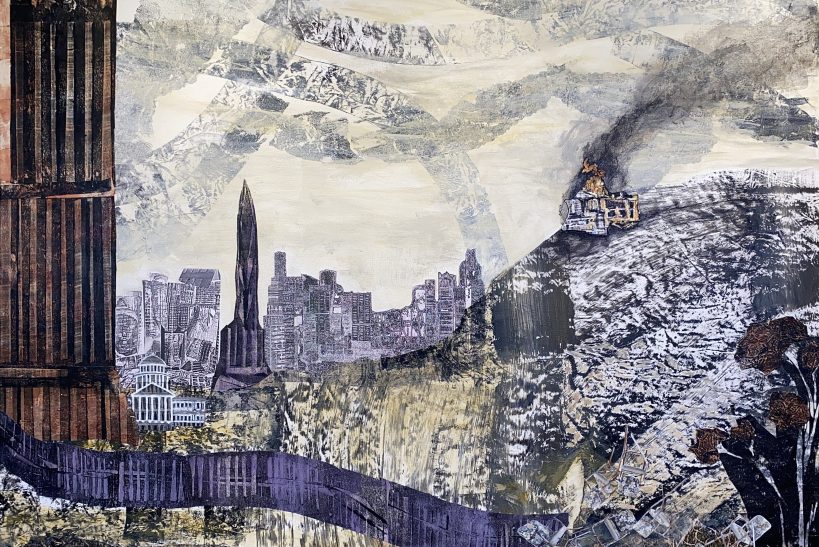
Blazing, California Dreamin’, acrylic painting incorporating original hand-painted paper on stretched canvas, 30”x 40
Over the past decade, we have witnessed a proliferation of climate-related disasters across the world. Storms have become stronger, wildfires more intense. Sea ice is melting at a higher rate as the earth grows hotter. Each of these problems alone endangers human welfare. Together, they represent an existential threat. Scientists often describe our position as nearing a “tipping point” at which we teeter at the precipice of an irreversible cascade of ecosystem collapse. My new collaboration with fellow artist Carin Walsh presents a different view of our role in this crisis. It serves as a reminder that we are not passive observers of this disaster, but active agents with the ability to change course and build a safer and healthier future. Our message is that while the climate is approaching a tipping point, our society is at a turning point. We have the power to choose whether we will continue on our current path, or whether we will turn to embrace the measures necessary to reverse climate change.
Entanglement (Paintings by Cecile Chong, Sculpture by Jack Henry, courtesy BravinLee Programs
Entanglement is a new exhibition of works by Jac Lahav, Cecile Chong, Jack Henry, and Erik Olson. The work ranges from the psychological to the sentimental with many references to the natural world. Much of the work is dissimilar, like a portrait of Ruth Bader Ginsburg wearing leopard print and a leafy necklace which stands in contrast to atmospheric encaustic paintings referencing Chinese landscape. Together these pieces take us deep into a post-pandemic psyche. The binding theme is plants, using nature as a metaphor for an internal growth many of us have experienced during the past two years. Entanglement opened on Thursday March 3rd and is up at BravinLee Programs in Chelsea New York until April 9th. We sat down with gallerist Karin Bravin and two of the artists to talk about the show.
Sea-Change Installation at MARS gallery, Melbourne, Australia, 2017. Photo by Matthew Stanton
Many artists have begun making work related to the climate crisis in recent years. But Australian visual artist Penelope Davis decided to address the subject eight years ago. Originally trained as a photographer with a portfolio including mainly camera-less photographs, she turned to sculpture and the looming environmental disaster after observing her first jellyfish blooms along the Melbourne coastline. Although alarmed by what appeared to be an unnatural and terrifying phenomenon, she was also attracted aesthetically to the jellyfish’s semi-transparency and how they reflected light.
Part 2: Mimi Czajka Graminski – Interview with Jennifer McGregor
Mimi Czajka Graminski, Petal Series Rose 1, 2020-2021, archival pigment print of photograph of rose petals, 10 x 10 inches
Landscape Deconstructed: Mimi Czajka Graminski and Linda Stillman is a virtual exhibition on view at the Hammond Museum and Japanese Stroll Garden website (hammondmuseum.org/virtual-galleries) until June 2022. It is curated by Bibiana Huang Matheis. The opening on September 11, 2021, included a virtual conversation with Mimi Czajka Graminski and Linda Stillmanmoderated byJennifer McGregor which has been distilled and reformatted for individual interviews with each artist.
The Hudson Valley artists met in 2011 and were immediately struck by the similarities in their work and have continued a dialogue since then. Landscape Deconstructed is the first time their artwork is presented in tandem and underscores the way that both artists discover elements of their surroundings and reassemble them in ingenious ways. Through distinct processes, they each preserve fleeting moments of beauty in nature while documenting a particular time and place.