Notice: Function WP_Object_Cache::add was called incorrectly. Cache key must not be an empty string. Please see Debugging in WordPress for more information. (This message was added in version 6.1.0.) in /www/artspiel_344/public/wp-includes/functions.php on line 6131

Mary Heilmann: Water Way at Guild Hall

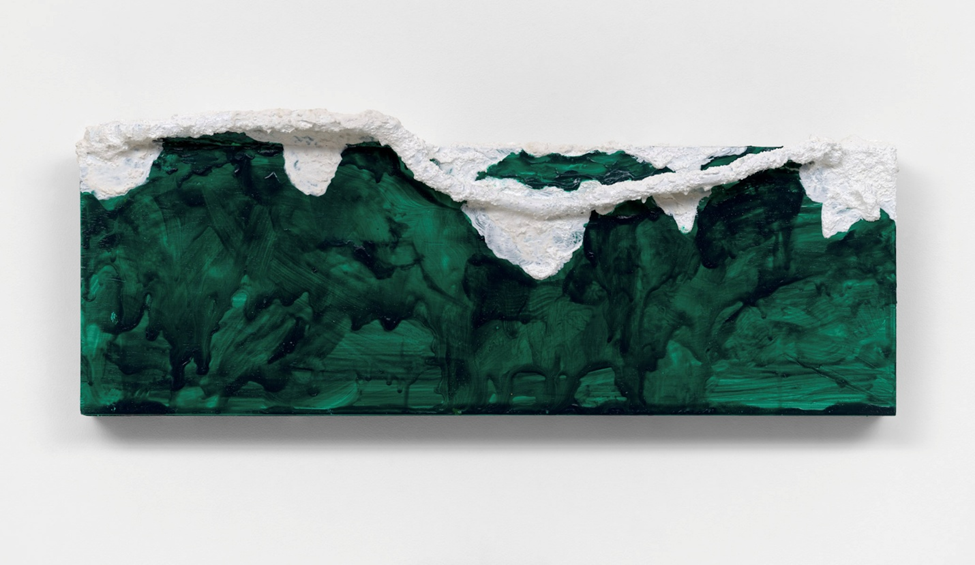
Mary Heilmann, Broken Wave, 2022,Acrylic and paper mache pulp on wood and panel, 10×26.75×3-1/2 inches, photo by Dan Bradica. @Mary Heilmann. Image courtesy of the artist, 303 Gallery, New York, and Hauser & Wirth

Water Way, Mary Heilmann’s newly opened show at Guild Hall in East Hampton and her first large-scale museum show on Long Island’s East End, is a joyous celebration of 40 years of the artist’s career. The water-themed exhibition includes not only paintings and works on paper but also chairs, a small table, and ceramics, the latter either on its own or incorporated into a painting as in the 2020’s red acrylic Barrel and Tube. Heilmann is a longtime resident of Bridgehampton and her reverence for the ocean reverberates throughout, underpinned by an underground, punk rock/new wave, California surf culture ethos.

Continue reading “Mary Heilmann: Water Way at Guild Hall”

Almond Zigmund: A Dance Between Structure and Disruption

In Dialogue
Almond Zigmund, figure ground yellow, 2023, acrylic on paper, 36 x 53”, photo credit: Jenny Gorman

Almond Zigmund’s work occupies the charged space between structure and disruption. Moving fluidly across sculpture, painting, and installation, her practice explores the intersection of geometry, architecture, and lived experience—often in subtle yet powerful ways. I have the pleasure of discussing her work at the end of her recent exhibition at East Hampton’s Guild Hall. In this interview exchange, Zigmund speaks about the formative influences that shaped her, from growing up in a creative household to navigating the distinct geographies of Brooklyn, Las Vegas, and the East End of Long Island. The conversation delves into the improvisational roots of her approach, her ongoing engagement with spatial systems, and how tension—between control and spontaneity, place and perception, the built and the organic—continues to animate her work. With references to theorists, artists, Zigmund offers a thoughtful and richly textured account of how art can be both experiential and critical, formal and deeply human.

Continue reading “Almond Zigmund: A Dance Between Structure and Disruption”

Erika Ranee: Feelings at Duck Creek

Erika Ranee, Sunset Beach, 2024, ink, shellac and oil pastel on canvas, 10 x 8 inches

I’ve been following Erika Ranee’s work since the mid-90s after I saw a handful of her works in person throughout a collector’s home. I recall a few key elements from that earlier work: medium to large scale, painted using a poured technique, and figurative or rather stenciled elements like references of figures and faces. Early on, Ranee’s work recalled a similarity to Donald Baechler’s. Think of a series of expressively painted applications layered upon one another and then codifying with a silhouette or stenciled image atop the coated process. I lost track of Ranee’s work for over a decade, then I came across it when she had a studio at The Marie Walsh Sharpe Art Foundation Program in 2011. I’ve been following her work and have had the pleasure of seeing it evolve steadily. Since my first encounter with the work, she has done away with a direct reference to figuration and seems to use titles to locate outside influences. Her work has grown, and her career is blossoming.

Continue reading “Erika Ranee: Feelings at Duck Creek”

Showings in Four Dimensions

Showings in Four Dimensions (installation view L-R), Darius Yektai, Waiting For Death Or Slavery: After Delacroix, 2022, Elise Ansel, Celestial Lounge Chair, 2021, Darius Yektai, Untitled Falling Flowers, 2021 & Kyle Hittmeier Natural Le Coultre, 2022. Photo: AB NY Gallery

As soon as the formula codified that a contemporary artist could reach a new level of institutional engagement once they proclaimed their inspiration from generations of art historical masterpieces, the flood gates opened to practitioners solely deploying references to the canon to project their careers farther and faster. With encyclopedic museums refreshing their image by aligning themselves with the success of the contemporary art world’s darlings, by connecting their creative process to roots foregrounded in the rich mire of historical artworks, new publications and programming surfaced. Notably The Artist Project at The Metropolitan Museum of Art was launched in 2015, and most recently even the gilded age indulgence of The Frick Collection created their exhibition series Living Histories: Queer Views and Old Masters at their temporary home on Madison Avenue.

Continue reading “Showings in Four Dimensions”

Down and Dirty at Duck Creek Arts

Installation view, photo courtesy of Gary Mamay

Down and Dirty, recent works by Bonnie Rychlak and Jeanne Silverthorne on view at Duck Creek Arts in East Hampton, NY, is a vaudevillian collection of subtly crafted works that tickle our collective psyche. The narrative of banal objects formed largely from wax and rubber elicits empathy, provokes thought and causes laughter, a complex jumble visually and emotionally. Arranged on the floor in the massive wooden barn, rejecting the hierarchical placement of art on pedestals, the works address a child-sized viewer, or perhaps an imp. They deftly implicate our inner child. The worn wood panels and flooring of the barn are complicit with Rychlak’s and Silverthorne’s works, collaborating to generate an experience in which the “feeling” or “haptic” sense is awakened, enriching the viewing experience. That Down and Dirty also blurs the boundaries between the works of the two artists is gleefully conspiratorial, the word defined here as “to breathe together.” It is a feminist gesture which includes an actual collaborative work titled Grate of Unintentional Consequences.

Continue reading “Down and Dirty at Duck Creek Arts”

Eunice Golden: Metamorphosis at SAPAR Contemporary

In Dialogue with curator Aliza Edelman


Eunice Golden painting Metamorphosis #20 in her East Hampton studio. Photo: © 2007 Walter Weissman

The excellent current exhibition Eunice Golden: Metamorphosis at SAPAR Contemporary, rigorously curated by scholar and curator Aliza Edelman, Ph.D., features paintings and photographs by the 93 years old prolific artist from 1979 to 2009. Based in the West Village and in East Hampton, New York, Eunice Golden has made throughout five decades an outstanding and bold body of work with consistent commitment to her artistic vision and to feminism, while keeping her work admirably fresh and urgent all the way. In her later paintings the body is fragmented and anthropomorphized into a landscape, described by the artist as a philosophical and spiritual outgrowth of her earlier radical oeuvre of sexual body landscapes. Golden says on these recent works, “I am concerned with tactility and the sensation of touch, but also of thought on a primal level, where there are no boundaries and where natural phenomenon are blurred by processes of metamorphosis.” In this interview Aliza Edelman elaborates on the genesis of this show and the ideas behind Eunice Golden’s work.

Continue reading “Eunice Golden: Metamorphosis at SAPAR Contemporary”