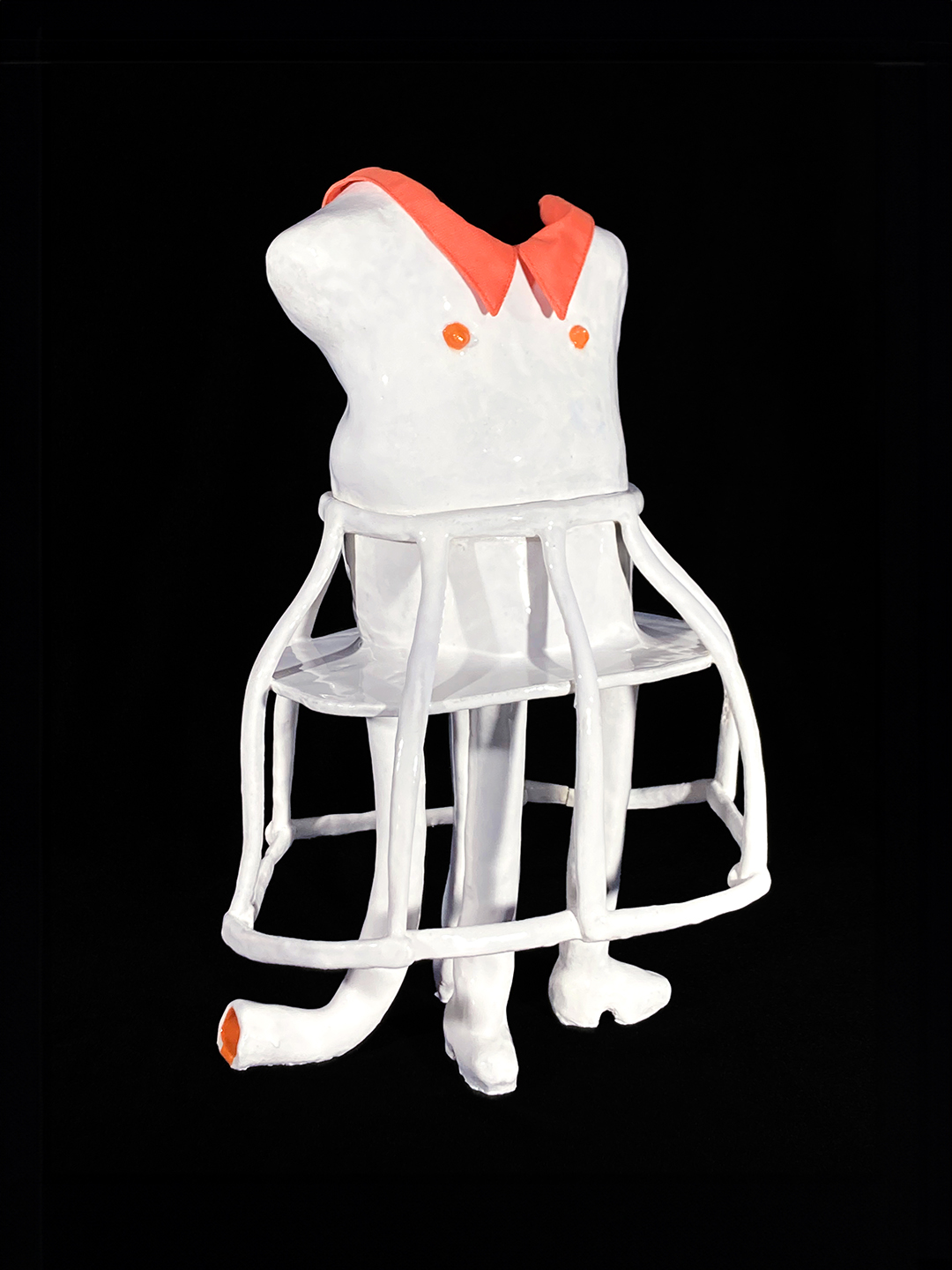
Brooklyn artist Jeanne Verdoux’s latest exhibition, Female Vaisselle, at the Sculpture Space NYC from February 2 to March 2, 2024, marks her first solo show in New York City. Verdoux captures the essence of the female form through a blend of ceramics, drawings, monoprints, and video art. The title itself is a linguistic play, merging the French word “vaisselle” (meaning tableware) with the English “vessel,” reflecting the dual themes of domesticity and the female body as a container of multifarious experiences.
Sok Song,- SoNoBe: Legermain Barbed and Coiled. Clay, paper, plastic, 16”x16”x16”.2023, Me, Mom, and the War on Identity. Acrylic, screen print, collage on paper, 36”x28” 2023 ( on wall)
The Long Island City Artists, an art non-profit known as LIC-A, is currently presenting a bold exhibition that brings together artists who work simultaneously in two media not always thought of as compatible. Curator Matt Nolen has gathered a fascinating group of artists from the NYC metropolitan area who work in both clay and drawing–one influencing and bouncing off the other. The synthesis is a fascinating and genre-bending exhibition.
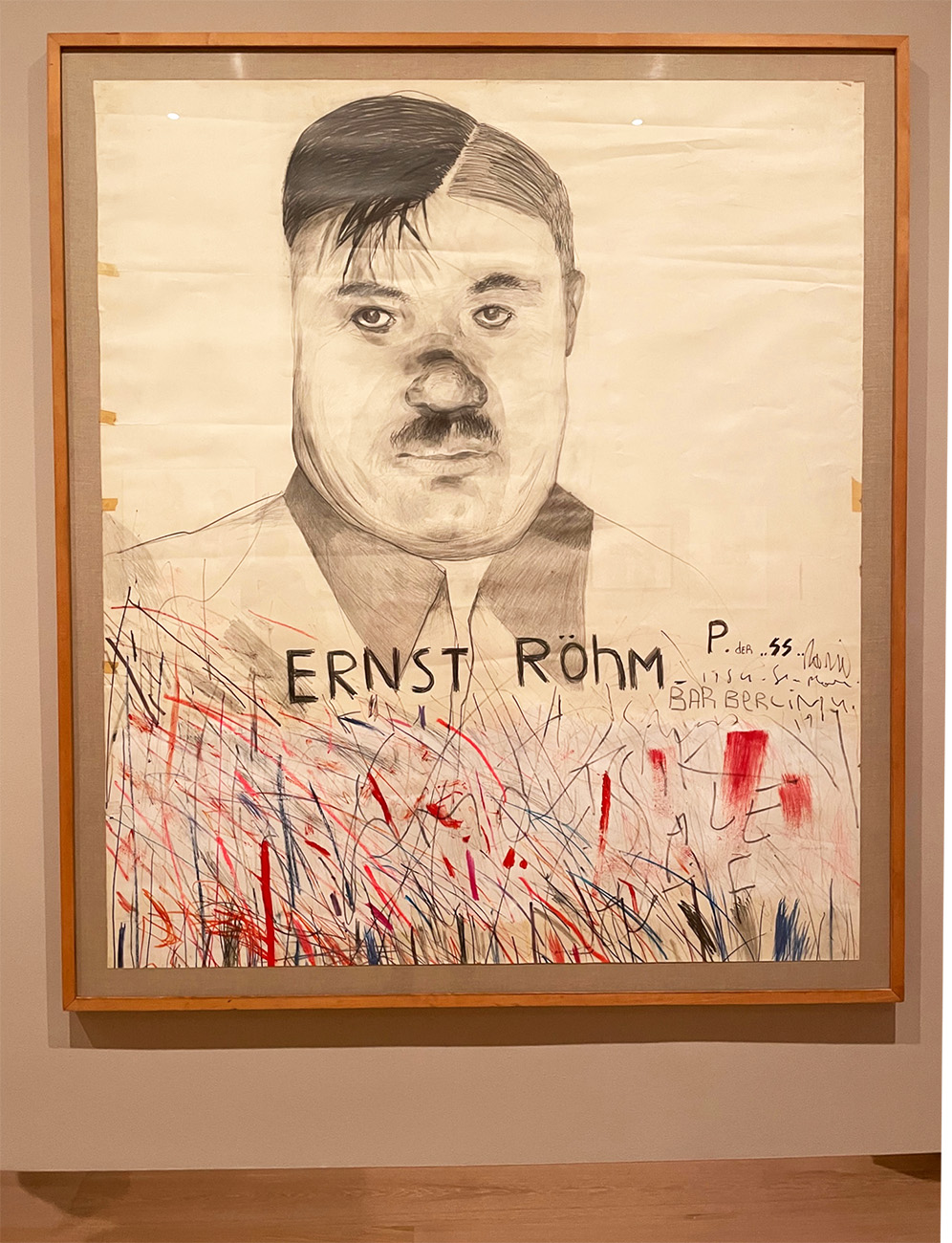
Ernst Röhm, 1981, Graphite, gouache, marker, and color pencil on paper. 54 3/4 x 47 1/4 inches
Who was Stephane Mandelbaum? A closeted gay man? The child of Holocaust survivors? A liar? A thief? A brilliant artist you’ve never heard of? All of the above and perhaps more.
The Drawing Center is presenting the first-ever show of Mandelbaum’s work in the US, and it is a show that left me gob-smacked. The combination of Mandelbaum’s brilliant drawing, deeply personal vision, and the complexity of his backstory is a tale made for cinema. Born in 1961 to a family of paternal Polish Holocaust survivors and maternal Belgian Armenians, Mandelbaum grew up in the town of Namur, about an hour and a half from Brussels. His Father, Ari, was a well-known painter, and his mother, Pili, was an illustrator. There is no record of siblings. A gifted draftsman from a young age but dyslexic and eccentric, Mandelbaum moved from Namur to Brussels, where he seemed to devote his time to making drawings and engaging in what is termed “petty crime.” He married a woman from Zaire (now called The Democratic Republic of Congo) and lived between the worlds of Belgian Africans, the Belgian crime underworld, and his own artistic imagination.
The Mirror Blue Night originated from an idea artist and curator Patrick Neal had for a show called Dark Noir, referencing the character of the city in the evening hours. When Neal was later invited to curate at the Undercroft Gallery, this idea expanded to include nocturnes and night in general. The gallery is located beneath The Church of Heavenly Rest on Museum Mile, and in this context, Neal began to look for spiritual echoes, considering how evening and twilight hours evoke the afterlife, the cosmos, anonymity, peace, and fear. “I had in mind depictions of darkness but also considered night as a condition that occupies half of our days and half of our lives, with all the symbolic, psychological, and temporal associations that come with it.”
The solo exhibition Reflections in James Howe Gallery at Kean University features Anna Shukeylo’s latest body of work from 2022- 2023. Shukeylo has always combined in her artwork private, autobiographical moments inter-spliced with imagined elements. Since becoming a mother, she has documented and deeply explored in her paintings and drawings the chaotic routine of early parenthood, including her attempts to balance her art career and the day-to-day rigors of two toddlers.
Portrait of the Artist in his studio, Hudson, NY. Image Credit: Matt Moment
David Dew Bruner is no more a thief than the next artist—it’s only that he is candid enough to tell us outright who he has stolen from. In “Equipoise: Stasis and The Power of Suggestion in Still Life,” a group show on view at Carrie Haddad Gallery through October 1, Bruner presents a series of drawings, each titled “Morandi Bottle.” More accurately, it is not so much Morandi’s bottles that Bruner has lifted (he’s the first to admit that the works “don’t look anything like Morandi paintings”) but rather the essence of Morandi’s mark-making. “Sometimes, I just love the way other people make marks,” Bruner enthuses. “My endeavor is [to riff off] the gesture of the form, the gesture in the detail, the quality of the line. It may be a subject matter that’s dull as dishwater to me, but the way it’s painted… I’m jealous.”
David Brooks, installation shots of Budding Bird Blind, at Planting Fields Arboretum, Oyster Bay, NY, and maquettes showing the future forest succession as the trees supplant the building
On April 23rd, Earth Day, 2023, at the Catskill Art Space in Livingston Manor, NY, I moderated a panel on artists’ responses to the climate crisis titled “Envisioning Adaptation.” The panel was one of the many events the director of the CAS, Sally Wright, has hosted at the arts and performance space newly refurbished in 2022. The concept for the symposium was to create a forum of artists whose practices addressed the idea of adaptation to, as opposed to mitigation of, the climate crisis. The panel participants included David Brooks, Simone Couto, Alexandra Hammond, Brian Kelley, and J. Morgan Puett.
Installation view Desire Lines, photo Argenis, courtesy of KODA
Sa’dia Rehman:Desire Lines is a solo exhibition as part of artist’s residency with KODA on Governors Island, New York. Rehman’s exhibition focuses on the building of the Tarbela dam in Pakistan in 1968-1976 – a hydroelectric dam responsible for the displacement and forced migration of 184 villages and the climate devastation following the completion of this project.
Vitamin C+ Collage in Contemporary Art. Introductory essay by Yuval Etgar. Phaidon (back cover)
Recently released by Phaidon, Vitamin C+ is another noteworthy addition to the publisher’s boundlessly malleable series of anthological volumes gathering scores of artist profiles into luxuriantly illustrated, conceptually cohesive tomes. Medium, era, genre, or movement tend to be the organizational binders for these books, as might be expected, and they’re generally wonderful and inspiring as such. But they’re sometimes wonderful and inspiring in less obvious ways as well, furnishing readers with much more to delve into, reflect on, and revisit time and again.
The riveting debut exhibition at Andrew Edlin showcases George Widener’s profound fascination with historical catastrophes, particularly the tragic sinking of the Titanic in 1912. The artworks on the wall, made of patched-together napkins and tea-stained scrolls, bear the marks of accidents, palimpsests, and esoteric knowledge, reminiscent of ancient manuscripts and enveloped in an aura of mystery. The elaborate numerical puzzles, complex wordplay, and prophetic visions informed by historical events become data landscapes that the viewer explores alongside the artist.