The Children’s Art Carnival presents Seed Bomb, an exhibition marking the 80th anniversary of the devastating atomic bombings of Hiroshima and Nagasaki. Coinciding with this solemn milestone, the exhibition and its accompanying workshops take place in a deeply resonant location—Harlem, just blocks from Manhattanville, where research for the Manhattan Project was once conducted.
Works by John Coplans (left) Jarret Key (center) and Melissa Stern (right). Photo courtesy of Etienne Frossard/601Artspace
The group exhibition Care / Condition / Control, which ends its run at 601Artspace on April 27th, takes its conceptual root, quite literally, in the form of hair. Experienced by different generations, cultures, genders, and identities, one’s relationship to the very follicles that grow from us and upon us is deeply personal and unique to each of us. As each artist mines their own stories from these relationships, Chapman expands upon the inspiration and undertaking of such a complicated and tangled subject. Yasmeen Abdallah interviews curator A.E. Chapman about the ideas behind this show.
Oskar Landi was born and raised in Italy. In 1998, he moved to New York to pursue art, arriving with two tools: a saxophone and a camera. Over time, the camera became the better instrument for making a living. With several years of experience as a photo assistant in Europe, he adapted to New York’s photography industry, building a basic commercial and editorial client base that allowed him to sustain himself while continuing to explore the medium’s possibilities.
Western Addition sign, photo Sheila Stover/Erni Burden circa 1960
A 1949 US Federal law set the stage for crisis-level upheaval. Cities across the country used the money it provided to launch “urban renewal” projects that often only added misery to the communities they professed to be helping. In San Francisco, a largely Black neighborhood in Western Addition was targeted on the premise that the vibrant ‘Harlem of the West’ was blighted. This misconception has gone unchallenged until now, thanks to the photographic documentation Ernest Burden III exposed in his late father’s immense photograph archive.
This article was initially published in Portfolio Magazine in Hebrew on October 25, 2023. It was translated into English and edited by Art Spiel. This publication in Art Spiel is in collaboration with Portfolio Magazine.
Photographer and photojournalist Roee Idan preferred to aim his lens at capturing the quiet drama of nature rather than the fraught tension along Israel’s borders—the first anemone bloom, the winter streams of the northern Negev, the majesty of flash floods in the desert, and the joy of bathers on the beach in summer.
For 18-year-old photographer Reef Avni, photography became a way to speak at 14 when words were hard to find, a tool against his social anxiety. His father, Hagi, was not only a strong supporter but also a frequent face in his photos, becoming an integral part of the narrative Reef was creating with his camera. The other constant in Avni’s work is documenting daily life in his Kibbutz. As a fourth-generation member of Kibbutz Be’eri, his roots were as embedded in the kibbutz as the farmlands and community his great-grandfather founded in the arid Negev in the south of Israel on the night of October 6, 1946. His grandfather was among its first newborns.
Reproducing as an Im/migrant: Young Joo Lee, Maria Kulikovska, and Coralina Rodriguez Meyer
Young Joo Lee. Disgraceful Blue, 2016. Digital Animation. 10:24 min. Courtesy of the artist and The Immigrant Artist Biennial.
During a talk at NYU, feminist post-Marxist scholar and author Silvia Federici said: “The image of the worker is not the image of the person at the assembly line; it’s the immigrant.” With this statement, she is referring to vulnerable migrants whose movements are fueled by the climate crisis, corporate control of natural resources, and economics. With her social practice project Mama Spa Botanica, Coralina Rodriguez Meyer attempts to recreate the bond between nature and the female body to enhance healthcare for black and brown pregnant women, empowering them to advocate for themselves and their communities within an inadequate maternal healthcare system. In her book, Beyond the Periphery of the Skin: Rethinking, Remaking, and Reclaiming the Body in Contemporary Capitalism, to explain the link between migrants and reproduction, Federici cites “the war on human reproduction” which encapsulates the separation of people from land, soil, sea, and independent means of reproduction acted out by corporate interests. This is a separation that Rodriguez Meyer both highlights and resists in her work.
The Kleinart James Center in Woodstock, New York, is currently presenting a very ambitious and interesting photography exhibition. Entitled Here Now: Contemporary Photographers of the Hudson Valley, the show presents 17 artists representing a portion of the many photographers working in this geography. Organized by curator Jane Hart, the show offers a wide range of aesthetic visions and techniques.
Meryl Meisler, Close Shave Family Grooming (The Mystery Club), Merrick, NY 1975
Meryl Meisler’s QUIRKYVISION will be featured at Le Palais des Congrès de Vichy during the PORTRAIT(S) Tenth Annual Festival in Vichy, France, from June 24 through September 4, 2022. Meisler’s images of sizzling disco nights and strip-tease clubs, domestic Jewish family in Long Island suburbia, or life in a public school in one of the roughest Brooklyn neighborhoods—encapsulate with humor and a sharp gaze life at the 1970s and 1980s New York City area.
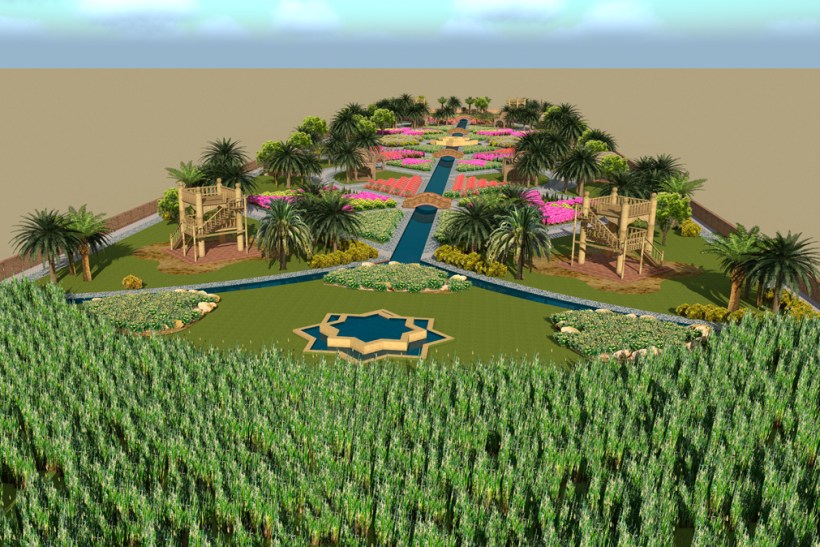
Eden in Iraq Wastewater Garden Project (2011-present), site drawing of El Chibaish, 26,250 square meters (6.4 acres, 2.6 hectares), rendering by Bernard Du, 2017)
In 2011, photographer and environmental artist Meridel Rubenstein envisioned creating a garden in southern Iraq where the Tigris and Euphrates Rivers cross, near the supposed site of the biblical Garden of Eden. However, unlike its idyllic predecessor – a mythical paradise in a newly formed world – this new garden would help to heal what had become a fragile, desert wasteland by cleaning existing wastewater and establishing a culturally significant green space.