Bonny Leibowitz “I Make My Own Weather”, “Raindrop installation”. photo courtesy Bonny Leibowitz
In her installation-based exhibition titled I Make My Own Weather at the MAC in Dallas, Bonny Leibowitz explores the validity of social constructs and the reliability of acquired or assumed perceptions, implying separateness, otherness and disconnection. Leibowitz’s work utilizes and expounds upon the landscape painting traditions of idealized histories, such as the Hudson River School, Romanticism, and Baroque. The installations act as deconstructed paintings, as though walking through fragments of represented landscapes—a tree root painted epoxy green, an Astro turf tarp in the shape of a pond, a peeling away of a blue sky.
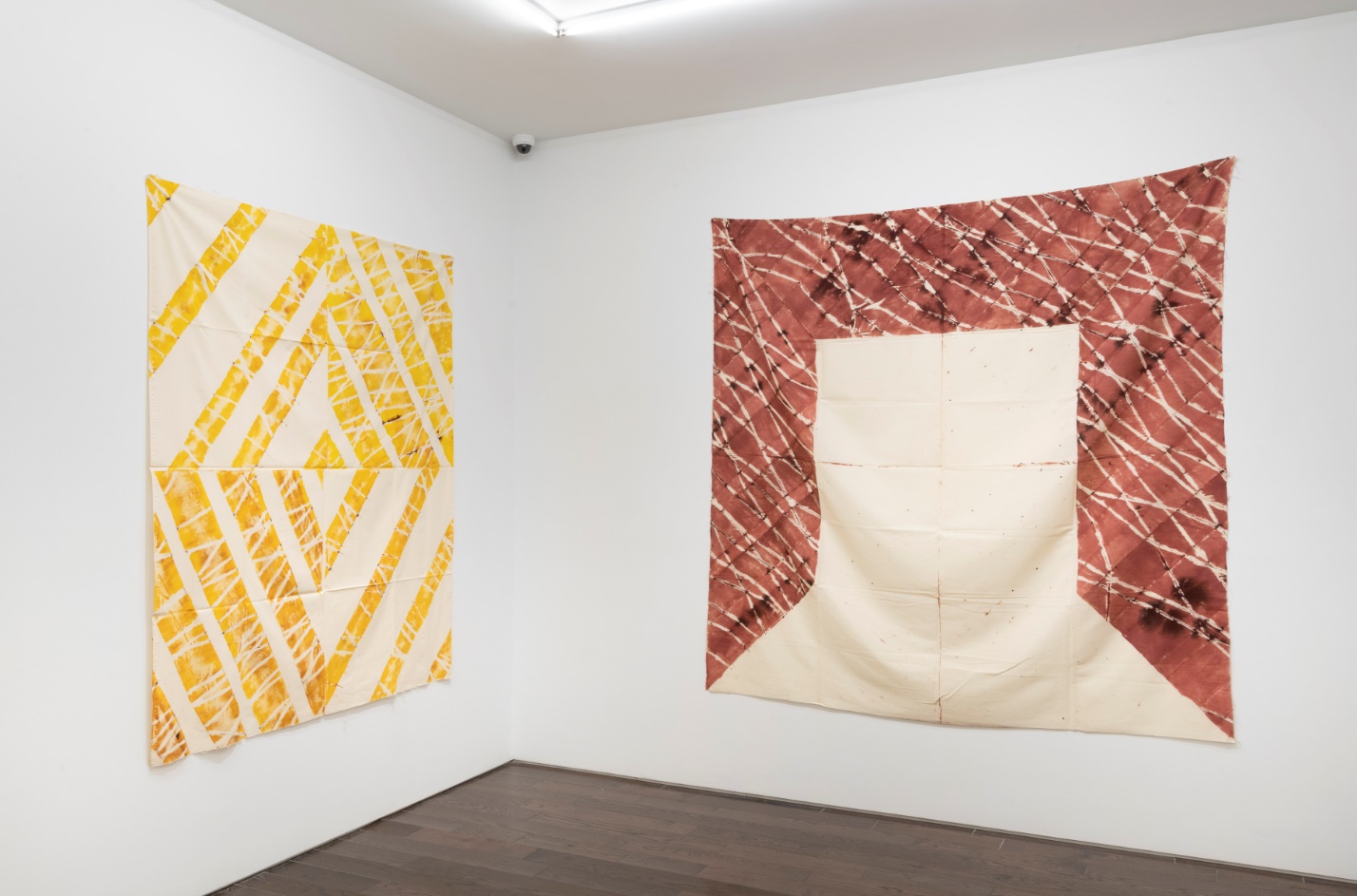
Installation view, André-Pierre Arnal at Ceysson & Bénétière New York. Photo courtesy of Ceysson & Bénétière New York
With the advent of Modernism in the late 19th – early 20th century, differing movements, schools, and networks sprang up internationally—some were generative and sustainable, others dead-ended, though unbeknownst to most of us, traces of these persist or return. This cross-fertilization drove Modernism’s evolution until the post-World War II era the new art made in the U.S. came to dominate the narrative. The triumph of the NY School (AbEx) corresponded to the new political and economic order. In this scenario the vanguards that emerged from the rubble and detritus of the War such as C.O.B.R.A., Nouveau Realisme, Lettrist, Zero, Arte Povera, etc. were trivialized, marginalized, or came to be appropriated. To this day, the European artists whose works come to be acknowledged in the States tend to be those whose works are used to typify the whole of a critical discourse, or style. This has reduced post-War European art to a short list that includes Pierre Soulages, Antonio Tapies, Lucio Fontana, Yves Klein, Francis Bacon, Joseph Beuys, Gerhardt Richter, Anselm Keifer, etc. In this manner, the illusionary status of the U.S. as the cultural leader of the free world is sustained, while European art is made to appear to be broken, fragmented, or at best sporadically relevant, rather than constituting a network of competing histories, practices, and critical discourses.
Susan Carr creates playful and bold paintings, sculptures, and everything in between – all characterized by her thick, chunky, and layered painting application. Carr’s work comes from a deep and highly intuitive place, always guided by her vibrant curiosity. The artist shares with Art Spiel what brought her to art, some of her thought process, and exploratory approach to material and form.
Susan Carr, Piece of Pi, 2018, hand cut wood with silk over the wood and yarn painted in oil with pieces of wood painted in oil 7×10 inch, photo courtesy of the artist