Finally! What a joy to meander through a show that is not just a formulaic scaffolding rendered to execute a marketing plan rather than make art. Walking into the building that houses September Gallery’s new space in Kinderhook, NY, The first thing you see is not a wall or architectural ornamentation but a monumental scroll that immediately hints you might be here for a while. This colossal collage introduces Myth Maker, the second exhibition at September Gallery by Laleh Khorramian.
A Meditation on Artists’ Residencies, a Dune Shack and the Twilight Zone
Ray Wells dune shack with well pump in the bottom left foreground, Provincetown/Truro 2016, photo courtesy of the writer
Sometimes I find myself scrolling Instagram on a dark day in February or March, just wondering what it would be like to make art in a lighthouse…or in Robert Rauschenberg’s old fishing shack…or in a Florida swamp…or in a small RV in a Utah ghost town…or on an island in Italy. Artists’ residencies are a nice thing to dream about when you feel stuck or in a rut and when life is wearing you down with mundane pressures. Sure, there are the big ones like MacDowell and Yaddo, but those are uber-competitive and hard to get into. There are so many other off-the-beaten-path secret outposts that will happily allow a creative person to try on their lifestyle for a bit. As an artist, it’s so helpful to get out of dodge now and then and hit the road for new sights and sounds.
Portrait of the Artist in his studio, Hudson, NY. Image Credit: Matt Moment
David Dew Bruner is no more a thief than the next artist—it’s only that he is candid enough to tell us outright who he has stolen from. In “Equipoise: Stasis and The Power of Suggestion in Still Life,” a group show on view at Carrie Haddad Gallery through October 1, Bruner presents a series of drawings, each titled “Morandi Bottle.” More accurately, it is not so much Morandi’s bottles that Bruner has lifted (he’s the first to admit that the works “don’t look anything like Morandi paintings”) but rather the essence of Morandi’s mark-making. “Sometimes, I just love the way other people make marks,” Bruner enthuses. “My endeavor is [to riff off] the gesture of the form, the gesture in the detail, the quality of the line. It may be a subject matter that’s dull as dishwater to me, but the way it’s painted… I’m jealous.”
Alaina Enslen in her studio in Cornwall-on-Hudson. Image Credit: Matt Moment
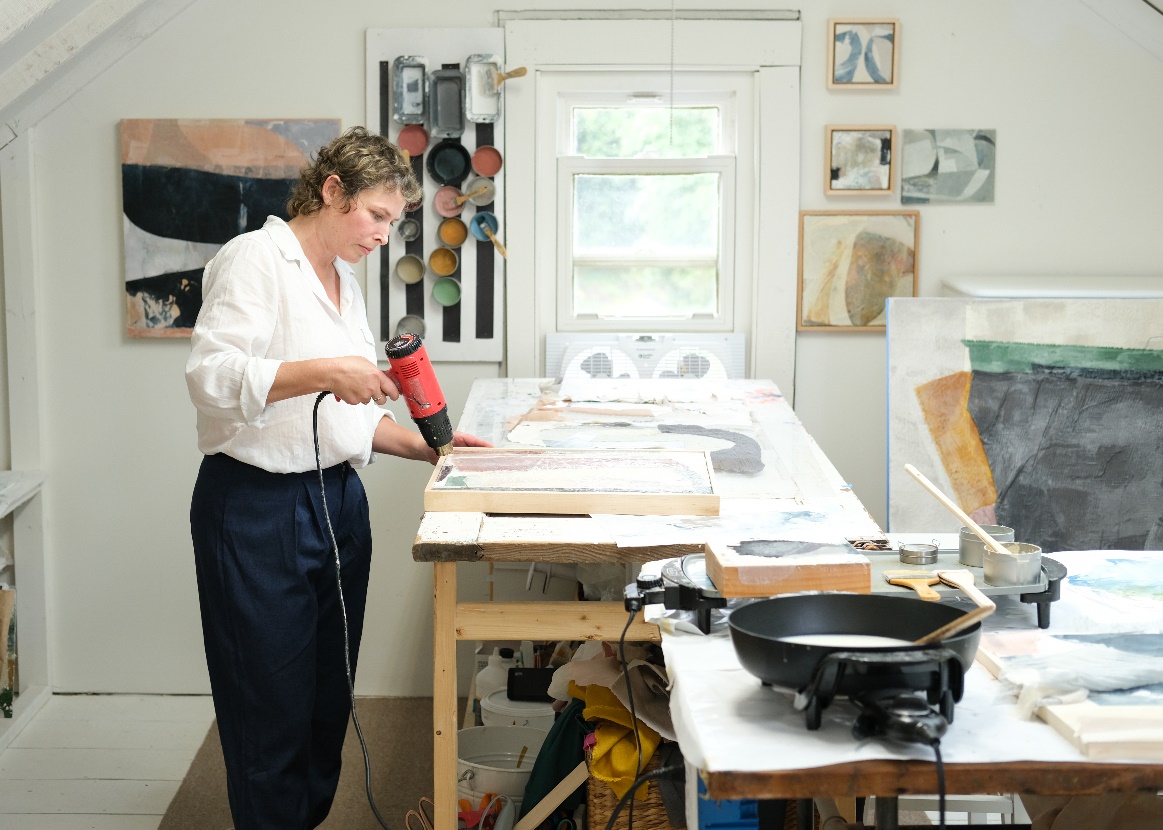
Around six in the morning, Alaina Enslen scales the steps of her Hudson Valley home to the attic where she works. Skylights invite brightness into the whitewashed studio. A hotplate rests upon a wax-spattered tabletop; she turns it on, waiting until it reaches about 170°F. After five minutes, the surface is finally hot enough to melt pigmented beeswax, an integral ingredient in her paintings. She collages in an 11-inch by 14-inch sketchbook, teasing out new ideas with pieces of fabric and leftover monotypes. “I set no expectations for the work,” the artist insists. “It’s all about experiment and play.”
Vitamin C+ Collage in Contemporary Art. Introductory essay by Yuval Etgar. Phaidon (back cover)
Recently released by Phaidon, Vitamin C+ is another noteworthy addition to the publisher’s boundlessly malleable series of anthological volumes gathering scores of artist profiles into luxuriantly illustrated, conceptually cohesive tomes. Medium, era, genre, or movement tend to be the organizational binders for these books, as might be expected, and they’re generally wonderful and inspiring as such. But they’re sometimes wonderful and inspiring in less obvious ways as well, furnishing readers with much more to delve into, reflect on, and revisit time and again.
Ellsworth Kelly (1923-2015) is one of those artists whose status I’ve never understood. While he is held in high esteem by many, I’ve always questioned his significance. Don’t get me wrong, I like his work, but liking it doesn’t necessarily make it significant. His work is elegant, refined, and smart, and yet even in the 1950s-70s, it seemed conservative against the backdrop of Abstract Expressionism, Pop, and Minimalism. What made Kelly different from his peers was that when he was living and studying in Paris after World War2 on the GI Bill, while many of his fellow artists from the States were exploring lyric abstraction and L’informale, Kelly was looking at Art Concrete and had begun to make multi-canvas paintings.
From its founding in 2009 by Maddy Rosenberg, CENTRAL BOOKING has focused on the exploration between art and science with emphasis on aspects of the environment and social justice issues. In many collaborative projects with organizations such as the New York Academy of Medicine and the Brooklyn Botanic Garden, artists researched their work in the collections, libraries and grounds of these institutions and exhibited the resulting work in several venues. Rosenberg says that after years of living along the Brooklyn waterfront of Buttermilk Channel and incorporating the imagery into her own work, she sensed it was time to take a deeper dive into the ecosystems of the Brooklyn waterfront and the last surviving section of functioning port within New York City’s boundaries. The life along the harbor integrates the wildlife, land and neighborhoods of human-made architectural elements seemed to her like “a perfect barometer for exploring climate change”. A collaboration with the New-York Historical Society was a natural step, as their collections preserve many of the earlier roots along the way to the transformations we live with today. Rosenberg says that in addition, by forging partnerships with other area organizations such as Kentler International Drawing Space, Pioneer Works and the RETI Center, the project became truly emblematic of the Brooklyn Waterfront.
Prior to her exhibition, Phantom Thread at Freight+Volume, Paige Beeber spoke with Amanda Millet-Sorsa at the artist’s studio in Brooklyn. Nestled into a Cube Smart storage space building in Gowanus on the edge of Red Hook, the studio is part of TI Studios. Beeber’s long family roots in Brooklyn date back to the early 1900s, as she continues to live and work in this borough. Her new work evolved from experiences she had at residencies in 2022 (DNA Residency in Provincetown, SARP in Sicily, and recently completed her fellowship at The Helene Wurlitzer Foundation). Her work exists between narration, figuration, and abstraction and largely uses the repurposing of her own past paintings that transform into new patterns, motifs, and imagery in new paintings. Ritual and community play an essential role in the stitching of new narratives.
John Molloy Gallery: installation view “Cutting Corners”
Bob Seng’s collages at John Molloy remake and reimagine the iconic EXIT sign. The artist says that he has chosen these ubiquitous signs for their attitude, a “go out” directive to an alternate space and time, and for their combative red and black elements. Initially he approached these signs as if they were archaeological excavations, selectively removing layers of the red and black paint to reveal what he imagined as “lost” civilizations buried underneath, “possibly a harbinger of our own in future time.”
Leduc installing Field Mark (Narrows Botanical Garden). Photo courtesy of the artist.
Bay Ridge through an Ecological Lens is a multi-faceted public art exhibition hosted by Stand4 Gallery and presented in collaboration with ecoartspace.
It consists of nature walks and community interventions in the gallery and various locations throughout the Bay Ridge community from April 15 through June 17, 2023. Art Spiel will feature a series of interviews related to this project throughout its duration, here with artist Rita Leduc.