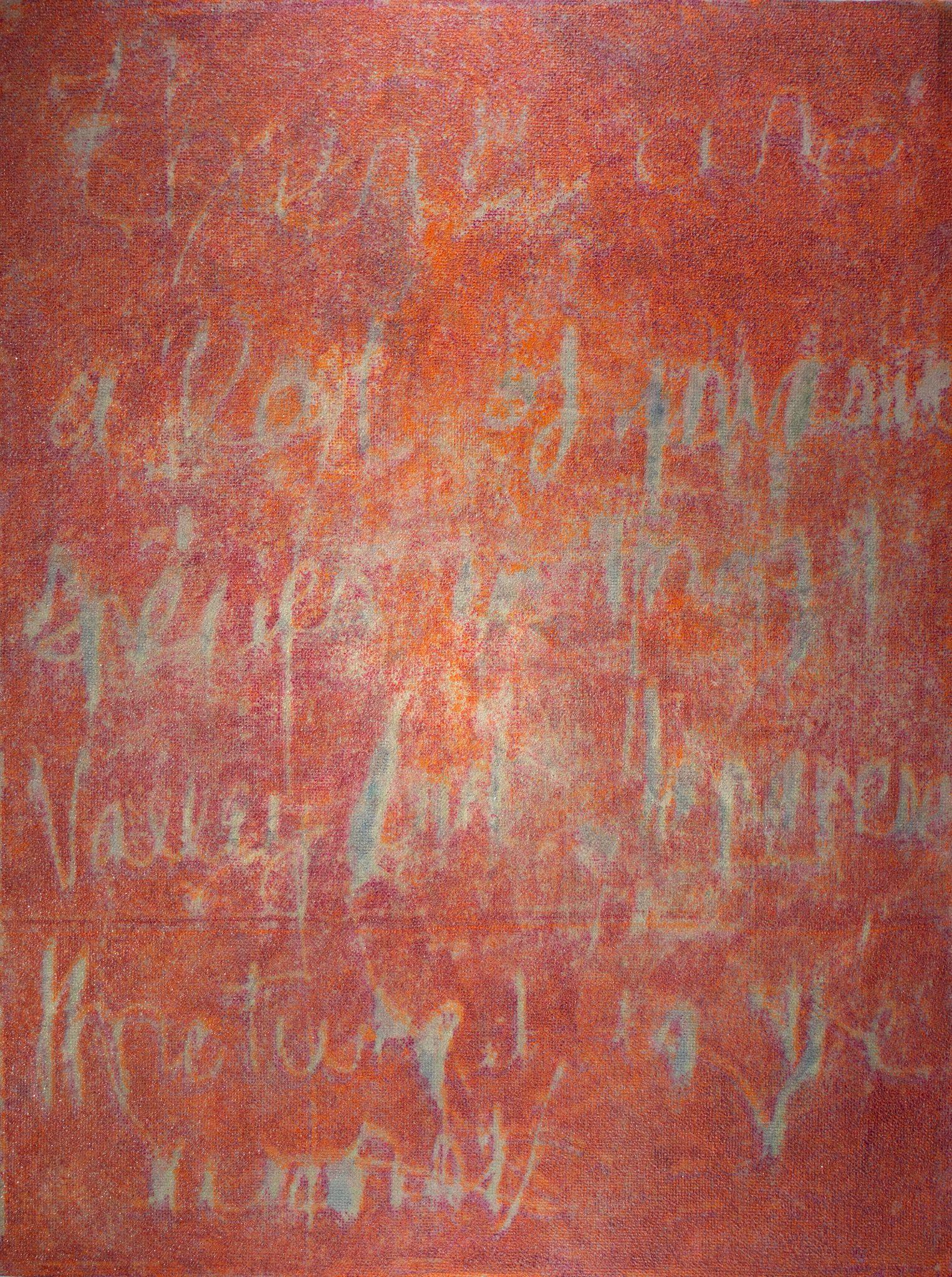
Reception for Invasive Species in Cornell University’s Mann Library gallery
Hovey Brock’s show, The Invasive Species, in collaboration with Cornell’s Eco Arts features a series of paintings that focuses on how the climate crisis in general and invasive species in particular threaten the forests of the Northeast—an outgrowth of his Crazy River project that focused on the climate crisis in the Catskills. The paintings have phrases or questions that have been obsessing Brock for some time.
Lucy Kim: Pigment Spells at Praise Shadows Gallery, Brookline, MA. Photo by Dan Watkins, courtesy of Praise Shadows Gallery
Several wonderful exhibitions are on view in Boston this month and many more are scheduled for the summer, along with artist talks, performances, and events. Boston’s Public Art Triennial kicked off with a ribbon cutting and a party to celebrate the arrival of several new public art installations around the city for art goers to enjoy throughout the summer. The schools are getting ready for summer break but many of their galleries remain open with dynamic shows. Whether you visit the city, the Cape, or the Islands over the next few months, there is always something to see. Here are a few highlights to consider.
Jean Shin, Home Base, 2022. Installation at Laumeier Sculpture Park, St. Louis, MO. Photo Credit ProPhotoSTL. Courtesy of the artist and Laumeier Sculpture Park.
With her public sculptures, Jean Shin makes powerful statements about the climate crisis out of discarded and obsolete materials. She often engages communities in her materials sourcing, mixing social practice into her public sculpture practice to create platforms for discussion. Ingenious and esthetically considered, her works show novel ways to engage with the climate crisis.
David Brooks, installation shots of Budding Bird Blind, at Planting Fields Arboretum, Oyster Bay, NY, and maquettes showing the future forest succession as the trees supplant the building
On April 23rd, Earth Day, 2023, at the Catskill Art Space in Livingston Manor, NY, I moderated a panel on artists’ responses to the climate crisis titled “Envisioning Adaptation.” The panel was one of the many events the director of the CAS, Sally Wright, has hosted at the arts and performance space newly refurbished in 2022. The concept for the symposium was to create a forum of artists whose practices addressed the idea of adaptation to, as opposed to mitigation of, the climate crisis. The panel participants included David Brooks, Simone Couto, Alexandra Hammond, Brian Kelley, and J. Morgan Puett.
Bonny Leibowitz “I Make My Own Weather”, “Raindrop installation”. photo courtesy Bonny Leibowitz
In her installation-based exhibition titled I Make My Own Weather at the MAC in Dallas, Bonny Leibowitz explores the validity of social constructs and the reliability of acquired or assumed perceptions, implying separateness, otherness and disconnection. Leibowitz’s work utilizes and expounds upon the landscape painting traditions of idealized histories, such as the Hudson River School, Romanticism, and Baroque. The installations act as deconstructed paintings, as though walking through fragments of represented landscapes—a tree root painted epoxy green, an Astro turf tarp in the shape of a pond, a peeling away of a blue sky.
A central theme in my Crazy River project has been highlighting the emotional toll of the climate crisis by putting under a microscope, so to speak, my own feelings about not only the impacts of the crisis but the knowledge that humans’ actions are the cause. This series of three on-line essays, thought experiments if you like, expands that project to change the POV to non-human actors that are inextricably bound with the habitat in the Western Catskills: the black-legged or deer tick (Ixodes scapularis), the white-tail deer (Odocoileus virginianus), and Japanese knotweed (Reynoutria japonica). All three have seen their habitat change dramatically through climate change and human interventions. Using my imagination and research, I try to enter the umwelt of all three species, an impossible task, as Thomas Nagel pointed out in “What Is It LIke to Be a Bat,” for which artistic license may give us the best chance to accomplish. My intentions in doing so fall along three axes: theoretical, aesthetic, and spiritual, dimensions all essential to my own art practice. Part III looks at the umwelt–a term normally applied only to animals whose use in this instance I will explain later–of Japanese knotweed from the perspective of the Vajrayana, or Tantric Buddhism.
Hovey Brock: Blackleg Tick, 2021, 24” x 36”, acrylic on panel
A central theme in my Crazy River project has been highlighting the emotional toll of the climate crisis by putting under a microscope, so to speak, my own feelings about not only the impacts of the crisis but the knowledge that humans’ actions are the cause. This series of three on-line essays, thought experiments if you like, expands that project to change the POV to non-human actors that are inextricably bound with the habitat in the Western Catskills: the black-legged or deer tick (Ixodes scapularis), the white-tail deer (Odocoileus virginianus), and Japanese knotweed (Reynoutria japonica). All three have seen their habitat change dramatically through climate change and human interventions. Using my imagination and research, I try to enter the umwelt of all three species, an impossible task, as Thomas Nagel pointed out in “What Is It LIke to Be a Bat,” for which artistic license may give us the best chance to accomplish. My intentions in doing so fall along three axes: theoretical, aesthetic, and spiritual, dimensions all essential to my own art practice. What follows is a look at the umwelt of black-legged ticks from the perspective of theory.
Diagram from the United States Geological Survey, Harvard.edu
What’s Your Golden Spike is the third in a series of three interrelated experimental pieces that combine graphics, text, and hyperlinks based on themes coming out of my Crazy River project, for which I gave an interview on this website on May 16th. Crazy River takes a wide-angle view of the climate crisis, ranging from my own climate grief to an in-depth focus on the many causes and effects of rapid environmental changes on the West Branch of the Neversink in Ulster County. In this piece I investigate the idea of the Catskills as a region, and an incongruous bundle of contradictions and coincidences. The Lands of Kats Kill weaves three timelines together: the geologic, the historical, and the personal. This structure repeats throughout my Crazy River project. The previous piece in this series, Invaders, took apart the idea of invasive species. The following will explore the concept of the Golden Spike in stratigraphy as fact and metaphor.
The Lands of Kats Kill is the second in a series of three interrelated experimental pieces that combine graphics, text, and hyperlinks based on themes coming out of my Crazy River project, for which I gave an interview on this website on May 16th. Crazy River takes a wide-angle view of the climate crisis, ranging from my own climate grief to an in-depth focus on the many causes and effects of rapid environmental changes on the West Branch of the Neversink in Ulster County. In this piece I investigate the idea of the Catskills as a region, and an incongruous bundle of contradictions and coincidences. The Lands of Kats Kill weaves three timelines together: the geologic, the historical, and the personal. This structure repeats throughout my Crazy River project. The previous piece in this series, Invaders, took apart the idea of invasive species. The following will explore the concept of the Golden Spike in stratigraphy as fact and metaphor.
Invaders is the first in a series of three interrelated experimental pieces that combine graphics, text, and hyperlinks based on themes coming out of my Crazy River project, for which I gave an interview on this website on May 16th. Invaders plays with the idea of invasive species, which has to be the misnomer of the century. So-called invasive species do reduce biodiversity in their new ecosystems but they are all the result of human intervention. International trade has been the main agent for transport to new locations, but climate change has also forced many species to move beyond their original habitat in order to survive. Every invasive species does what all living creatures do, including our own: take advantage of opportunities. Invaders includes my Crazy River paintings, photographs, and a list of 100 species from an on-line source: The Global Invasive Species Database, produced by the Invasive Species Specialist Group, a global network of scientists dedicated to identifying and tracking invasives.