This month’s Manhattan highlights focus on artists tapping into the natural world, where these practices converge with the man-made in a clash of stunning reinvention and compelling engagement. These exhibitions channel the experimental through exploratory processes that harness our attention and hold us in their spell.
Anne Neely, Eruption (2024). Oil on linen. 22 x 28 in. Photo credit: Kay Hickman, Julia Featheringill
On April 26th and 27th, from 1 to 6 pm, artists in DUMBO will open their doors to the public as part of DUMBO Open Studios, offering a rare look inside the art studios along the Brooklyn waterfront. Since the 1970s, DUMBO has been shaped by its vibrant art community. This interview series highlights a handful of participating artists in 2025. Each response offers a glimpse of what’s waiting behind the studio door. Anne Neely has been in DUMBO since November 2024 as part of the Sharpe Walentas Studio Program at 20 Jay Street, #720.
Diane Burko’s Bearing Witness at Cristin Tierney Gallery combines mixed-media paintings shaped by her experiences in extreme environments—glaciers, coral reefs, deserts, and rainforests. She has engaged with the shifting landscape for fifty years, responding to the accelerating changes that threaten these places. This marks a significant moment in her career—her first solo exhibition in New York in over forty years and her debut at Cristin Tierney Gallery.
Nancy Baker Cahill, Substrate Part #1: Universum, video still, project artists Shereen Moustafa, Mark Sosa, Casper Torres, and Miguel Zavala-Lopez, Central Library Video Wall, Los Angeles Central Library, Los Angeles. On view through December 2024. Video still selected by the author.
Three Downtown Lost Angeles exhibitions use data, disaster, and a shared history to explore community connections. They tap into the past, present, and imagined future to speak about class, labor, and inequity through the use of storage systems, pride of place, and what happens when things fall apart. At Gallery Luisotti’s El Cuerpo: The (Performing) Body and the Photographic Stage Chicano/a artists use themselves as subject to connect through a shared history, at the Los Angeles Central Library Nancy Baker Cahill: Substrate Part #1: Universum uses civic institutions, cultural resources, and data storage systems to forge a connection of community driven by data and at The Museum of Contemporary Art MOCA Grand exhibition Josh Kline: Climate Change community members connect to survive the aftermath of the climate crisis.
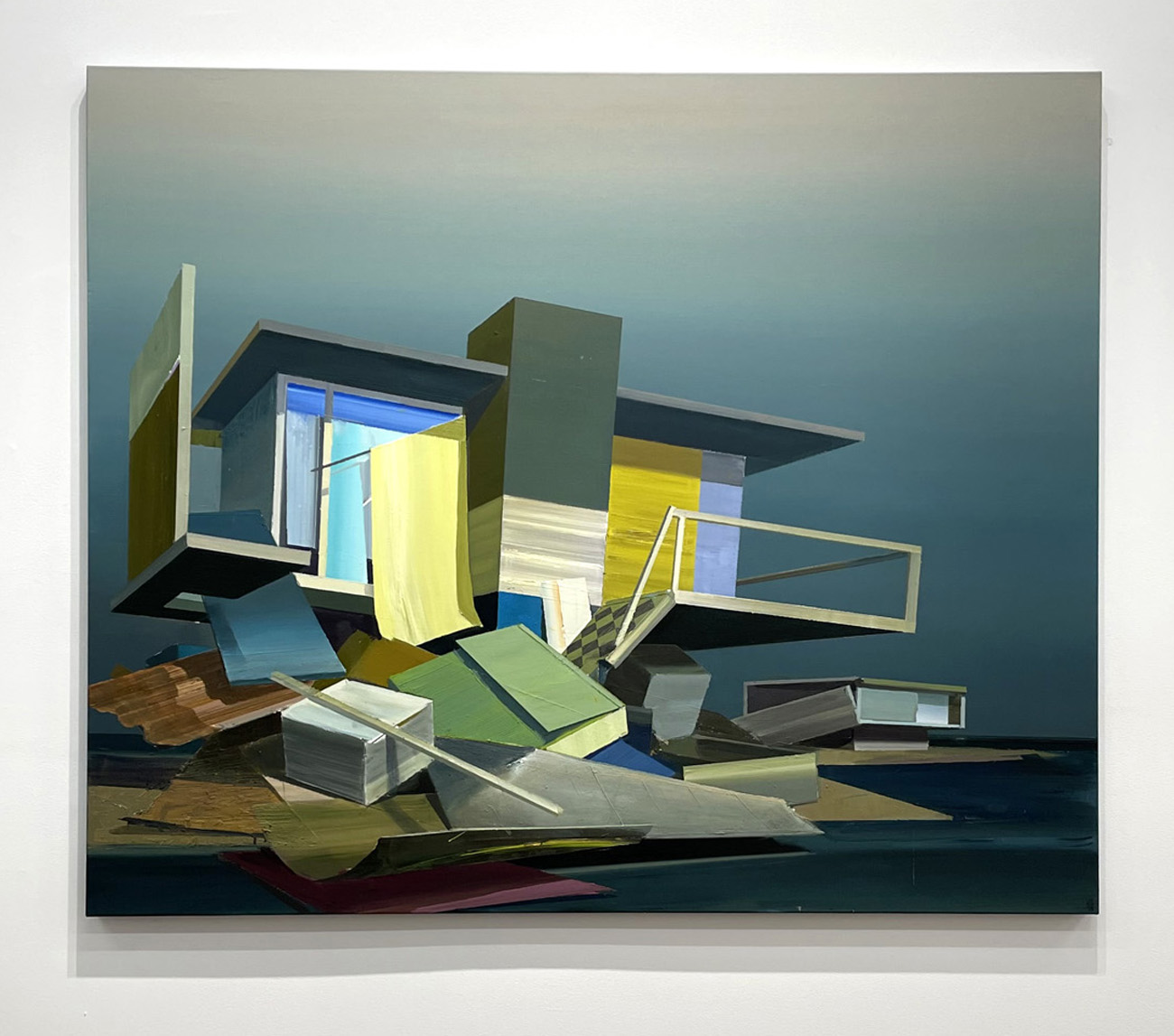
Marc Straus Gallery is currently presenting the paintings of Ulf Puder, a German artist whose landscape paintings are deeply evocative and strangely alluring. I was not familiar with the artist or his work, and I’ll admit, it took a beat to enter his Universe. But once in I began to see deeper into the complex issues he deals with in his paintings.
Grantee of Brooklyn Arts Fund Grant Type: (Brooklyn Arts Fund/Local Arts Support/Creative Equations Fund) Project Profile: Daniela Holban (Curator)
Photo courtesy of Last Frontier NYC & Sol Kjok
Brooklyn Arts Council announced in March 2022 an allocation of over $1.3 million to 238 Brooklyn-based artists and cultural organizations. This year marks the highest number of grantees and awardees as well as the largest amount of funding BAC has ever distributed. Art Spiel in collaboration with Brooklyn Arts Council features some artists who received a Brooklyn Arts Fund, Local Arts Support, and/or Creative Equations Fund grant in 2022.
Diagram from the United States Geological Survey, Harvard.edu
What’s Your Golden Spike is the third in a series of three interrelated experimental pieces that combine graphics, text, and hyperlinks based on themes coming out of my Crazy River project, for which I gave an interview on this website on May 16th. Crazy River takes a wide-angle view of the climate crisis, ranging from my own climate grief to an in-depth focus on the many causes and effects of rapid environmental changes on the West Branch of the Neversink in Ulster County. In this piece I investigate the idea of the Catskills as a region, and an incongruous bundle of contradictions and coincidences. The Lands of Kats Kill weaves three timelines together: the geologic, the historical, and the personal. This structure repeats throughout my Crazy River project. The previous piece in this series, Invaders, took apart the idea of invasive species. The following will explore the concept of the Golden Spike in stratigraphy as fact and metaphor.
Featured Project with Co-Curators Anastasia Amrhein and Patricia Eunji Kim
Gallery view with works by Tessa Grundon, David Nasca, Joiri Minaya, Himali Singh Soin and Alexis Rider, and micha cárdenas.
Fluid Matters, Grounded Bodies: Decolonizing Ecological Encounters at the Gallatin Galleries in New York City explores complex questions around impermanence, belonging, transformation, and erasure as they relate to human and non-human lives and the earth itself. The exhibition showcases the work of several contemporary artists, of various backgrounds, who utilize a broad range of media. It includes work by Farah Al Qasimi, Beatriz Cortez, micha cárdenas, Tessa Grundon, Joiri Minaya, Ada M. Patterson, Himali Singh Soin, and Alexis Rider, among others. The show runs from July 22 to August 17, 2022. Co curators Anastasia Amrhein and Patricia Eunji Kim shed some light on this group show.
The Lands of Kats Kill is the second in a series of three interrelated experimental pieces that combine graphics, text, and hyperlinks based on themes coming out of my Crazy River project, for which I gave an interview on this website on May 16th. Crazy River takes a wide-angle view of the climate crisis, ranging from my own climate grief to an in-depth focus on the many causes and effects of rapid environmental changes on the West Branch of the Neversink in Ulster County. In this piece I investigate the idea of the Catskills as a region, and an incongruous bundle of contradictions and coincidences. The Lands of Kats Kill weaves three timelines together: the geologic, the historical, and the personal. This structure repeats throughout my Crazy River project. The previous piece in this series, Invaders, took apart the idea of invasive species. The following will explore the concept of the Golden Spike in stratigraphy as fact and metaphor.
Invaders is the first in a series of three interrelated experimental pieces that combine graphics, text, and hyperlinks based on themes coming out of my Crazy River project, for which I gave an interview on this website on May 16th. Invaders plays with the idea of invasive species, which has to be the misnomer of the century. So-called invasive species do reduce biodiversity in their new ecosystems but they are all the result of human intervention. International trade has been the main agent for transport to new locations, but climate change has also forced many species to move beyond their original habitat in order to survive. Every invasive species does what all living creatures do, including our own: take advantage of opportunities. Invaders includes my Crazy River paintings, photographs, and a list of 100 species from an on-line source: The Global Invasive Species Database, produced by the Invasive Species Specialist Group, a global network of scientists dedicated to identifying and tracking invasives.